NUS Medicine ranks
17th
on the 2025 Times Higher Education World University Rankings and
18th
on the 2025 QS World University Rankings for Medicine

Issue 54
Jul 2025
SCIENCE OF LIFE
By Professor Roger Foo, Vice-Dean and Dr Rupangi Verma, NUHS Research Support Unit

“You can’t really know where you are going until you know where you have been.” – Maya Angelou, memoirist, poet, civil rights activist
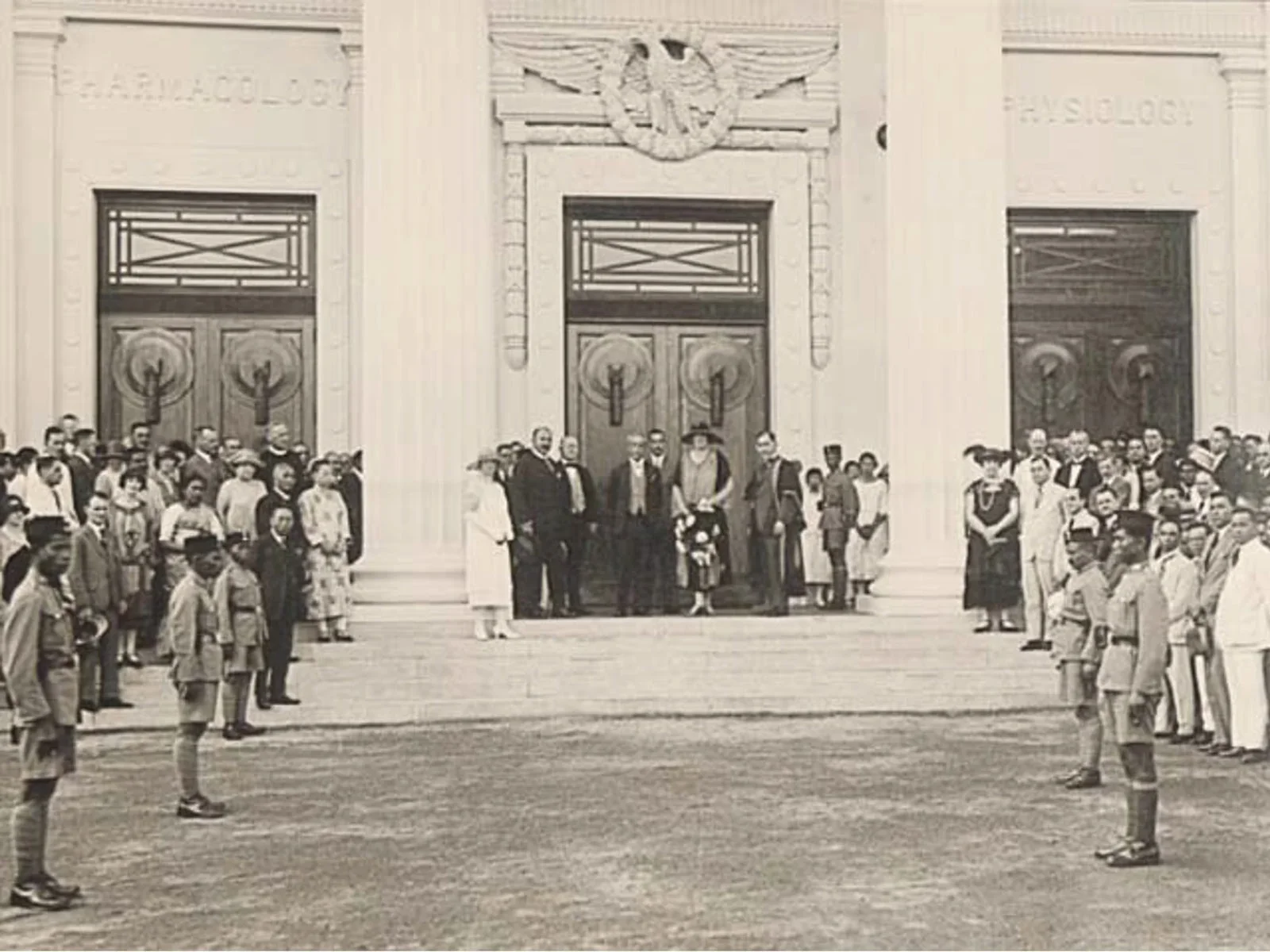
Established in 1905 to train doctors for the country, the NUS School of Medicine (renamed Yong Loo Lin School of Medicine in 2005), has grown from a tiny Straits Settlement and Federated Malay States medical college into a leading medical academic research-engine in Asia today. With 17 departments, 10 Translational Research Programmes (TRPs), 15 Faculty Research Centres and 11 Research Cores, NUS Medicine investigators and their teams drive impactful research, pioneer breakthroughs, and seek to shape healthcare policies across the span of Medicine. As it marks its 120th year, the School moves ever purposefully to push the boundaries of medical science and innovation, reinforcing its legacy as a pillar of medical excellence.
A modest start
Up till the late 1990s, research at NUS Medicine lagged behind the education and training of doctors as the latter was prioritised to meet the healthcare needs of the nation. Over time, structured funding, research governance, and the development of essential facilities and cores laid the foundation for the School’s transformation into a leading research institution.
A new era dawns
When the Biomedical Sciences Initiative of 2000 fuelled Singapore’s research boom, the School geared up to attract global talent, aiming for better funding opportunities, developing world-class infrastructure, and fostering collaborations across academia, healthcare, and industry. In 2005, a $100 million gift from the Yong Loo Lin Trust provided impetus for powerful, transformative changes in research. The gift immediately enabled much-needed support for enhancing infrastructure and expanding NUS Medicine’s talent base. Facilities were significantly upgraded, the Centre for Translational Medicine (MD6) was built. Today, this flagship building with state-of-the-art research and teaching spaces houses some of the most competitive research programmes in the world.
Visionary leadership was pivotal in reshaping our research landscape, driving international collaborations and attracting leading scientists. Under then-Dean Professor John Eu‐Li Wong, global recruitment brought in cancer biology experts Professor Yoshiaki Ito and Professor Edison Liu. Professor Peter Hwang hired leading researchers—Marie‐Veronique Clement, Reshma Taneja, Herbert Schwarz, Shing Chuan Hooi and Lina Lim, among others. The School gained international recognition through Professor Barry Halliwell for his work in redox biology and Professor Markus Wenk for his contributions to lipidomics. Professor Wong Tien Yin emerged as a global leader in diabetic retinopathy research. Cancer research was led by Professor Daniel Tenen, and cardiovascular research by Professor Mark Richards. Professors Hsu Li Yang, Dale Fisher, and Paul Macary expanded the impact across infectious diseases and immunology. Professor Ariff Bongso made landmark pioneering contributions to reproductive medicine and stem cell biology. Professor Lee Eng Hin advanced tissue engineering, particularly in bone regeneration.
NUS President (2008–2017), Professor Tan Chorh Chuan streamlined research processes to enhance efficiency. Bridging funds were set up to sustain productive scientists through temporary funding gaps. Proactive deans fostered faculty growth through initiatives such as international conference funding and expanded the NUS global footprint. In just under two decades, NUS Medicine rose to stand tall alongside Asia’s top institutions, publishing in leading journals NEJM, JAMA, Nature, and The Lancet, securing major competitive grants, and earning national and international recognition.
As Singapore’s first academic health system, NUHS was designed to enhance academic collaboration, drive multidisciplinary research, introduce innovative care models, and create enriched learning opportunities for faculty and students, ultimately improving patient outcomes.
Recognising the need to bridge biomedical science and medicine, Singapore launched initiatives to train clinician-scientists domestically. Professor Philip Moore, then Vice-Dean for Research, was pivotal in establishing clinician-scientist career tracks, encouraging young doctors to pursue research at NUS Medicine. A major turning point came in 2008 with the NMRC Clinician Scientist Award, which offered funding to secure protected research time and incentivise clinicians to enter research—Professor Chng Wee Joo was among its first recipients. In 2006, the NUS Medicine Clinician Scientist Unit was established under the direction of Professor Mahesh Choolani.
The need to integrate impactful basic research with clinical research was met under the leadership of Deans John Eu-Li Wong and Yeoh Khay Guan, when efforts were taken to bridge this gap and strengthen collaboration. They encouraged a forward-thinking approach that remains central to the School’s research success today. A key step in this integration came in 2008 with the formation of the National University Health System (NUHS), uniting NUS Medicine, the Faculty of Dentistry, the National University Hospital and later, Saw Swee Hock School of Public Health. As Singapore’s first academic health system, NUHS was designed to enhance academic collaboration, drive multidisciplinary research, introduce innovative care models, and create enriched learning opportunities for faculty and students, ultimately improving patient outcomes.
Coming to the fore
In recent years, NUS Medicine has built an unparalleled ecosystem to support clinician-scientists at every stage—from medical school to established careers. In 2010, the Wong Hock Boon Society was established to spark medical students’ interest in research, offering early exposure, mentorship, protected time, and networking opportunities. The Clinician Scientist Academy (CS Academy), led by Professor Roger Foo, was established in 2019 as a strategic initiative to cultivate a thriving research ecosystem between NUS Medicine and NUHS healthcare institutions to drive discovery. Cross-faculty workshops with Engineering and Business faculties have further expanded collaboration, fostering MedTech innovation through seed funding.
Complementing this, the Clinician Scientist Development Unit (CSDU), led by Professor Koh Woon Puay, provides structured training and mentorship from senior residency onwards. Initiatives, including the integral NUHS Clinician Scientist Programme, offer budding clinician-scientists dedicated funding and end-to-end support, empowering them to transform medical research and practice through research. Last year (2024), the NUSMedSci Alliance was launched, marking yet another milestone in the School’s effort to bridge the preclinical and clinical research communities. Led by Assistant Dean (Research), Associate Professor Thai Tran, and including dynamic council members representing diverse TRPs, preclinical departments, and faculty across the career stages, the Alliance’s vision is to empower researchers, transform science and drive the mission further through fostering vibrant research and breaking down silos between TRPs and preclinical departments. Junior faculty are especially supported in the Alliance, making them aware of the multiple platforms and cores that exist in NUS Medicine today. More resources are being expanded to include grant writing, handbooks for grant onboarding, onboarding for new NUS Medicine faculty, “meet the experts” and international editors, altogether promoting translational effort and outreach initiatives to deliver impactful research to the community.

Groundbreaking translational research
Over the years, NUS Medicine research has come to the forefront of medical breakthroughs, improving patient care and shaping clinical guidelines. Professor Heng Phon Too and Professor Yeoh Khay Guan pioneered the groundbreaking innovation GASTROClear, which is the world’s first molecular blood test for early gastric cancer detection. Professor Allen Yeoh and Professor Thuan Chong Quah developed the Malaysia-Singapore (MASPORE) protocol, now the gold standard for treating paediatric leukemia in Singapore and Malaysia, offering young patients an improved chance of survival. Through the world-acclaimed GUSTO cohort, NUS Medicine Dean Professor Chong Yap Seng changed clinical guidelines on gestational diabetes. Professor Goh Boon Cher has been instrumental in advancing oncology clinical trials in Singapore, establishing a robust trial ecosystem. As Founding Director of the Investigational Medicine Unit, he expanded Singapore’s capabilities in early-phase trials. Professor Nick Paton recently published a shorter TB treatment regimen in NEJM, promising cost savings without compromising efficacy, highlighting again the School’s impact on research globally, beyond our shores.
Another transformation landmark came when the TRPs were established in 2020 under VDR Prof Chng and Dean Chong’s leadership. Today, the TRPs unite experts in shared fields across the School and NUHS, under a cohesive framework of research. This integration not only enhanced collaboration but also strengthened NUS Medicine’s competitiveness for large-scale programmatic funding anchored around research themes. Moreover, TRPs have played the crucial role of further bridging basic science and clinical research by pairing clinician-scientists with basic scientist leadership. TRPs have also made it attractive for NUS Medicine to hire world-leading scientists and clinician-scientists into a home where integrated research resources were easily and readily accessible. TRP core funding supports researchers, regardless of their department—an unprecedented move contrasting with the past reliance solely on grants parked individually in departments. This unique model has positioned TRPs as incubators for scientists, fostering a dynamic and sustainable research ecosystem. Thus far, TRPs have reaped multifold benefits in securing funding and producing high-quality research, with further expectations to evolve their organisation and administration in the coming years.
Aspiring not just to be the best in Asia, but also the best for Asia. NUS Medicine's collaborative spirit, diverse faculty, and strong global partnerships foster groundbreaking discoveries with real-world significance. More than just infrastructure, NUS Medicine has built a thriving research community—one that breaks barriers, inspires bold ideas, pushes at boundaries relentlessly, and nurtures the next generation of biomedical leaders. As it looks to the future, the School holds firmly to the shared vision of transforming healthcare and inspiring health for all, for many more generations to come.
In 2025 and looking toward the horizon, the research priorities of NUS Medicine focus on Precision Medicine, Ageing and Longevity, Population Health, and Altered Metabolism. These resonate strongly with the health and disease issues that Singapore faces widely across the board, and offer NUS Medicine researchers a chance at biomedical research that is highly relevant to Asia and beyond.
Up and on
The humble medical college that was brought to life through the combined philanthropic efforts of early Singapore’s business community and the British colonial government has come a long way, having risen to become Asia’s leading medical school, ranking 17th on the 2025 Times Higher Education World University Rankings and 18th on the 2025 QS World University Rankings for Medicine. What sets NUS Medicine apart remains its unwavering commitment to excellence. Aspiring not just to be the best in Asia, but also the best for Asia. Its collaborative spirit, diverse faculty, and strong global partnerships foster groundbreaking discoveries with real-world significance. More than just infrastructure, it has built a thriving research community—one that breaks barriers, inspires bold ideas, pushes at boundaries relentlessly, and nurtures the next generation of biomedical leaders. As it looks to the future, the School holds firmly to the shared vision of transforming healthcare and inspiring health for all, for many more generations to come.
More from this issue

SPECIAL FEATURE
A Glimpse into the Past – Medicine in Singapore (Part 6)

SPECIAL FEATURE
A Glimpse into the Past – Medicine in Singapore (Part 4)