Issue 54
Jul 2025
IN VIVO
The growing adoption of telehealth, using predictive nudges to help patients stick to care plans, leveraging artificial intelligence (AI) to detect anomalies in mammograms—technology and AI are increasingly influencing how Singapore delivers care at the population level. Many of these applications are on the cusp of being used at scale.1
This is the healthcare landscape medical students will be part of when they graduate and begin practice. To ensure that they are equipped and ready, Yong Loo Lin School of Medicine, National University of Singapore (NUS Medicine) students from Academic Year 2023/2024 are required to complete a compulsory Minor in Biomedical Informatics before graduation. The school is one of the first worldwide to introduce this.
Getting the MVP* up
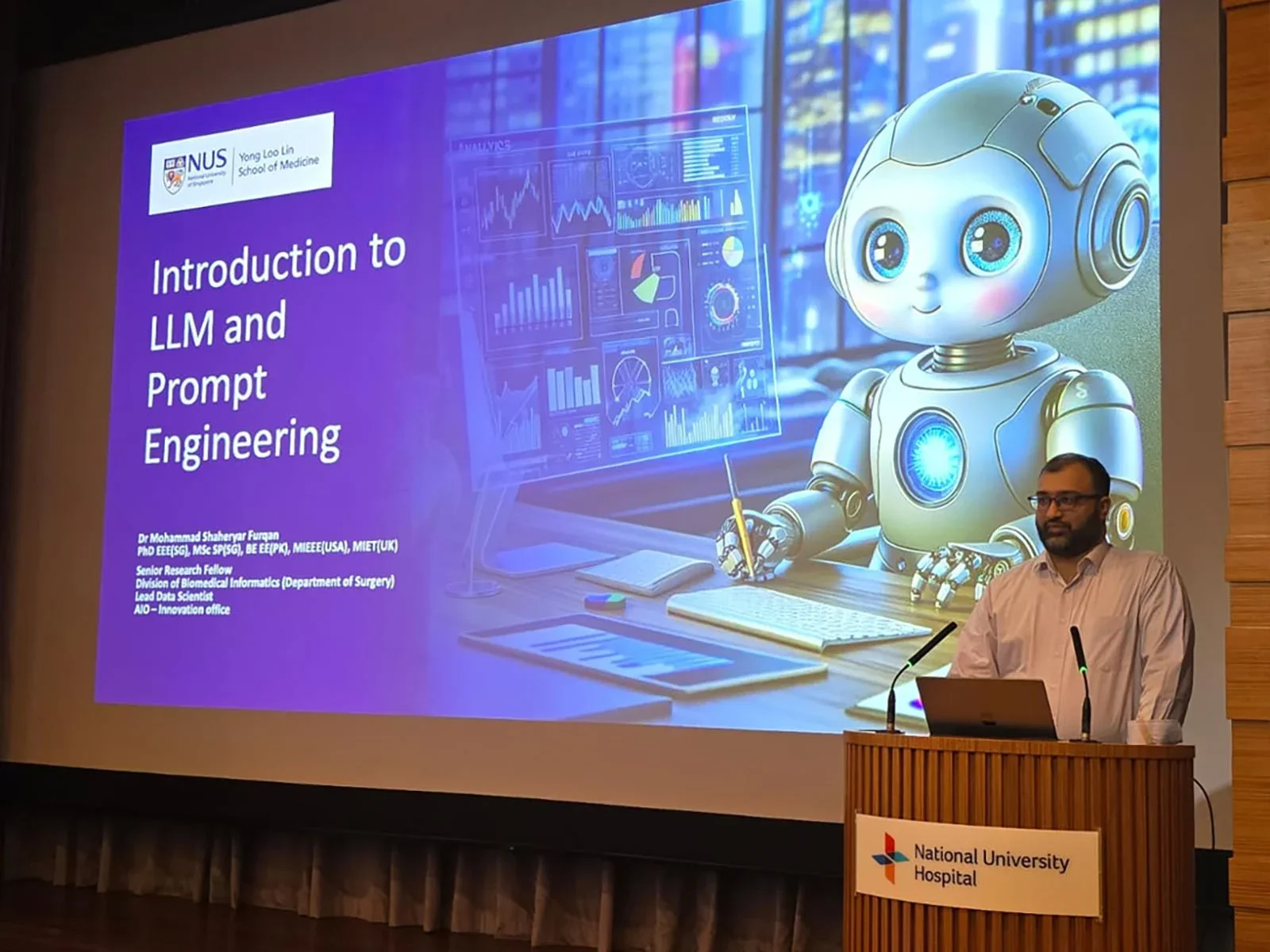
Adjunct Professor Ngiam Kee Yuan, Head of Division of Biomedical Informatics at NUS Medicine said, “When the first AI wave hit in 2018, many of us started thinking seriously about how AI could be used meaningfully in healthcare. Much of the focus was on applications and research — but students and doctors started to show great interest in wanting to understand and use such technologies. One example is my student Yong Cai Ling. Her curiosity led to us working together to use large language models (LLMs) to enhance medical education using Socratic methods.”
As NUS Medicine did not offer any tech-related course at the time, students had to pick up the knowledge and skills on an ad hoc basis on their own. Driven by the growing demand for tech skills among practising doctors, NUS Medicine set up the Division of Biomedical Informatics in 2020, and launched the Master of Science in Biomedical Informatics in 2022. Adj Prof Ngiam said, “There was no doubt that technology is transforming the practice of Medicine — and sitting it out was not an option. But we were also unsure how it would be received, or at what level it should be taught to ensure relatability and relevance.”
These concerns proved unfounded. The response was enthusiastic. “It quickly became clear that we needed to expand this initiative and incorporate it into the undergraduate curriculum. We need to train a future generation of doctors who understand data analytics, and can apply AI and machine learning,” he continued.
Work was soon underway to formalise a biomedical informatics curriculum for undergraduates, but the format and requirements of the curriculum was then a topic of intense discussion. “NUS Medicine curriculum is packed—but if we were to do this, we needed something robust. As a university, our goal is not just to teach students skills (for example, how to code in Python), but also how to think. That takes time,” Adj Prof Ngiam explained.
In the hands of tomorrow's doctors, technology becomes an instrument of compassion. By equipping every medical student with knowledge of Biomedical Informatics and AI, we aren't just preparing them for the future—we're empowering them to create it. These aren't just tools; they're extensions of the healing touch, allowing more lives to be transformed through the perfect union of human empathy and technological precision.”
Developing a robust curriculum
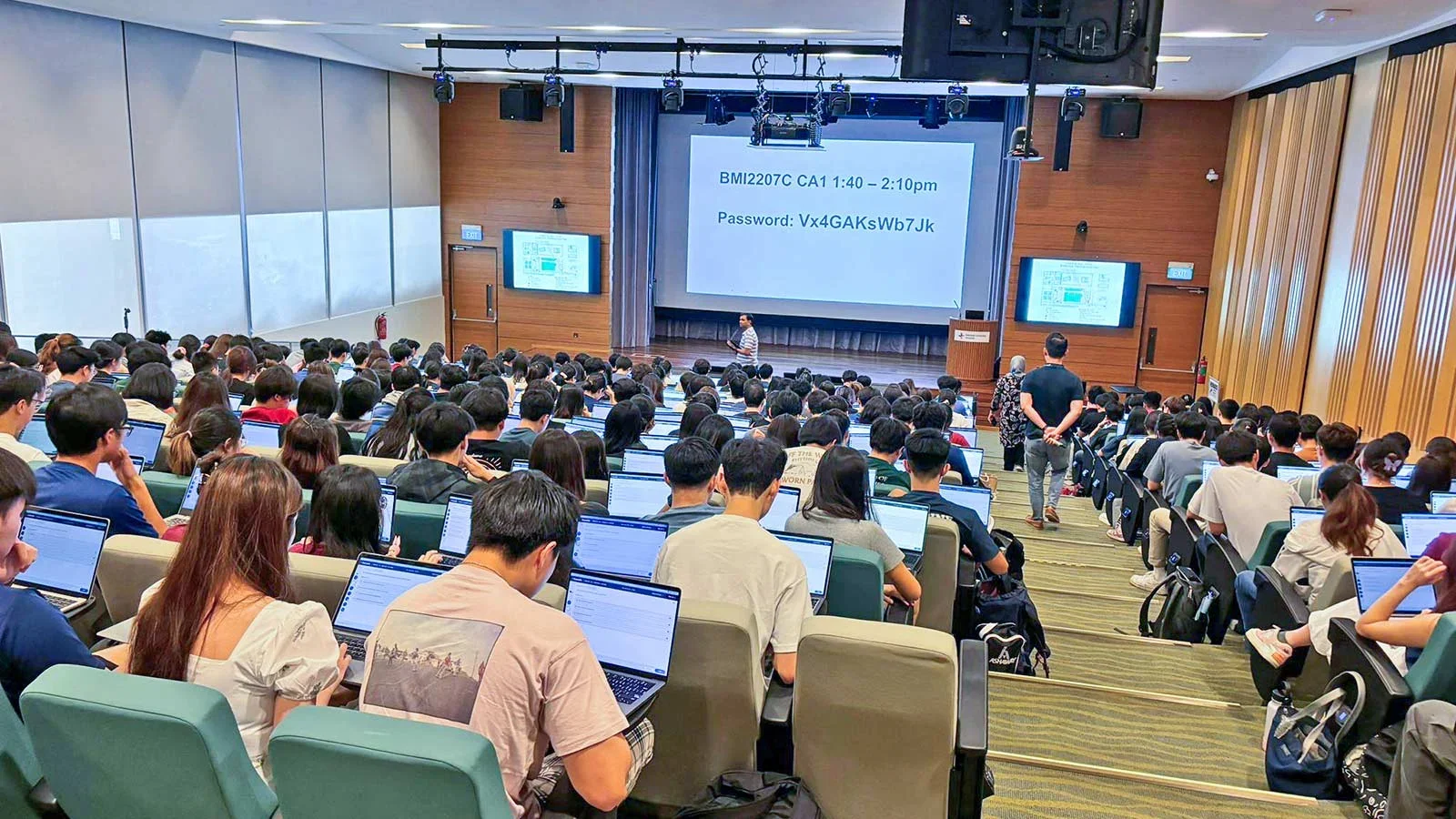
Striking a balance between the rigours of the medical curriculum and giving students a solid grounding in biomedical informatics, the team decided to implement a compulsory Minor in Biomedical Informatics for all incoming batches of NUS Medicine students. The minor consists of five courses—with two courses embedded under the Common Curriculum for Healthcare Professionals—to be completed in the first three years. Adj Prof Ngiam said, “We benchmarked our courses to the American Medical Informatics Association (which outlines a set of core competencies), but made our own additions to include emerging technology such as LLMs.”
To complete the minor, students take Data Literacy for Healthcare and Digital Literacy for Healthcare under the Common Curriculum along with Introduction to Medical Data and Data Processing in the first two years. This is followed by Value Based Healthcare and Clinical Data System Design Testing and Governance in the third.
Adj Prof Ngiam said, “By having students take Introduction to Medical Data and Data Processing, we familiarise them with data use in healthcare, as well as healthcare databases like the electronic medical record systems commonly used in the clinical setting. Courses in succeeding years build on these foundational knowledge. For instance, Value Based Healthcare introduces students to the value and costs of healthcare—which leverages their understanding of data.”
The courses also go beyond technological aspects. He added, “Even as we get students excited about technology and what they can do with it, we also want to get them thinking about the cost implications, patient safety, and ethical applications.”
Optimising for effective learning
Since implementation, two batches of students have started on the minor programme—with Adj Prof Ngiam and his team beginning to see promising results. He said, “We’ve started to identify students with great passion in this area and guide them in developing their interests. This is unlike the past (before implementation of the minor), where they would have to figure everything out on their own.”
He continued, “At the same time—we’ve found students who are completely uninterested in such technological topics. While their disinterest doesn’t mean we are going to teach them any less, their response is constructive for us in adapting our evaluative framework to help them see the importance of learning these.” One such adjustment was to include personal reflections in assessments.
“For example, we cannot stop students from using LLMs like ChatGPT to create their answers, but what we can do is set our assessment questions to invite them to reflect on how they are using the technology. In this way, we encourage them to think critically about the use of technology—something they wouldn’t necessarily have done otherwise.”

Adj Prof Ngiam with NUS Medicine Phase IV student Yong Cai Ling and Prof Koh Woon Puay, Director of the Clinician Scientist Development Unit, at Dragon’s Den, an annual elevator pitch competition where students and their mentors pitch a research proposal for funding.
I now see technology not as a distant field, but as a vital partner in modern medicine to bridge gaps in patient care. I'm motivated to explore further how interdisciplinary collaborations with data scientists and tech experts can create breakthroughs in both clinical research and day-to-day healthcare operations.”
Updating for future-readiness
In addition to adapting to student responses, the team conducts an annual review of the curriculum based on feedback and latest technological developments. “When we first drew up our proposal, we were primarily focused on machine learning and neural networks,” said Adj Prof Ngiam. “But since then, LLMs have come to the fore. That’s why we are keeping our definition of “AI’ broad—the key is to teach students what’s relevant and not limit ourselves.”
The array of technology and AI tools available in healthcare is set to increase against the backdrop of a fast-evolving tech landscape and a shortage of healthcare professionals. “Medical graduates who can’t leverage them—will undoubtedly struggle compared to their peers who are well-adapted to AI tools and proficient in their use. This struggle translates into lacklustre performances, which could very well impact their career growth. That’s why—regardless of individual interest—we are committed to equipping our graduates with tech skills that will give them a distinct head start as junior doctors,” Adj Prof Ngiam concluded.
https://www.straitstimes.com/singapore/health/ai-already-playing-bigger-roles-behind-the-scenes-in-healthcare-kenneth-mak.
More from this issue

PEOPLE OF NUS MEDICINE
NUS MedSoc at 76