Issue 54
Jul 2025
DOSSIER
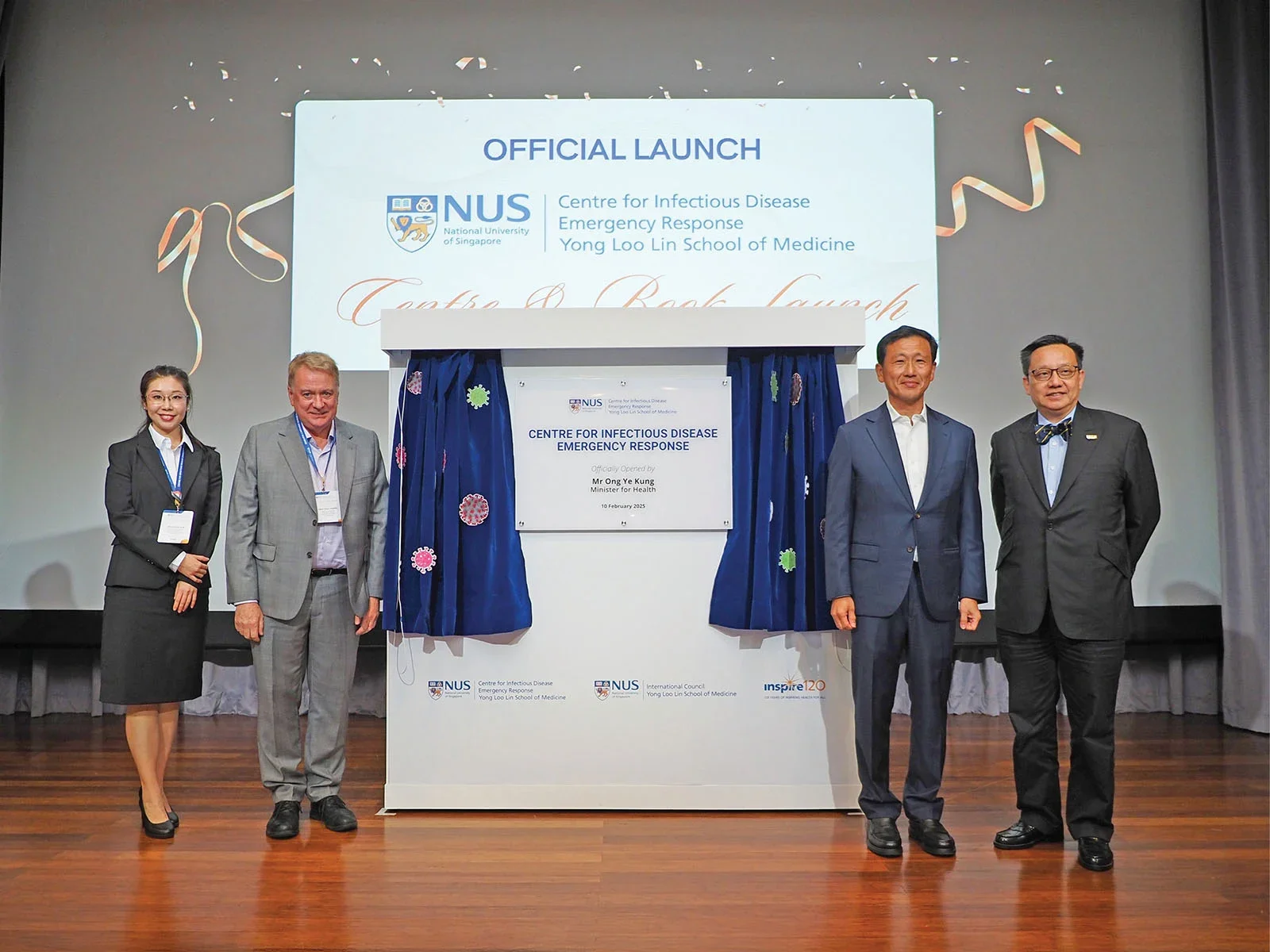
The Yong Loo Lin School of Medicine, National University of Singapore (NUS Medicine) has established the Centre for Infectious Disease Emergency Response (CIDER), aimed at enhancing global preparedness for pandemics and infectious disease outbreaks. The Centre has also released a book and introduced a new Master’s programme, to equip individuals with the critical public health knowledge and practical skills needed to lead during infectious disease crises.
NUS Medicine announced the official launch of CIDER, an innovative initiative aimed at enhancing pandemic preparedness and strengthening responses to infectious disease emergencies. The launch was graced by Mr Ong Ye Kung, Minister for Health, Singapore, and attended by various country representatives.
Led by infectious diseases and global health expert and Centre Director Professor Dale Fisher, CIDER will serve as an education and operational hub for public health professionals and policymakers across Singapore and internationally. The Centre is part of NUS Medicine’s ongoing commitment to building a robust global health infrastructure. Through a wide range of training, teaching, and operational initiatives, CIDER will play a crucial role in enabling healthcare professionals to tackle infectious disease outbreaks with improved resilience and response capabilities. As part of its mission, CIDER will focus on expanding the regional capacity to prevent, prepare for, detect, and respond to infectious disease emergencies—with a long-term vision to foster global health equity.
“We are proud to launch CIDER — a Centre which will not only advance research and education but will have a direct and tangible impact on national health systems. Through establishing the Centre, we aim to empower the next generation of public health leaders to effectively respond to infectious disease emergencies and, ultimately, contribute to a healthier, more resilient world,” said Prof Fisher, Professor of Medicine at NUS Medicine, Group Chief of Medicine at the National University Health System (NUHS), and Senior Consultant in the Division of Infectious Diseases, National University Hospital (NUH).
Master of Science in Infectious Disease Emergencies (MSc IDE)
As part of CIDER’s flagship offerings, the newly launched Master of Science in Infectious Disease Emergencies (MSc IDE) is a groundbreaking programme for professionals in the field of public health and outbreak response. The MSc IDE is a first-of-its-kind degree designed to equip individuals with the critical knowledge and practical skills needed to lead during infectious disease crises.
Developed by CIDER in collaboration with leading local and international experts, the MSc IDE programme is specifically tailored for early- to mid-career professionals with work experience in relevant sectors such as public health, health promotion, health administration, occupational and environmental health, clinical research, or other related fields, who are looking to take on leadership roles in outbreak response and management.
Dr Louisa Sun, Deputy Director, CIDER, added, “The MSc IDE programme reflects our commitment to building a resilient workforce capable of responding to global health threats. By combining academic rigour with real-world application, we will be equipping professionals with the tools they need to make a real difference in global health crises—comprehensive training in areas such as outbreak dynamics, prevention strategies, and emergency response management.” Dr Sun is also Consultant at the Division of Infectious Diseases, and Head of the Infection Prevention and Control and Epidemiology Unit at Alexandra Hospital.
The programme includes three compulsory core courses on the following topics:
1) |
Leadership and Coordination; |
2) |
Surveillance and Epidemiology; and |
3) |
Communications and Engagement in a Crisis. |
Students will also be required to choose and complete seven elective courses from the list of offerings available, on the following topics:
1) |
Clinical Management, Infection Prevention and Control (IPC), and Facility Infrastructure; |
2) |
Interventions for Outbreak Control; |
3) |
Research in a Pandemic; |
4) |
Mental Health and Support for the Vulnerable; |
5) |
Laboratory; |
6) |
Training for Outbreak Response; |
7) |
Outbreak Prone Pathogens; and |
8) |
Infectious Disease Emergency Response Modelling. |
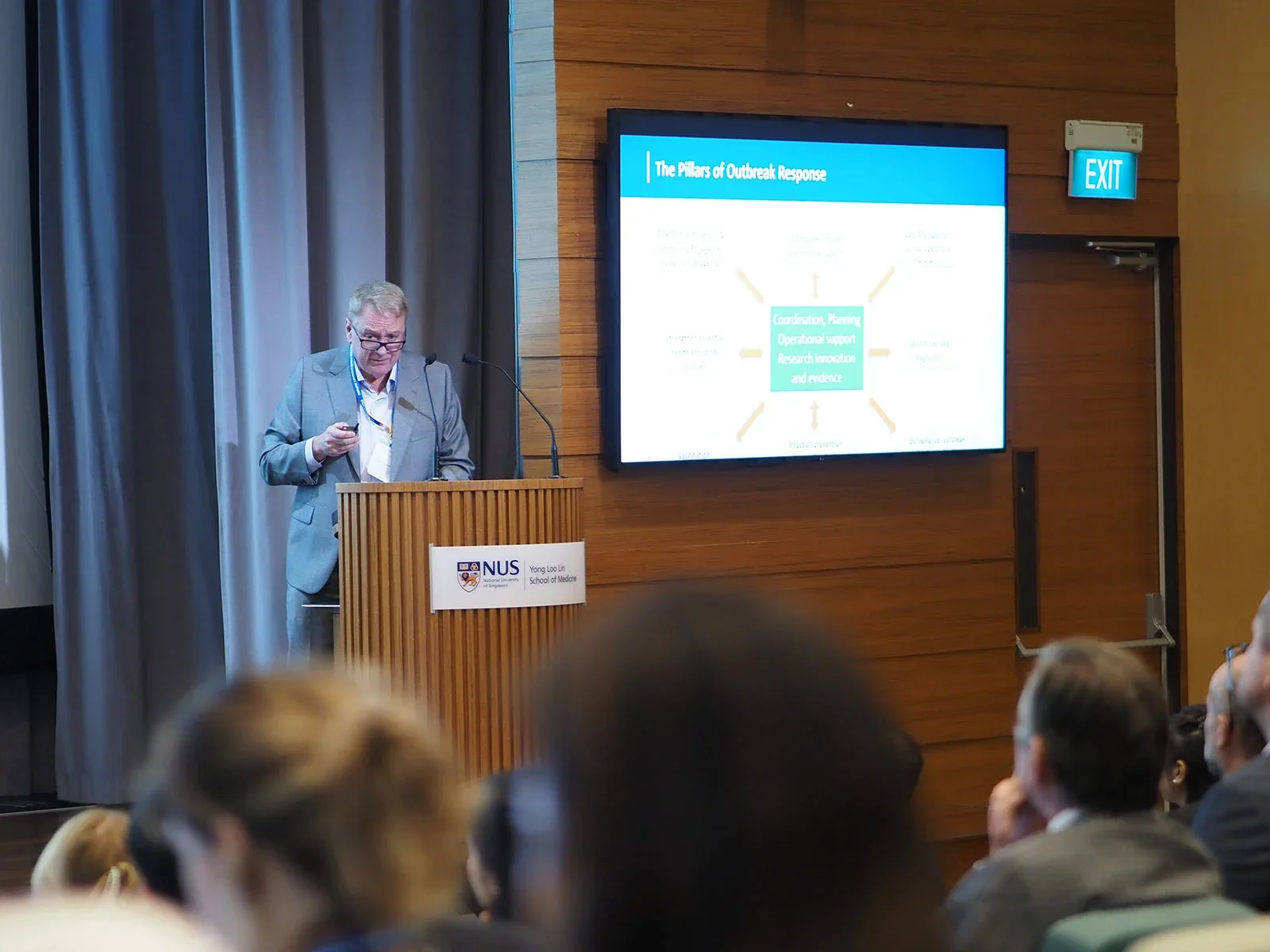
Prof Dale Fisher, Director, CIDER, NUS Medicine, giving an address at the launch of the Centre.
The programme features a distinguished faculty of professionals from around the world. These include Professor Daniel Bausch, Visiting Professor, CIDER, NUS Medicine, and the London School of Hygiene and Tropical Medicine; Professor Benjamin Ong, Department of Medicine at NUS Medicine and Senior Consultant at the Division of Neurology, NUH; Dr Shawn Vasoo, Clinical Director and Senior Consultant at the National Centre for Infectious Diseases (NCID), Singapore; Dr Maleena Suppiah Cavert, Chief, Learning & Culture, Tsao Foundation; Associate Professor Ayelet Berman, Visiting Associate Professor, NUS Saw Swee Hock School of Public Health (SSHSPH), and Lead of the Law & Governance Programme at the Asia Centre for Health Security; Associate Professor David Allen, Department of Medicine at NUS Medicine and Senor Consultant at the Division of Infectious Diseases, NUH; and Professor Paul Tambyah, Deputy Director, Infectious Diseases Translational Research Programme, NUS Medicine, and Department of Medicine at NUS Medicine and Senior Consultant at the Division of Infectious Diseases, NUH.
Graduates of the MSc IDE will be well-equipped to shape health policies, lead emergency responses, and contribute to the development of global health systems. Registration for the programme opened on 1 November 2024, and will remain open until 30 April 2025, with the first cohort beginning in July 2025. The programme will welcome up to 80 students annually, ensuring a high-impact learning experience and facilitating the development of lifelong professional collegiality and networks.

Junior authors of “Infectious Disease Emergencies: Preparedness and Response”. (From left) Joycelyn Soo, Caleb Luo, Yap Qi Rou, Javier Thng, Sylvia Phua.
“Infectious Disease Emergencies: Preparedness and Response”:
A groundbreaking textbook
In line with its educational efforts, CIDER is proud to announce the publication of a book, titled Infectious Disease Emergencies: Preparedness and Response from NUS Press. This peer-reviewed, comprehensive resource is designed to guide professionals in managing infectious disease crises. Edited by Prof Fisher, the book features contributions from over 100 global experts actively working in the field of infectious diseases, including Professor David Paterson, Director, ADVANcing Clinical Evidence in Infectious Diseases; Dr Sylvie Briand, Director, Global Preparedness Monitoring Board; Dr Ali S. Khan, Richard Holland Presidential Chair and Dean, College of Public Health, University of Nebraska Medical Center; Professor Alex R. Cook, Vice Dean (Research), SSHSPH; Professor Heidi J. Larson, Director, Vaccine Confidence Project, London School of Hygiene and Tropical Medicine; and Myriam Henkens, Senior Advisor, Médecins Sans Frontières.
This comprehensive book will serve as an essential textbook for the MSc IDE programme and is also aimed at professionals globally who need practical, evidence-based strategies to prepare for infectious disease emergencies. The book’s content is grounded in real-world applications, offering actionable insights and solutions based on the latest research and field experiences.
Medical journal The Lancet, highlighted the comprehensive approach to infectious disease preparedness, praising its real-world applicability and its potential to become the “backbone for courses and training” in public health and outbreak response.
“Infectious Disease Emergencies: Preparedness and Response is a crucial resource, taking readers through the key components of an effective outbreak response. Informed by lessons from COVID-19 and other disease outbreaks, this book provides the essential knowledge needed for global health professionals and policymakers.” – The Lancet, Vol 405, 1 February 2025
Professor Chong Yap Seng, Lien Ying Chow Professor in Medicine, and Dean of NUS Medicine, said, “The launch of CIDER marks a significant milestone in Singapore’s ongoing efforts to position itself as a global leader in public health and pandemic preparedness. By offering educational opportunities, practical training, and operational support, CIDER aims to enhance public health systems, particularly in low-income countries, through scholarships and financial aid for professionals from these regions.”
More from this issue