Issue 57
Feb 2026
DOSSIER
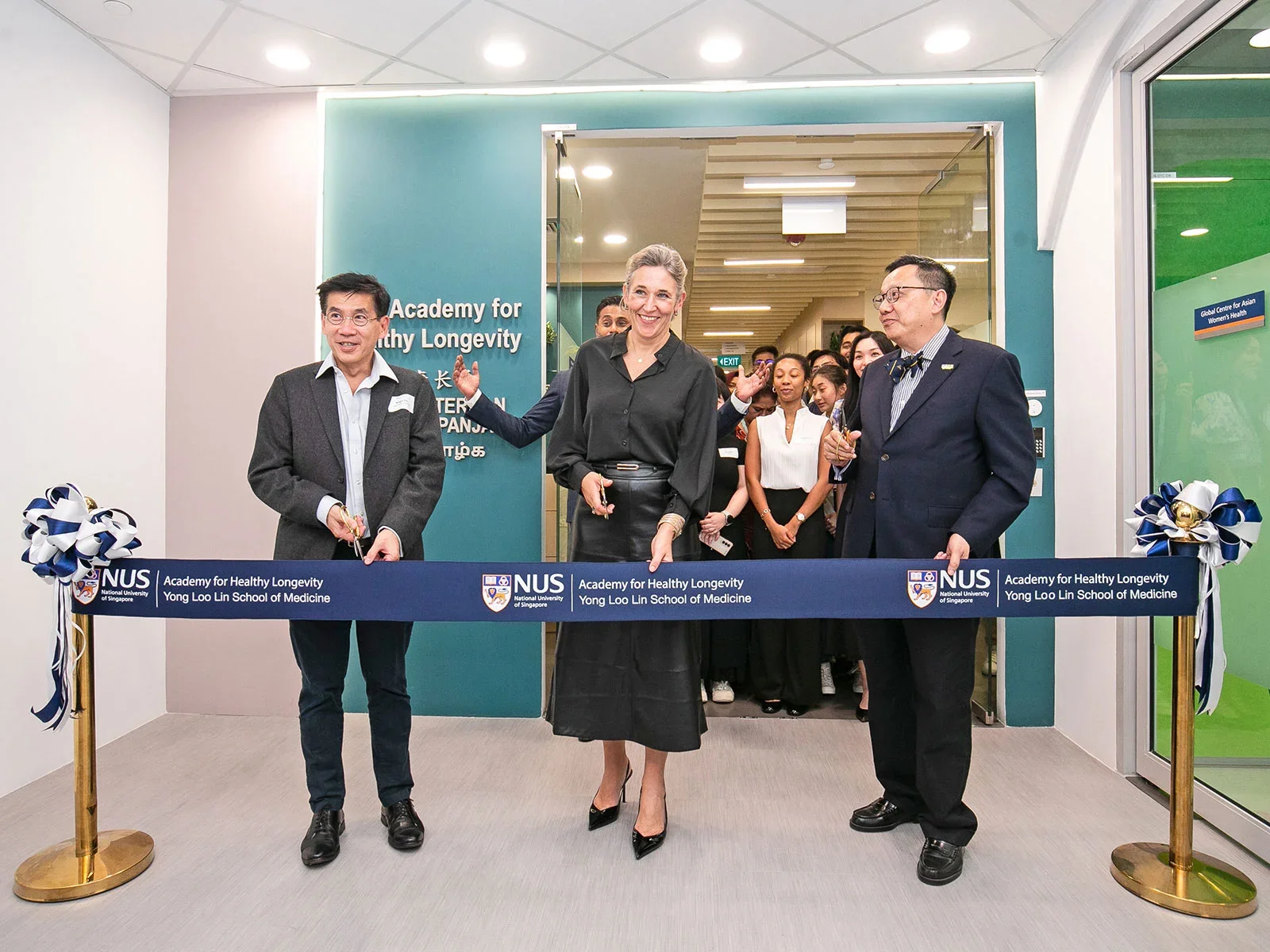
On 10 October 2025, Yong Loo Lin School of Medicine, National University of Singapore (NUS Medicine) launched a new Clinical Trial Centre under its Academy for Healthy Longevity, a pioneering hub to advance clinical research and catalyse educational excellence in precision geromedicine. Spanning 350 square metres, the new centre is poised to enhance research capabilities and accelerate the clinical translation of geroscience into real-world solutions.
The new centre is purpose-built to accelerate precision geromedicine research. Precision geromedicine entails the application of personalised, biomarker-driven strategies to optimise health, extend healthspan, prevent age-related diseases and tailor interventions to an individual’s unique genetic, molecular, clinical, social, environmental and behavioural profile. By integrating multi-omics data, digital health monitoring and systems biology, this approach can predict ageing trajectories, detect early deviations from healthy ageing and guide interventions that enhance resilience and promote longevity across the adult lifespan.
The centre will support multiple clinical trials in parallel and enable on-site collection and immediate processing of biological samples, streamlining operations and enhancing reproducibility. It offers comprehensive assessments of organ health, including advanced skin, scalp, eye, and dental evaluations, as well as full-body bone mineral density scanning using Dual-Energy X-ray Absorptiometry (DEXA), sleep and behaviour monitoring, as well as an on-site investigative product repository. Together, these capabilities enable the most comprehensive evaluations available for healthy longevity clinical trials, setting new benchmarks in global healthcare innovation.
Professor Andrea Maier, Oon Chiew Seng Professor in Medicine, Healthy Ageing and Dementia Research at NUS Medicine and Director of the NUS Academy for Healthy Longevity at NUS Medicine, explained, “At the core of the Academy’s approach is an interdisciplinary gerodiagnostics framework that assesses biological age and the function of multiple physiological and organ systems. The framework enables standardised evaluations across different levels, from molecular, clinical, psychological, behavioural, to social biomarkers of ageing, providing comprehensive, system-wide analyses of participant health and intervention impact. With the centre, we aim to generate high-quality evidence needed to extend healthspan, while training a new cadre of clinician-scientists to translate geroscience from bench to bedside.”
Traditional clinical trials focus on a one factor (intervention, therapy, measurement method) to isolate the effect of that single modality on the targeted outcome. While that approach can yield important insights, it often fails to capture the complexity of ageing, where multiple biological systems interact and influence one another.
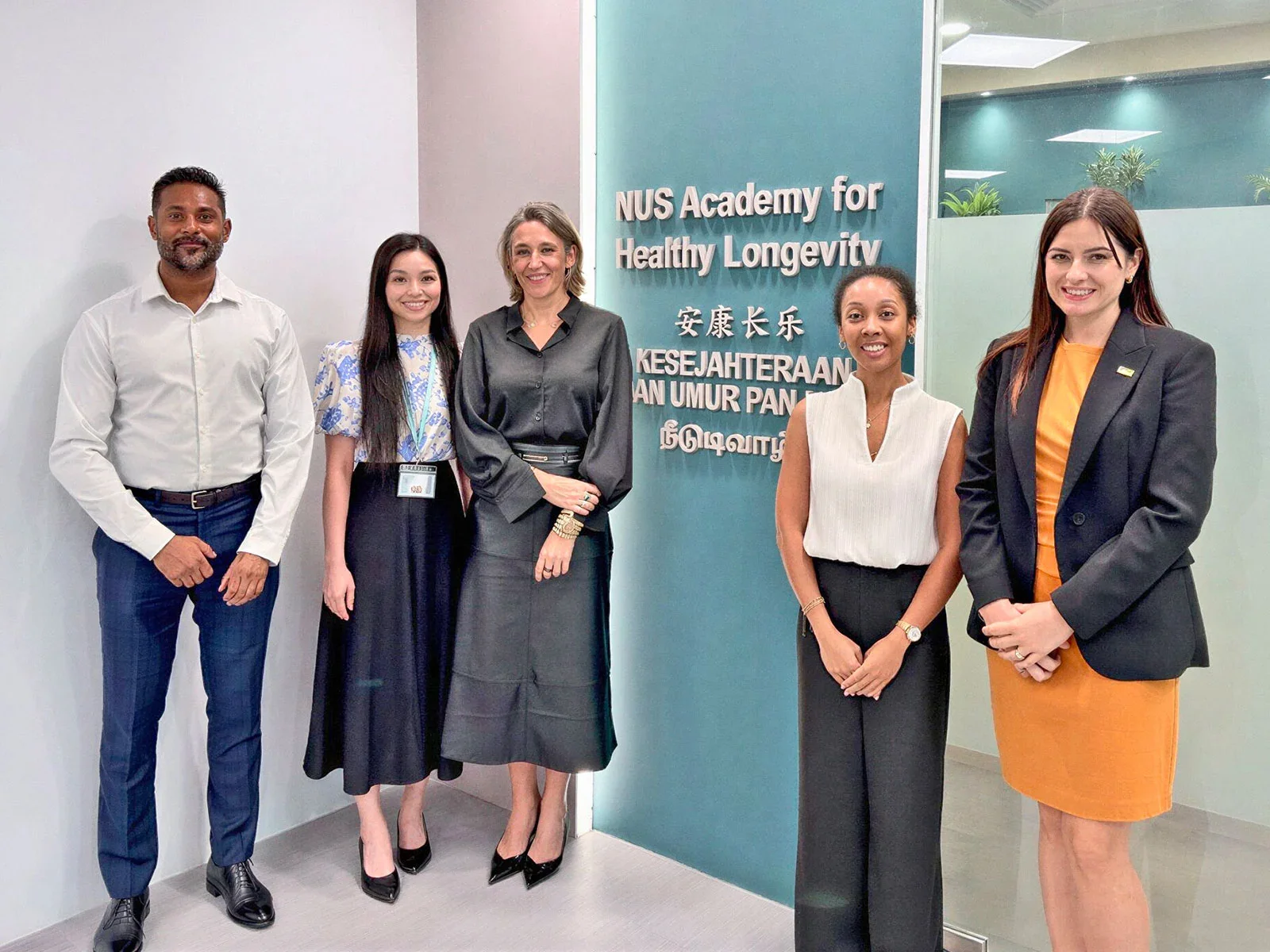
NUS Medicine’s Academy for Healthy Longevity team. From left to right: Mr Shivaji Rikka, Ms Jane Ong, Professor Andrea Maier, Dr Dotou Mazzarine, and Dr Ajla Hodzic Kuerec.
Prof Maier also highlighted that the centre’s move toward multimodal trials, integrating interventions and measurements across multiple organ systems, will enable researchers to tailor strategies for synergistic outcomes.
Beyond research, the centre serves as a training hub for emerging scientists, healthcare professionals and educators. Through specialised programmes, learners gain the knowledge and skills to advance in Healthy Longevity. Upcoming initiatives will offer hands-on experience in real-world clinical trials, from data collection and clinical assessments to translational research, bridging the gap between theory and practice, and enhancing expertise in this vital field.
Professor Chong Yap Seng, Dean, NUS Medicine, added, “Ageing is one of the greatest challenges confronting the world today. While Singaporeans are living longer, the last 10 years of life are often spent in ill health. The Clinical Trial Centre strengthens our ability to translate our research into real-world solutions that improve care, policy, and population health. By integrating geroscience research and education into one facility, we are building the talent and the evidence base required to benefit our ageing communities here and around the world.”
In tandem with the launch of the Clinical Trial Centre, the Academy also announced the signing of three new strategic partnerships. It formalised collaborations with the State University of Makassar in Indonesia to advance education in healthy longevity, the Royal Melbourne Institute of Technology (RMIT) to foster cross-border academic and research initiatives, and the Alliance of Patients’ Organisations Singapore (APOS) to strengthen patient-powered collaboration in healthy longevity medicine.
The Academy also spearheaded the Global Epigenetic Age Systematic Review Consortium, a pioneering effort to rigorously evaluate the validity and real-world application of epigenetic clocks, and the HELO Survey Consortium, a multi-nation study examining public awareness and motivation toward healthy longevity.