



Abstract:
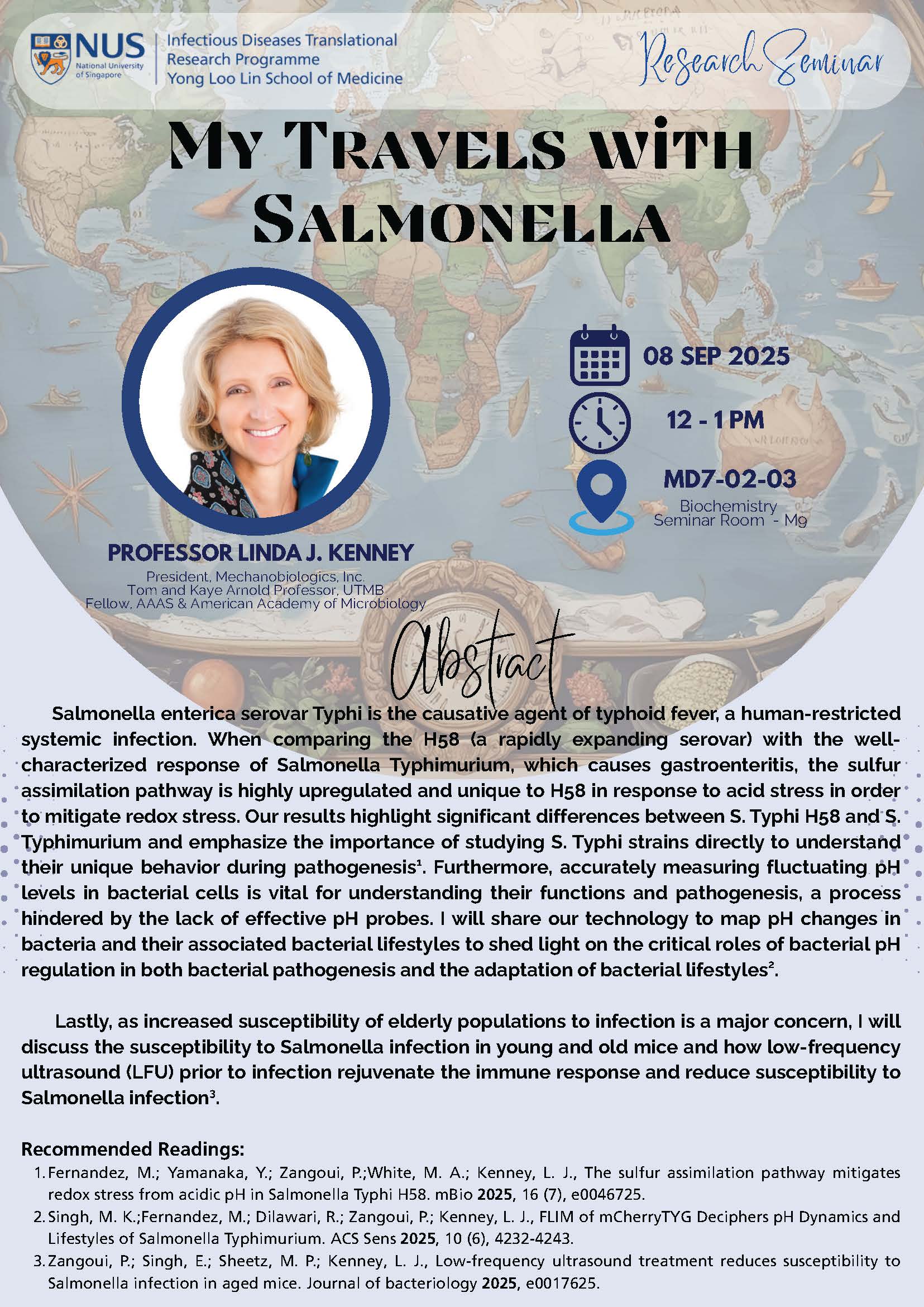
Salmonella enterica serovar Typhi is the causative agent of typhoid fever, a human-restricted systemic infection. When comparing the H58 (a rapidly expanding serovar) with the well-characterized response of Salmonella Typhimurium, which causes gastroenteritis, the sulfur assimilation pathway is highly upregulated and unique to H58 in response to acid stress in order to mitigate redox stress. Our results highlight significant differences between S. Typhi H58 and S. Typhimurium and emphasize the importance of studying S. Typhi strains directly to understand their unique behavior during pathogenesis . Furthermore, accurately measuring fluctuating pH levels in bacterial cells is vital for understanding their functions and pathogenesis, a process hindered by the lack of effective pH probes. I will share our technology to map pH changes in bacteria and their associated bacterial lifestyles to shed light on the critical roles of bacterial pH regulation in both bacterial pathogenesis and the adaptation of bacterial lifestyles .
Lastly, as increased susceptibility of elderly populations to infection is a major concern, I will discuss the susceptibility to Salmonella infection in young and old mice and how low-frequency ultrasound (LFU) prior to infection rejuvenate the immune response and reduce susceptibility to Salmonella infection .
Recommended Readings:
1.Fernandez, M.; Yamanaka, Y.; Zangoui, P.;White, M. A.; Kenney, L. J., The sulfur assimilation pathway mitigates redox stress from acidic pH in Salmonella Typhi H58. mBio 2025, 16 (7), e0046725.
2.Singh, M. K.;Fernandez, M.; Dilawari, R.; Zangoui, P.; Kenney, L. J., FLIM of mCherryTYG Deciphers pH Dynamics and Lifestyles of Salmonella Typhimurium. ACS Sens 2025, 10 (6), 4232-4243.
3.Zangoui, P.; Singh, E.; Sheetz, M. P.; Kenney, L. J., Low-frequency ultrasound treatment reduces susceptibility to Salmonella infection in aged mice. Journal of bacteriology 2025, e0017625.