

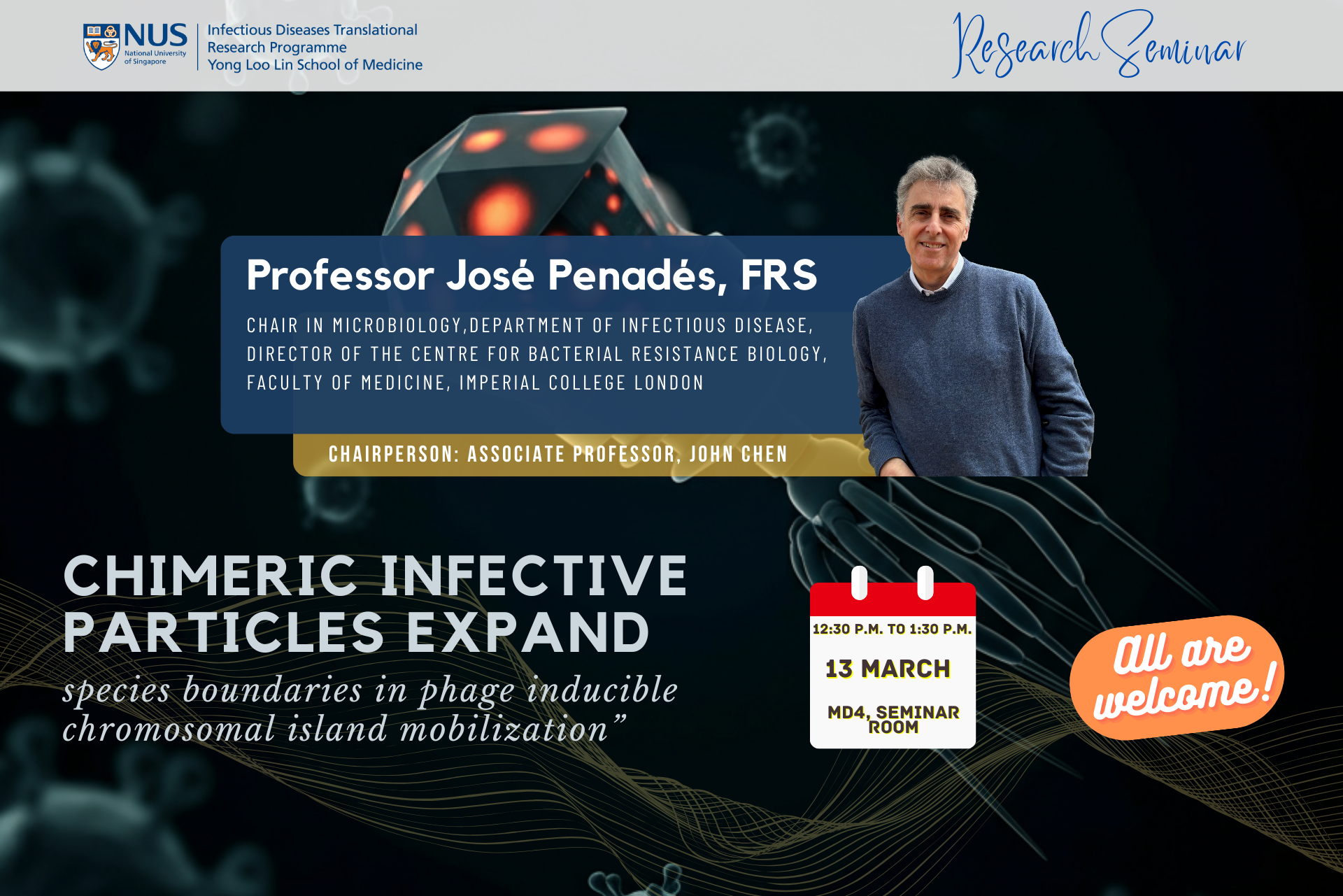
Chimeric infective particles expand species boundaries in phage inducible chromosomal island mobilization

Mar 13, 2025
MD4 level 2 Seminar Room (MD4-02-03E)

Abstract:  

Capsid-forming phage-inducible chromosomal islands (cf-PICIs) are genetic elements capable of spreading across bacterial species. They form small-sized capsids to package their DNA, requiring only phage tails to create infective particles. In this talk, we will unravel a unique mechanism that enables them to transfer between different bacteria. Since cf-PICIs encode virulence genes, their spread contributes to bacterial evolution. Experimental evidence highlights how cf-PICIs use this strategy for inter-species transfer, providing valuable insights into bacterial ecology and potential therapeutic applications.


Biography:  

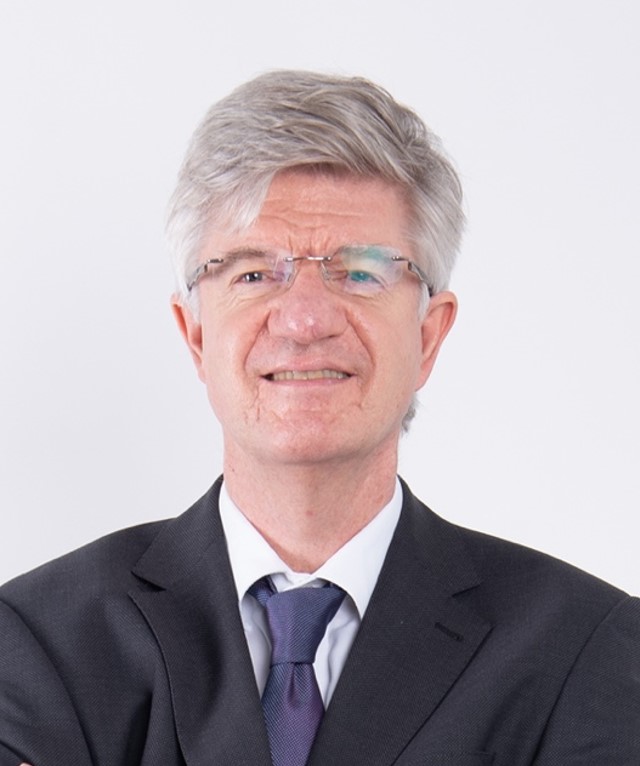
Professor José Penadés, currently the Director of the Centre for Bacterial Resistance Biology at Imperial College London, has had a distinguished career in microbiology. Originally from Agullent, Spain, he was inspired by his grandfather’s curiosity and pursued Veterinary Medicine. His research journey began with work on Staphylococcus aureus and biofilm formation, leading to a pivotal discovery in 2001 of Bap, the first protein linked to biofilm production. This steered his focus toward S. aureus pathogenicity islands (SaPIs) and phages. Throughout his career, he has held key positions at the Instituto Valenciano de Investigaciones Agrarias, the Spanish National Research Council, and the University of Glasgow. His work has been shaped by collaborations with esteemed scientists, contributing significantly to bacterial genetics and antimicrobial resistance research. At Imperial College, he continues to lead groundbreaking studies on bacterial pathogenesis and mobile genetic elements.
More Seminar, Courses & Workshops

On-site

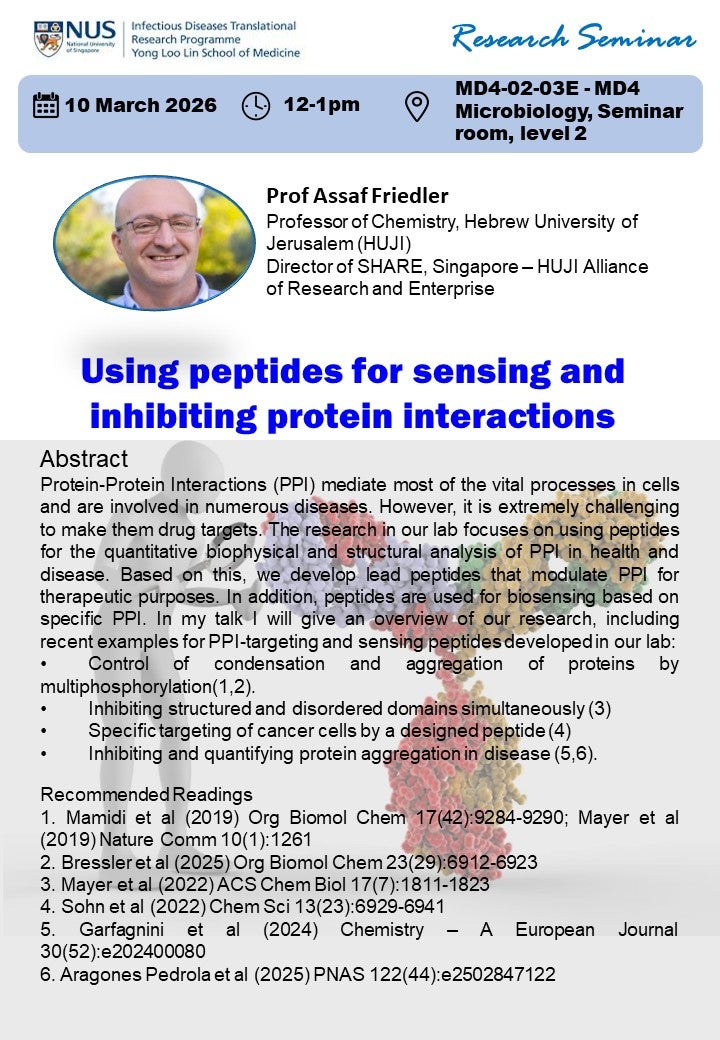
Using peptides for sensing and inhibiting protein interactions

Abstract:   Protein-Protein Interactions (PPI) mediate most of the vital processes …

On-site

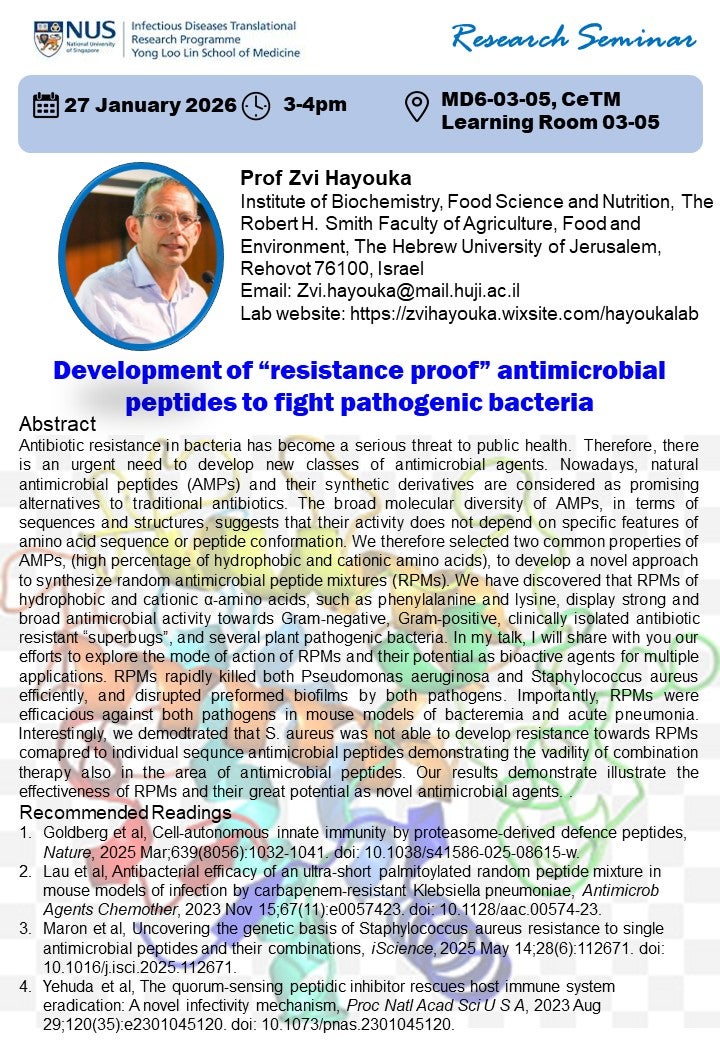
Development of “resistance proof” antimicrobial peptides to fight pathogenic bacteria

Abstract:   Antibiotic resistance in bacteria has become a serious threat …

On-site

The dream of HBV Cure

Abstract:   Chronic Hepatitis B (CHB) remains the foremost problem of …

Secondary Members

David ALLEN

Associate Professor​ (Medicine)​ ​

Sophia ARCHULETA

Associate Professor (Medicine)

Yann BOUCHER

Associate Professor (SPH)​

Louis CHAI

Associate Professor​ (Medicine)​

Kaiwen CHEN

Assistant Professor (Micro & Immuno)

CHN'G Jun Hong

Senior Lecturer (Micro & Immuno)


LOK Shee Mei

 Professor (Duke-NUS)

Hannah CLAPHAM

Assistant Professor (SPH)

Dale FISHER​

Professor​ (Medicine)​

KOH Cho Yeow

Associate Professor (Medicine)

Raymond LIN

Associate Professor​ (NPHL-NCID)​

LUO Min

Assistant Professor (DBS)

Benoit MALLERET

Assistant Professor (Micro & Immuno)

Matthew TAY

Adjunct Assistant Professor (Biochemistry)

Kevin TAN

Associate Professor​ (Micro & Immuno)​

Adjunct Members

Guillaume CARISSIMO

Assistant Professor​ (A*STAR ID Labs)

Yin Xiang SETOH​

Assistant Professor​ (EHI)​

Marco VIGNUZZI

Associate Professor 
(A*STAR ID Labs)

Primary Members

Sylvie ALONSO​

Associate Professor

John CHEN​

Associate Professor

Vincent CHOW​

Associate Professor​

Justin CHU

Associate Professor​

GAN Yunn Hwen

Associate Professor

HSU Li Yang​

 Professor

Catherine ONG​

Associate Professor

David PATERSON

Professor

Nick PATON​

Professor​

QU Kun

Assistant Professor

SHAM​ Lok To

Associate Professor​

Paul A. TAMBYAH

Professor

TAN Chee Wah

Research Assistant Professor

TAN Yee Joo​

Associate Professor​

Thai TRAN​

Associate Professor​

NAGARAJAN Niranjan

Associate Professor

ZHONG Youjia

Assistant Professor

CHNG Shu Sin

Associate Professor​ (Chemistry)​

MO Yin

Consultant (Medicine) 

Yassine CHERRAK

Assistant Professor

Cheryl LEE Qi En

Assistant Professor ?

CHNG Shu Sin

Associate Professor​ (Chemistry)​

MO Yin

Consultant (Medicine) 

WANG De Yun​

Professor​

TAN Yee Joo​

Associate Professor​