



Abstract:
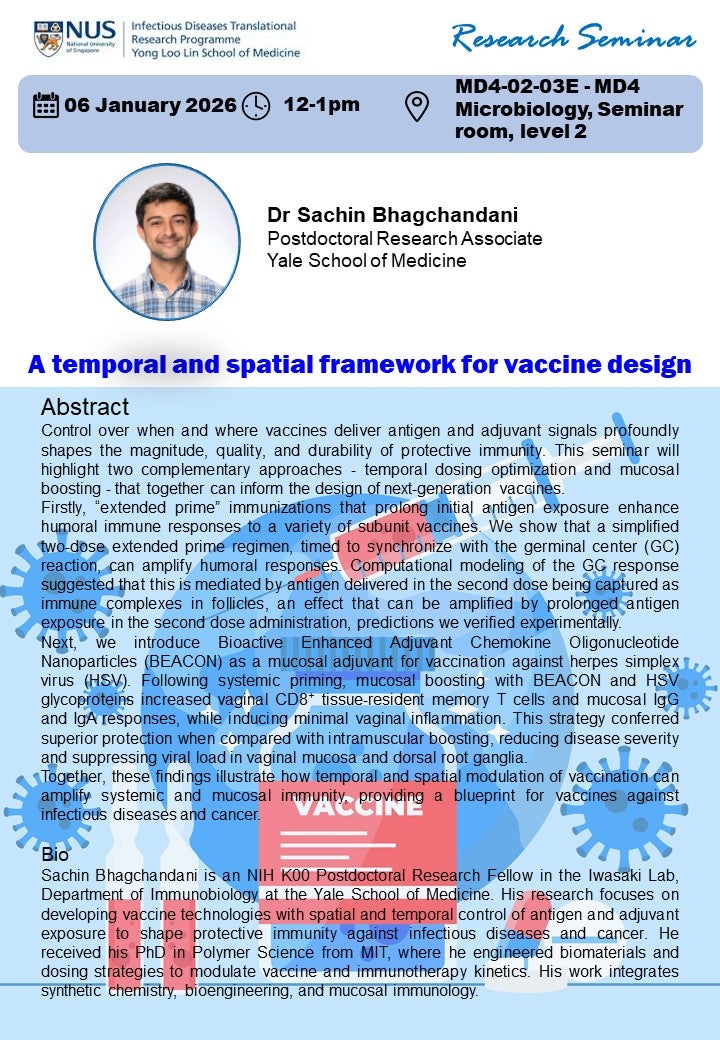
Control over when and where vaccines deliver antigen and adjuvant signals profoundly shapes the magnitude, quality, and durability of protective immunity. This seminar will highlight two complementary approaches – temporal dosing optimization and mucosal boosting – that together can inform the design of next-generation vaccines.
Firstly, “extended prime” immunizations that prolong initial antigen exposure enhance humoral immune responses to a variety of subunit vaccines. We show that a simplified two-dose extended prime regimen, timed to synchronize with the germinal center (GC) reaction, can amplify humoral responses. Computational modeling of the GC response suggested that this is mediated by antigen delivered in the second dose being captured as immune complexes in follicles, an effect that can be amplified by prolonged antigen exposure in the second dose administration, predictions we verified experimentally.
Next, we introduce Bioactive Enhanced Adjuvant Chemokine Oligonucleotide Nanoparticles (BEACON) as a mucosal adjuvant for vaccination against herpes simplex virus (HSV). Following systemic priming, mucosal boosting with BEACON and HSV glycoproteins increased vaginal CD8⁺ tissue-resident memory T cells and mucosal IgG and IgA responses, while inducing minimal vaginal inflammation. This strategy conferred superior protection when compared with intramuscular boosting, reducing disease severity and suppressing viral load in vaginal mucosa and dorsal root ganglia.
Together, these findings illustrate how temporal and spatial modulation of vaccination can amplify systemic and mucosal immunity, providing a blueprint for vaccines against infectious diseases and cancer.
Bio:
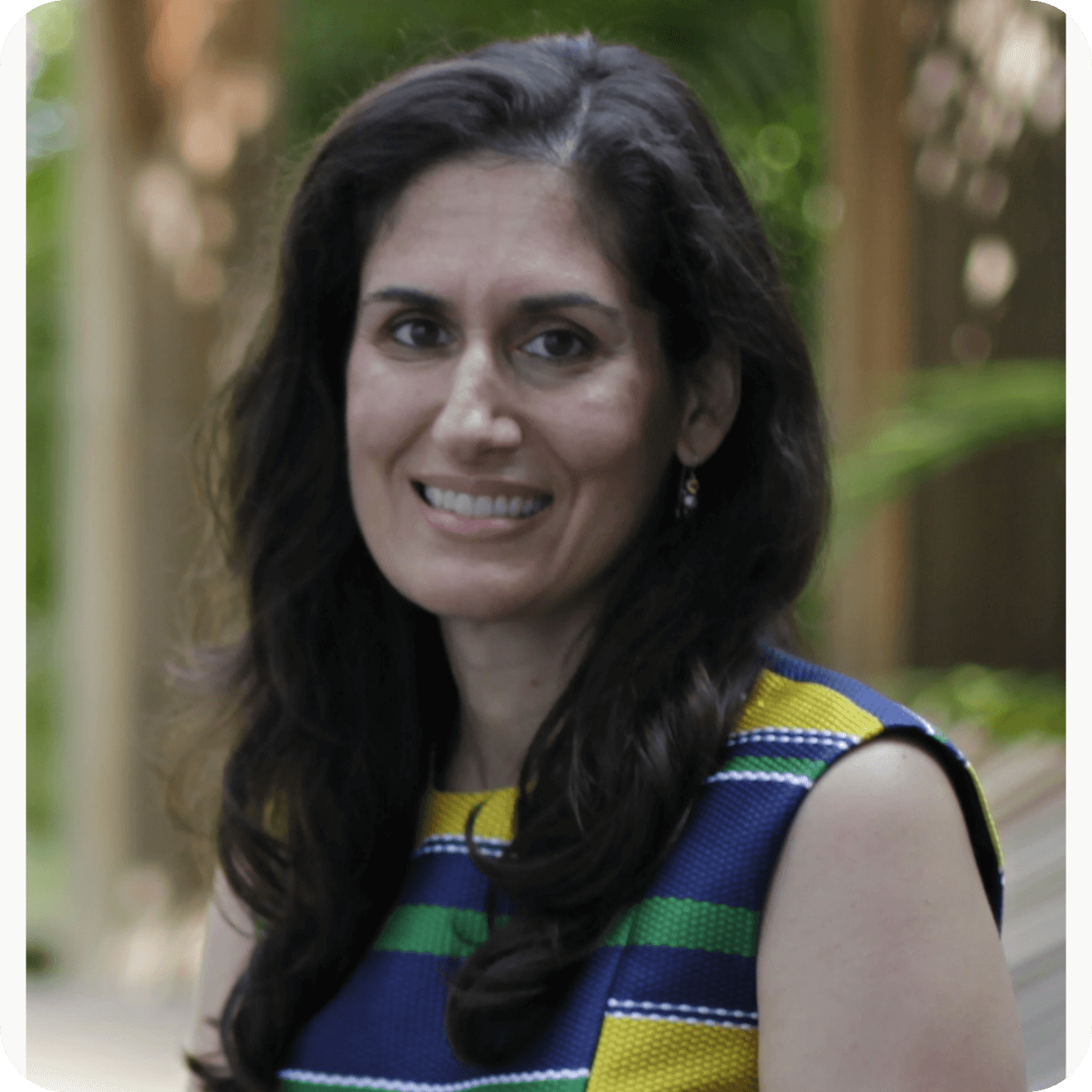
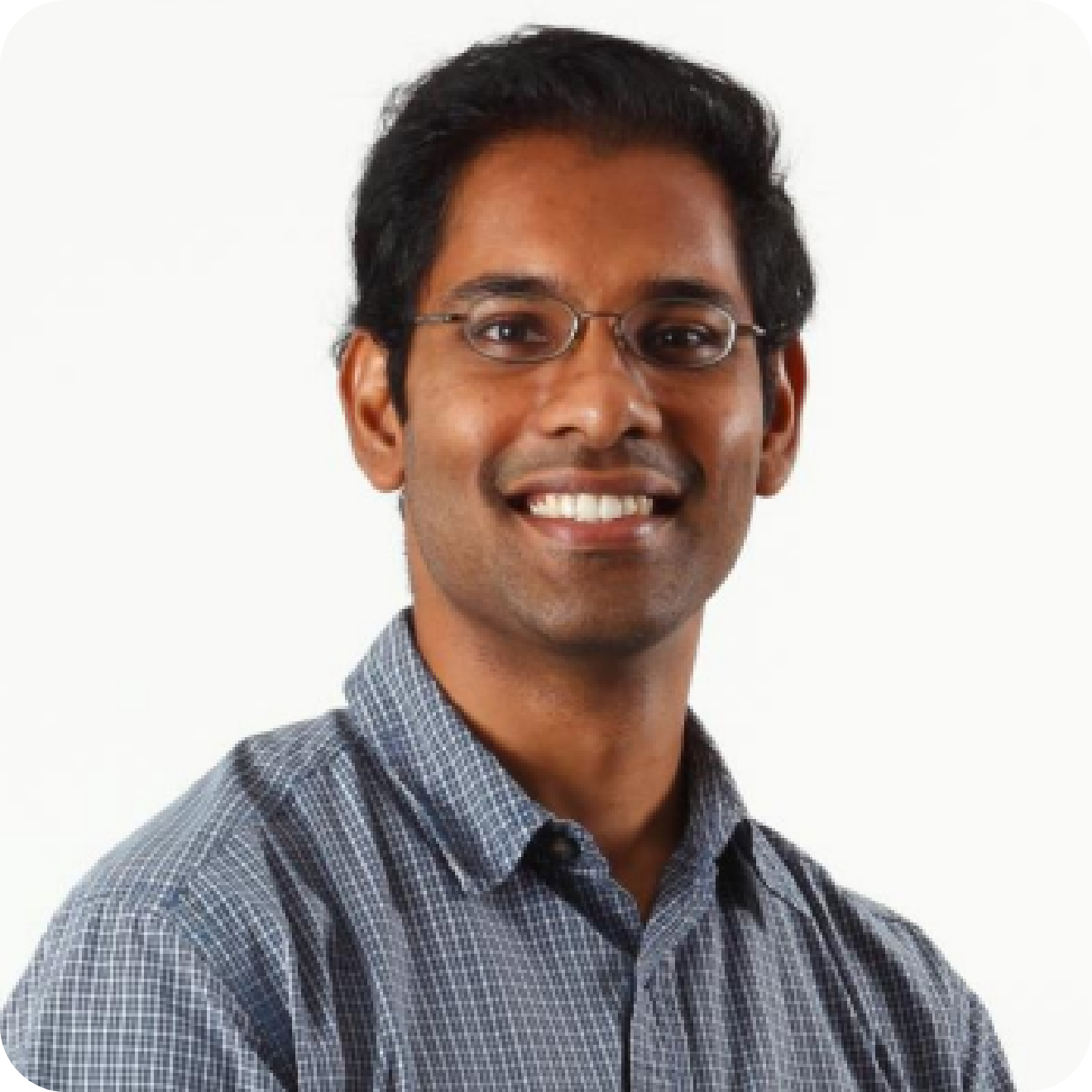
Sachin Bhagchandani is an NIH K00 Postdoctoral Research Fellow in the Iwasaki Lab, Department of Immunobiology at the Yale School of Medicine. His research focuses on developing vaccine technologies with spatial and temporal control of antigen and adjuvant exposure to shape protective immunity against infectious diseases and cancer. He received his PhD in Polymer Science from MIT, where he engineered biomaterials and dosing strategies to modulate vaccine and immunotherapy kinetics. His work integrates synthetic chemistry, bioengineering, and mucosal immunology.