
 |
 |
Abstract
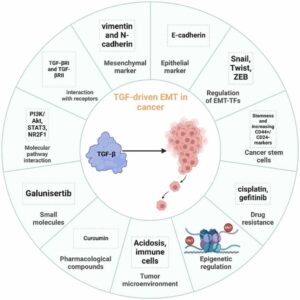
The carcinogenesis and drug resistance can be accelerated by TGF-β, primarily by enhancing epithelial-mesenchymal transition (EMT). This review examines the complex mechanisms by which TGF-β drives EMT across different tumors, highlighting its function in increasing cellular plasticity, promoting metastasis, and contributing to therapy resistance. TGF-β activates both canonical Smad-dependent and non-canonical signaling, leading to profound changes in cell morphology, motility, and stemness. This review highlights recent discoveries on how TGF-β regulates cancer stem cells and contributes to drug resistance, including resistance to both conventional chemotherapy and targeted treatments. In addition, it examines the intricate interaction between TGF-β and the key molecular pathways controlling EMT, such as PI3K/AKT, MAPK, and epigenetic regulators. It also examines potential therapeutic approaches aimed at TGF-β-induced EMT, emphasizing promising preclinical results from novel compounds and combination therapies—including natural products, small-molecule inhibitors, and epigenetic regulators—that interfere with TGF-β receptor activation or downstream signaling pathways. Understanding these complex interactions provides valuable insights for developing more effective cancer therapies. The review concludes by identifying key research gaps as well as suggesting future directions for investigating TGF-β’s role in cancer biology and treatment resistance.
Full Article: https://doi.org/10.1016/j.cytogfr.2025.05.004


