
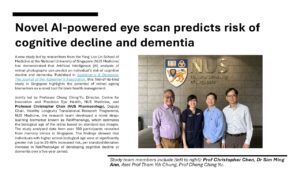
A new study led by researchers from the Yong Loo Lin School of Medicine at the National University of Singapore (NUS Medicine) has demonstrated that Artificial Intelligence (AI) analysis of retinal photographs can predict an individual’s risk of cognitive decline and dementia. Published in Alzheimer’s & Dementia: The Journal of the Alzheimer’s Association, this first-of-its-kind study in Singapore highlights the potential of retinal ageing biomarkers as a novel tool for brain health management.
Jointly led by Professor Cheng Ching-Yu, Director, Centre for Innovation and Precision Eye Health, NUS Medicine, and Professor Christopher Chen, Deputy Chair, Healthy Longevity Translational Research Programme, NUS Medicine, the research team developed a novel deep-learning biomarker known as RetiPhenoAge, which estimates the biological age of the retina based on standard eye images. The study analysed data from over 500 participants recruited from memory clinics in Singapore. The findings showed that individuals with higher retinal biological age were at significantly greater risk (up to 25-40% increased risk, per standard deviation increase in RetiPhenoAge) of developing cognitive decline or dementia over a five-year period.
These findings were further validated in a larger population sample using data from more than 33,000 participants in the UK Biobank. In this cohort, elevated RetiPhenoAge was similarly associated with a higher risk of developing dementia over twelve years of follow-up, reinforcing its predictive utility across diverse populations. The study further showed that retinal ageing reflects key biological processes associated with neurodegeneration, with brain scans and blood markers used to validate RetiPhenoAge’s link to brain changes and ageing-related changes in blood proteins. While the retinal age algorithm has not yet been deployed within clinical practice, these associations suggest a novel alternative for the use of retinal ageing as a biomarker of cognitive health.
Prof Cheng said, “With RetiPhenoAge, we are able to non-invasively estimate an individual’s biological age, offering valuable insights for both cognitive health management and broader ageing research. This can help doctors identify people at risk of cognitive decline or dementia, before symptoms appear, enabling more targeted interventions. We hope to validate this screening tool in larger and more diverse populations, and assess its impact in clinical settings to guide earlier treatment of dementia.” Prof Cheng is also Principal Clinician Scientist at the Singapore Eye Research Institute.
Prof Chen added, “With dementia numbers rising globally, we urgently need tools that are both scalable and predictive. RetiPhenoAge could hold the key to community-level screening that is both effective and affordable. These findings bring us closer to developing simple and affordable screening modalities that can be integrated into routine health checks, enabling earlier detection of dementia risk and timely support.” Prof Chen is also from the Department of Pharmacology at NUS Medicine, and is the Director of the Memory, Ageing and Cognition Centre, NUHS and Visiting Consultant, Department of Psychological Medicine, National University Hospital (NUH).
Co-first authors of the study, Dr Sim Ming Ann and Asst Prof Tham Yih Chung, added, “We hope that these findings will lead to improvements in care, which will help doctors identify people at risk of dementia before symptoms appear, which may lead to earlier interventions and improved patient outcomes.” Dr Sim is a Consultant at the Ng Teng Fong General Hospital and NUH, and a PhD candidate at NUS Medicine, while Asst Prof Tham is from the Centre for Innovation and Precision Eye Health, NUS Medicine and a Clinician Scientist at the Singapore Eye Research Institute.
This study marks a significant advancement in the field of digital biomarkers and demonstrates the potential of combining AI with non-invasive imaging to tackle pressing healthcare challenges. As RetiPhenoAge uses retinal scans from existing imaging tools already available in many Singapore polyclinics, it offers a convenient and scalable solution that can be seamlessly integrated into routine health checks. The research team is currently working to validate the biomarker across diverse populations in Asia and beyond, as well as to assess its applicability in both clinical and community healthcare settings.
Read more in the press release here.


