Publications

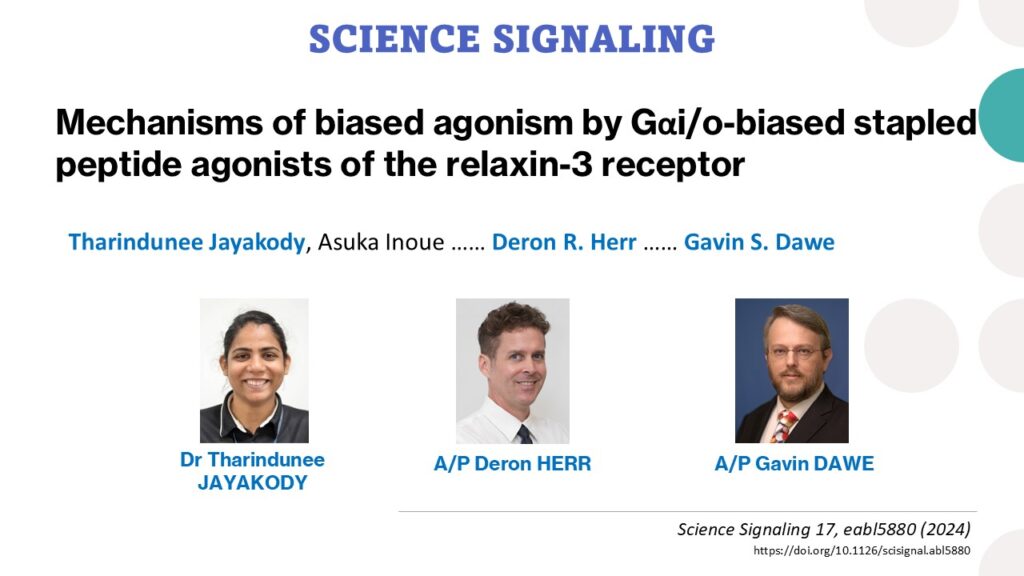
Mechanisms of biased agonism by Gαi/o-biased stapled peptide agonists of the relaxin-3 receptor


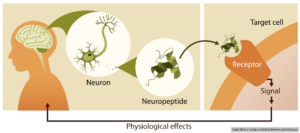
The neuropeptide relaxin-3 is composed of an A chain and a B chain held together by disulfide bonds, and it modu- lates functions such as anxiety and food intake by binding to and activating its cognate receptor RXFP3, mainly through the B chain. Biased ligands of RXFP3 would help to determine the molecular mechanisms underlying the

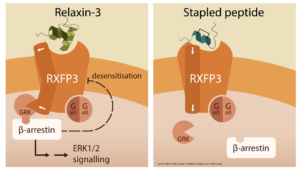
activation of G proteins and β-arrestins downstream of RXFP3 that lead to such diverse functions. We showed that the i, i+4 stapled relaxin-3 B chains, 14s18 and d(1-7)14s18, were Gαi/o-biased agonists of RXFP3. These peptides did not induce recruitment of β-arrestin1/2 to RXFP3 by GPCR kinases (GRKs), in contrast to relaxin-3, which enabled the GRK2/3-mediated recruitment of β-arrestin1/2 to RXFP3. Relaxin-3 and the previously reported peptide 4 (an i, i+4 stapled relaxin-3 B chain) did not exhibit biased signaling. The staple linker of peptide 4 and parts of both the A chain and B chain of relaxin-3 interacted with extracellular loop 3 (ECL3) of RXFP3, moving it away from the

binding pocket, suggesting that unbiased ligands promote a more open conformation of RXFP3. These findings highlight roles for the A chain and the N-terminal residues of the B chain of relaxin-3 in inducing conformational changes in RXFP3, which will help in designing selective biased ligands with improved therapeutic efficacy.

Image credit: Office of the Deputy President (Research and Technology)

Full article:https://doi.org/10.1126/scisignal.abl5880

Mechanisms of biased agonism by Gαi/o-biased stapled peptide agonists of the relaxin-3 receptor Read More »

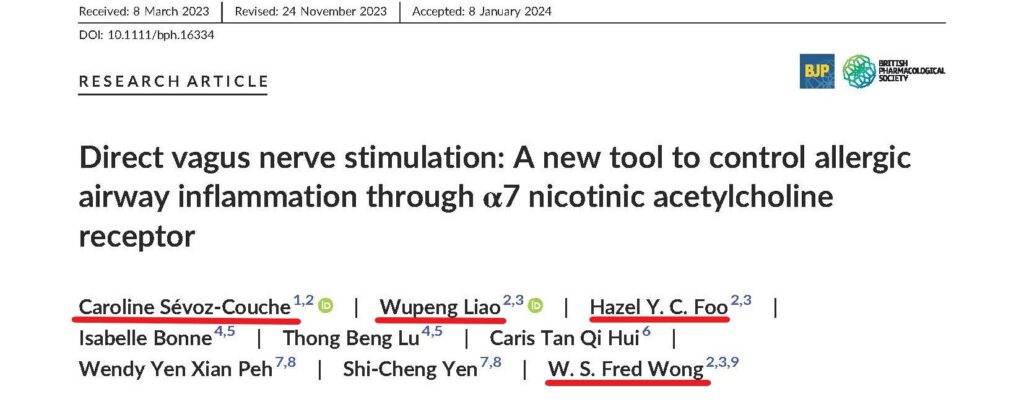
Direct vagus nerve stimulation: A new tool to control allergic airway inflammation through α7 nicotinic acetylcholine receptor

Direct vagus nerve stimulation: A new tool to control allergic airway inflammation through α7 nicotinic acetylcholine receptor
Caroline Sévoz-Couche, Wupeng Liao, Hazel Y. C. Foo, Isabelle Bonne, Thong Beng Lu, Caris Tan Qi Hui, Wendy Yen Xian Peh, Shi-Cheng Yen, W. S. Fred Wong

Background and Purpose: Asthma is characterized by airway inflammation, mucus hypersecretion, and airway hyperresponsiveness. The use of nicotinic agents to mimic the cholinergic anti-inflammatory pathway (CAP) controls experimental asthma. Yet, the effects of vagus nerve stimulation (VNS)-induced CAP on allergic inflammation remain unknown.

Experimental Approach: BALB/c mice were sensitized and challenged with house dust mite (HDM) extract and treated with active VNS (5 Hz, 0.5 ms, 0.05–1 mA). Bronchoalveolar lavage (BAL) fluid was assessed for total and differential cell counts and cytokine levels. Lungs were examined by histopathology and electron microscopy.

Key Results: In the HDM mouse asthma model, VNS at intensities equal to or above 0.1 mA (VNS 0.1) but not sham VNS reduced BAL fluid differential cell counts and alveolar macrophages expressing α7 nicotinic receptors (α7nAChR), goblet cell hyperplasia, and collagen deposition. Besides, VNS 0.1 also abated HDM-induced elevation of type 2 cytokines IL-4 and IL-5 and was found to block the phosphorylation of transcription factor STAT6 and expression level of IRF4 in total lung lysates. Finally, VNS 0.1 abrogated methacholine-induced hyperresponsiveness in asthma mice. Prior administration of α-bungarotoxin, a specific inhibitor of α7nAChR, but not propranolol, a specific inhibitor of β2-adrenoceptors, abolished the therapeutic effects of
VNS 0.1.

Conclusion and Implications: Our data revealed the protective effects of VNS on various clinical features in allergic airway inflammation model. VNS, a clinically approved therapy for depression and epilepsy, appears to be a promising new strategy for controlling allergic asthma.

Direct vagus nerve stimulation: A new tool to control allergic airway inflammation through α7 nicotinic acetylcholine receptor Read More »

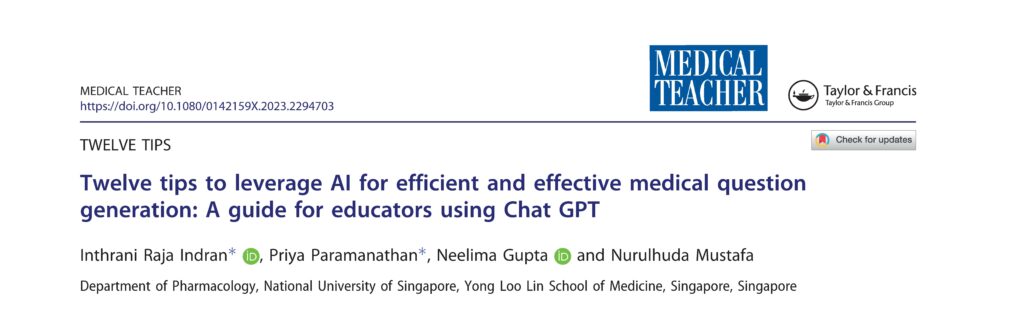
Twelve tips to leverage AI for efficient and effective medical question generation: A guide for educators using Chat GPT

Twelve tips to leverage AI for efficient and effective medical question generation: A guide for educators using Chat GPT

Inthrani Raja Indran , Priya Paramanathan, Neelima Gupta and Nurulhuda Mustafa

Department of Pharmacology, National University of Singapore, Yong Loo Lin School of Medicine, Singapore, Singapore

Abstract

Background: Crafting quality assessment questions in medical education is a crucial yet time-consuming, expertise-driven undertaking that calls for innovative solutions. Large language models (LLMs), such as ChatGPT (Chat Generative Pre-Trained Transformer), present a promising yet underexplored avenue for such innovations.

Aims: This study explores the utility of ChatGPT to generate diverse, high-quality medical questions, focusing on multiple-choice questions (MCQs) as an illustrative example, to increase educator’s productivity and enable self-directed learning for students.

Description: Leveraging 12 strategies, we demonstrate how ChatGPT can be effectively used to generate assessment questions aligned with Bloom’s taxonomy and core knowledge domains while promoting best practices in assessment design.

Conclusion: Integrating LLM tools like ChatGPT into generating medical assessment questions like MCQs augments but does not replace human expertise. With continual instruction refinement, AI can produce high-standard questions. Yet, the onus of ensuring ultimate quality and accuracy remains with subject matter experts, affirming the irreplaceable value of human involvement in the artificial intelligence-driven education paradigm.

MEDICAL TEACHER
https://doi.org/10.1080/0142159X.2023.2294703

Twelve tips to leverage AI for efficient and effective medical question generation: A guide for educators using Chat GPT Read More »

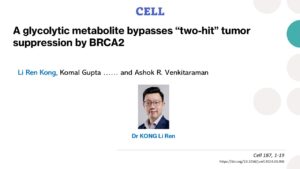
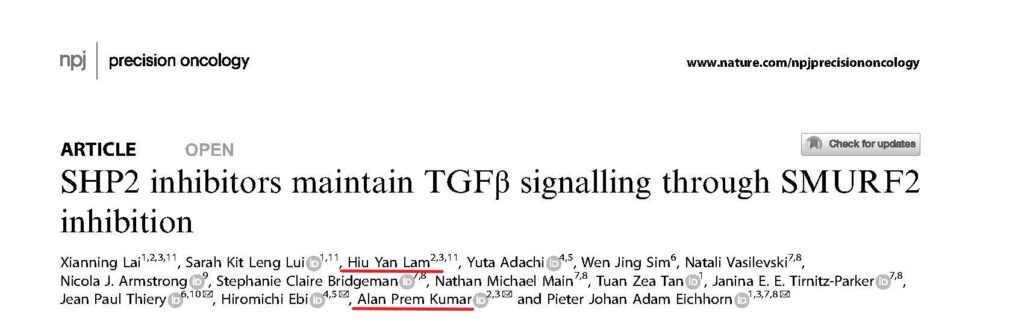
SHP2 inhibitors maintain TGFβ signalling through SMURF2 inhibition

SHP2 inhibitors maintain TGFβ signalling through SMURF2 inhibition

Xianning Lai, Sarah Kit Leng Lui, Hiu Yan Lam, Yuta Adachi, Wen Jing Sim, Natali Vasilevski, Nicola J. Armstrong, Stephanie Claire Bridgeman,

Nathan Michael Main, Tuan Zea Tan, Janina E. E. Tirnitz-Parker, Jean Paul Thiery, Hiromichi Ebi, Alan Prem Kumar, and Pieter Johan Adam Eichhorn

Abstract

Despite the promising antitumor activity of SHP2 inhibitors in RAS-dependent tumours, overall responses have been limited by
their narrow therapeutic window. Like with all MAPK pathway inhibitors, this is likely the result of compensatory pathway activation
mechanisms. However, the underlying mechanisms of resistance to SHP2 inhibition remain unknown. The E3 ligase SMURF2 limits
TGFβ activity by ubiquitinating and targeting the TGFβ receptor for proteosome degradation. Using a functional RNAi screen
targeting all known phosphatases, we identify that the tyrosine phosphatase SHP2 is a critical regulator of TGFβ activity. Specifically,
SHP2 dephosphorylates two key residues on SMURF2, resulting in activation of the enzyme. Conversely, SHP2 depletion maintains
SMURF2 in an inactive state, resulting in the maintenance of TGFβ activity. Furthermore, we demonstrate that depleting SHP2 has
significant implications on TGFβ-mediated migration, senescence, and cell survival. These effects can be overcome through the use
of TGFβ-targeted therapies. Consequently, our findings provide a rationale for combining SHP2 and TGFβ inhibitors to enhance
tumour responses leading to improved patient outcomes.


npj Precision Oncology (2023)7:136 ; https://doi.org/10.1038/s41698-023-00486-6

SHP2 inhibitors maintain TGFβ signalling through SMURF2 inhibition Read More »

Isthmin-1 attenuates allergic Asthma by stimulating adiponectin expression and alveolar macrophage efferocytosis in mice

Isthmin-1 attenuates allergic Asthma by stimulating adiponectin expression and alveolar macrophage efferocytosis in mice

Jong Huat Tee, Udhaya Vijayakumar, Mahalakshmi Shanmugasundaram, Terence Y. W. Lam, Wupeng Liao, Yuansheng Yang, W. S. Fred Wong* and Ruowen Ge*

Abstract
Background Allergic asthma is a common respiratory disease that significantly impacts human health. Through in silico analysis of human lung RNASeq, we found that asthmatic lungs display lower levels of Isthmin-1 (ISM1) expression than healthy lungs. ISM1 is an endogenous anti-inflammatory protein that is highly expressed in mouse lungs and bronchial epithelial cells, playing a crucial role in maintaining lung homeostasis. However, how ISM1 influences asthma remains unclear. This study aims to investigate the potential involvement of ISM1 in allergic airway inflammation and uncover the underlying mechanisms.

Methods  We investigated the pivotal role of ISM1 in airway inflammation using an ISM1 knockout mouse line (ISM1−/−) and challenged them with house dust mite (HDM) extract to induce allergic-like airway/lung inflammation. To examine the impact of ISM1 deficiency, we analyzed the infiltration of immune cells into the lungs and cytokine levels in bronchoalveolar lavage fluid (BALF) using flow cytometry and multiplex ELISA, respectively. Furthermore, we examined the therapeutic potential of ISM1 by administering recombinant ISM1 (rISM1) via the intratracheal route to rescue the effects of ISM1 reduction in HDM-challenged mice. RNA-Seq, western blot, and fluorescence microscopy techniques were subsequently used to elucidate the underlying mechanisms.

Results  ISM1−/− mice showed a pronounced worsening of allergic airway inflammation and hyperresponsiveness upon HDM challenge. The heightened inflammation in ISM1−/− mice correlated with enhanced lung cell necroptosis, as indicated by higher pMLKL expression. Intratracheal delivery of rISM1 significantly reduced the number of eosinophils in BALF and goblet cell hyperplasia. Mechanistically, ISM1 stimulates adiponectin secretion by type 2 alveolar epithelial cells partially through the GRP78 receptor and enhances adiponectin-facilitated apoptotic cell clearance via alveolar macrophage efferocytosis. Reduced adiponectin expression under ISM1 deficiency also contributed to intensified necroptosis, prolonged inflammation, and heightened severity of airway hyperresponsiveness.

Conclusions  This study revealed for the first time that ISM1 functions to restrain airway hyperresponsiveness to HDM-triggered allergic-like airway/lung inflammation in mice, consistent with its persistent downregulation in human asthma. Direct administration of rISM1 into the airway alleviates airway inflammation and promotes immune cell clearance, likely by stimulating airway adiponectin production. These findings suggest that ISM1 has therapeutic potential for allergic asthma.

Isthmin-1 attenuates allergic Asthma by stimulating adiponectin expression and alveolar macrophage efferocytosis in mice Read More »

Multifunctional Antibacterial Nanonets Attenuate Inflammatory Responses through Selective Trapping of Endotoxins and Pro-Inflammatory Cytokines

Multifunctional Antibacterial Nanonets Attenuate Inflammatory Responses through Selective Trapping of
Endotoxins and Pro-Inflammatory Cytokines

Nhan Dai Thien Tram, Quy Thi Ngoc Tran, Jian Xu, Jeannie Ching Ting Su, Wupeng Liao, Wai Shiu Fred Wong, and Pui Lai Rachel Ee*

Extracellular lipopolysaccharide (LPS) released from bacteria cells can enter the bloodstream and cause septic complications with excessive host inflammatory responses. Target-specific strategies to inactivate inflammation mediators have largely failed to improve the prognosis of septic patients in clinical trials. By utilizing their high density of positive charges, de novo
designed peptide nanonets are shown to selectively entrap the negatively charged LPS and pro-inflammatory cytokines tumor necrosis factor-? (TNF-?) and interleukin-6 (IL-6). This in turn enables the nanonets to suppress LPS-induced cytokine production by murine macrophage cell line and rescue the antimicrobial activity of the last-resort antibiotic, colistin, from LPS
binding. Using an acute lung injury model in mice, it is demonstrated that intratracheal administration of the fibrillating peptides is effective at lowering local release of TNF-? and IL-6. Together with previously shown ability to simultaneously trap and kill pathogenic bacteria, the peptide nanonets display remarkable potential as a holistic, multifunctional anti-infective, and
anti-septic biomaterial.

Multifunctional Antibacterial Nanonets Attenuate Inflammatory Responses through Selective Trapping of Endotoxins and Pro-Inflammatory Cytokines Read More »

Degradation of MK2 with natural compound andrographolide: A new modality for anti-inflammatory therapy

Degradation of MK2 with natural compound andrographolide: A new modality for anti-inflammatory therapy

Quy T.N. Tran a,b,c,1, Phyllis X.L. Gan a,2, Wupeng Liao a,d,3, Yu Keung Mok e,4, Christina L.L. Chai b,c,*,5, W.S. Fred Wong

a Department of Pharmacology, Yong Loo Lin School of Medicine, National University Health System, 117600, Singapore
b Department of Pharmacy, Faculty of Science, National University of Singapore, 117543, Singapore
c Drug Discovery and Optimization Platform (DDOP), Yong Loo Lin School of Medicine, National University Health System, 117600, Singapore
d Singapore-HUJ Alliance for Research and Enterprise (SHARE), National University of Singapore, Singapore
e Department of Biological Sciences, Faculty of Science, National University of Singapore, 117543, Singapore

A B S T R A C T

The p38MAPK-MK2 signaling axis functions as an initiator of inflammation. Targeting the p38MAPK-MK2 signaling axis represents a direct therapeutic intervention of inflammatory diseases. We described here a novel role of andrographolide (AG), a small-molecule ent-labdane natural compound, as an inhibitor of p38MAPK-MK2 axis via MK2 degradation. AG was found to bind to the activation loop of MK2, located at the interface of the p38MAPKMK2 biomolecular complex. This interaction disrupted the complex formation and predisposed MK2 to proteasome-mediated degradation. We showed that AG induced MK2 degradation in a concentration- and timedependent manner and exerted its anti-inflammatory effects by enhancing the mRNA-destabilizing activity of tristetraprolin, thereby inhibiting pro-inflammatory mediator production (e.g., TNF-α, MCP-1). Administration of AG via intratracheal (i.t.) route to mice induced MK2 downregulation in lung alveolar macrophages, but not lung tissues, and prevented macrophage activation. Our study also demonstrated that the anti-inflammatory effects achieved by AG via MK2 degradation were more durable and sustained than that achieved by the conventional MK2 kinase inhibitors (e.g., PF-3644022). Taken together, our findings illustrated a novel mode of action of AG by modulating the p38MAPK-MK2 signaling axis and would pave the way for the development of a novel class of anti-inflammatory agents targeting MK2 for degradation by harnessing the privileged scaffold of AG.

Degradation of MK2 with natural compound andrographolide: A new modality for anti-inflammatory therapy Read More »

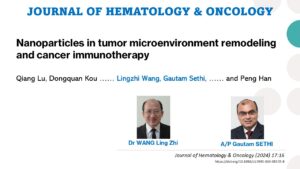
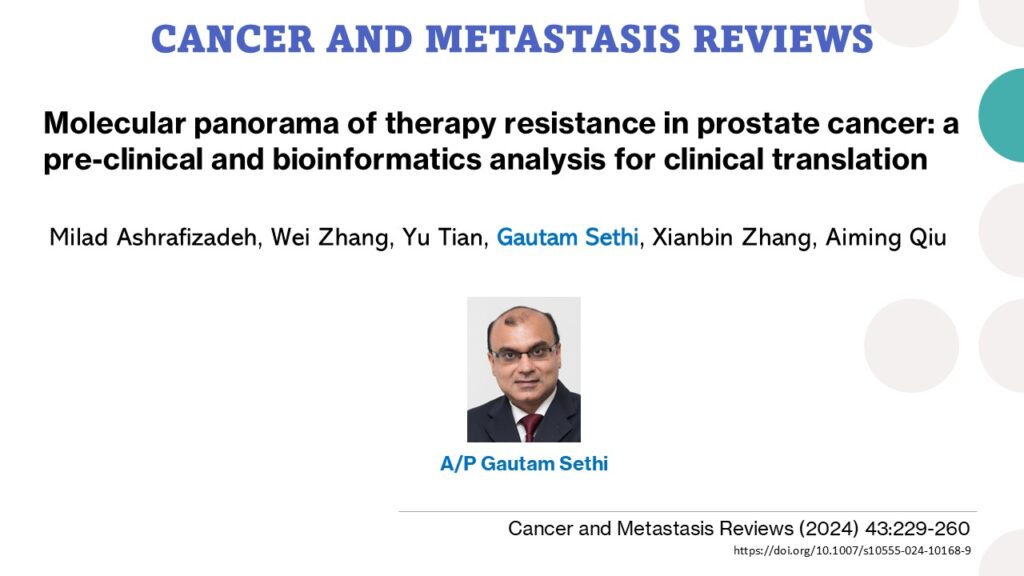
PI3K/AKT/mTOR signaling transduction pathway and targeted therapies in cancer

PI3K/AKT/mTOR signaling transduction pathway and targeted therapies in cancer

Antonino Glaviano1, Aaron S. C. Foo2, Hiu Y. Lam3,4, Kenneth C. H. Yap3,4, William Jacot5, Robert H. Jones6,
Huiyan Eng2,3, Madhumathy G. Nair7, Pooyan Makvandi8, Birgit Geoerger9, Matthew H. Kulke10,
Richard D. Baird11, Jyothi S. Prabhu7, Daniela Carbone1, Camilla Pecoraro1, Daniel B. L. Teh12, Gautam Sethi2,3,
Vincenzo Cavalieri1, Kevin H. Lin13, Nathalie R. Javidi‑Sharifi13, Eneda Toska14, Matthew S. Davids13,
Jennifer R. Brown13, Patrizia Diana1, Justin Stebbing15, David A. Fruman16 and Alan P. Kumar2,3*

Abstract

The PI3K/AKT/mTOR (PAM) signaling pathway is a highly conserved signal transduction network in eukaryotic cells that promotes
cell survival, cell growth, and cell cycle progression. Growth factor signalling to transcription factors in the PAM axis
is highly regulated by multiple cross-interactions with several other signaling pathways, and dysregulation of signal transduction
can predispose to cancer development. The PAM axis is the most frequently activated signaling pathway in human
cancer and is often implicated in resistance to anticancer therapies. Dysfunction of components of this pathway such
as hyperactivity of PI3K, loss of function of PTEN, and gain-of-function of AKT, are notorious drivers of treatment resistance
and disease progression in cancer. In this review we highlight the major dysregulations in the PAM signaling pathway in cancer,
and discuss the results of PI3K, AKT and mTOR inhibitors as monotherapy and in co-administation with other antineoplastic
agents in clinical trials as a strategy for overcoming treatment resistance. Finally, the major mechanisms of resistance
to PAM signaling targeted therapies, including PAM signaling in immunology and immunotherapies are also discussed.

PI3K/AKT/mTOR signaling transduction pathway and targeted therapies in cancer Read More »

Endocytosis of red blood cell extracellular vesicles by macrophages leads to cytoplasmic heme release and prevents foam cell formation in atherosclerosis

Thach Tuan Pham, Anh Hong Le, Cong Phi Dang, Suet Yen Chong, Dang Vinh Do, Boya Peng,

Migara Kavishka Jayasinghe, Hong Boon Ong, Dong Van Hoang, Roma Anne Louise, Yuin-Han Loh,

HanWei Hou, Jiong-WeiWang, Minh TN Le

Abstract

Extracellular vesicles (EVs) can be produced from red blood cells (RBCs) on a large
scale and used to deliver therapeutic payloads efficiently. However, not much is
known about the native biological properties of RBCEVs. Here, we demonstrate that
RBCEVs are primarily taken up by macrophages and monocytes. This uptake is an
active process, mediated mainly by endocytosis. Incubation of CD14+ monocytes
with RBCEVs induces their differentiation into macrophages with an Mheme-like
phenotype, characterized by upregulation of heme oxygenase-1 (HO-1) and the ATPbinding
cassette transporter ABCG1. Moreover, macrophages that take up RBCEVs
exhibit a reduction in surface CD86 and decreased secretion of TNF-α under inflammatory
stimulation. The upregulation of HO-1 is attributed to heme derived from
haemoglobin in RBCEVs. Heme is released from internalized RBCEVs in late endosomes
and lysosomes via the heme transporter, HRG1. Consequently, RBCEVs
exhibit the ability to attenuate foamcell formation fromoxidized low-density lipoproteins
(oxLDL)-treated macrophages in vitro and reduce atherosclerotic lesions in
ApoE knockout mice on a high-fat diet. In summary, our study reveals the uptake
mechanism of RBCEVs and their delivery of heme to macrophages, suggesting the
potential application of RBCEVs in the treatment of atherosclerosis.

Endocytosis of red blood cell extracellular vesicles by macrophages leads to cytoplasmic heme release and prevents foam cell formation in atherosclerosis Read More »

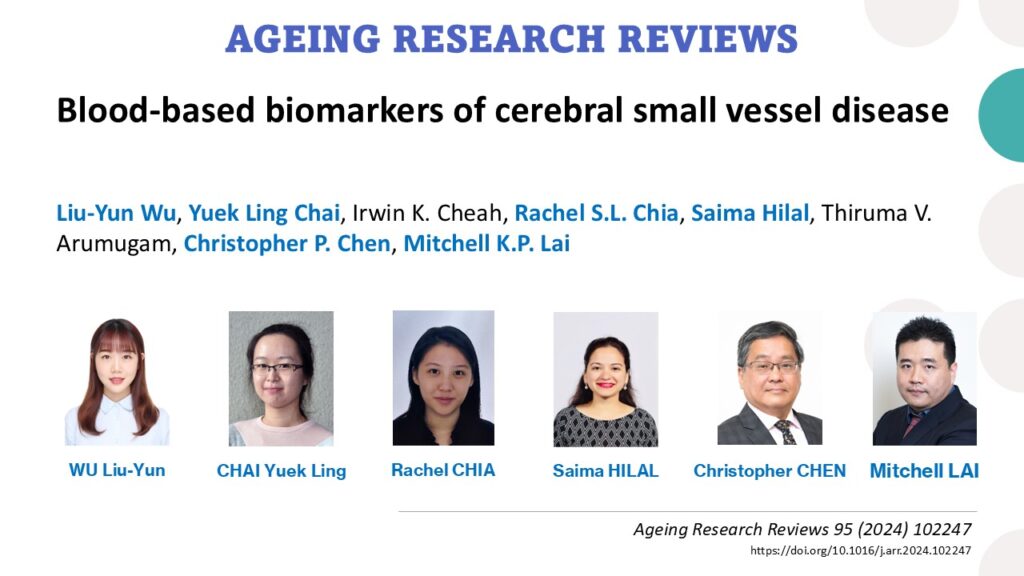
Associations of Blood Cardiovascular Biomarkers With Brain Free Water and Its Relationship to Cognitive Decline

Fang Ji, PhD, Yuek Ling Chai, PhD, Siwei Liu, PhD, Cheuk Ni Kan, MSc, Marcus Ong, BSc,
Arthur Mark Richards, MD, Boon Yeow Tan, MMed, Narayanaswamy Venketasubramanian, FRCP,
Ofer Pasternak, PhD, Christopher Chen, MD, Mitchell K.P. Lai, PhD,* and Juan Helen Zhou, PhD*

Abstract

Background and Objectives: There is an increasing awareness of the “Heart-Brain Connection,” whereby cardiovascular function is connected with cognition. Diffusion-MRI studies reported higher brain free water (FW) was associated with cerebrovascular disease (CeVD) and cognitive impairment. In this study, we investigated whether higher brain FW was related to blood cardiovascular biomarkers and whether FW mediated the associations between blood biomarkers and cognition.

Methods: Participants recruited from 2 Singapore memory clinics between 2010 and 2015 underwent collection of blood samples and neuroimaging at baseline and longitudinal neuropsychological assessments up to 5 years. We examined the associations of blood cardiovascular biomarkers (high-sensitivity cardiac troponin-T [hs-cTnT], N-terminal pro-hormone B-type natriuretic peptide [NT-proBNP], and growth/differentiation factor 15 [GDF-15]) with brain white matter (WM) and cortical gray matter (GM) FWderived from diffusion MRI using whole brain voxel-wise general linear regression. We then assessed the relationships among baseline blood biomarkers, brain FW, and cognitive decline using path models.

Results: A total of 308 older adults (76 with no cognitive impairment, 134 with cognitive impairment no dementia, and 98 with Alzheimer disease dementia and vascular dementia; mean [SD] age: 72.1 [8.3]) were included. We found that blood cardiovascular biomarkers were associated with higher FW in widespreadWMregions and in specific GM networks including the default mode, executive control, and somatomotor networks at baseline (p < 0.01, family-wise error corrected). Baseline FW in widespread WM and network-specific GM fully mediated the associations of blood biomarkers with longitudinal cognitive decline over 5 years. Specifically, in GM, higher FW in the default mode network mediated the relationship with memory decline (hs-cTnT: β = −0.115, SE = 0.034, p = 0.001; NT-proBNP: β = −0.154, SE = 0.046, p = 0.001; GDF-15: β = −0.073, SE = 0.027, p = 0.006); by contrast, higher FW in the executive control network was responsible for executive function decline (hs-cTnT: β = −0.126, SE = 0.039, p = 0.001; NT-proBNP: β = −0.110, SE = 0.038, p = 0.004; GDF-15: β = −0.117, SE = 0.035, p = 0.001). Similar full mediation effects of brain FW were also identified for baseline cognition.

Discussion: Results suggested a role of brain FW in linking cardiovascular dysfunction to cognitive decline. These findings provide new evidence for brain-heart interactions, paving the way for prediction and monitoring of domain-specific cognitive trajectory.

Associations of Blood Cardiovascular Biomarkers With Brain Free Water and Its Relationship to Cognitive Decline Read More »

Scroll to Top