
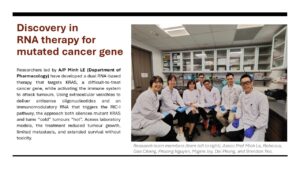
Two complementary studies led by researchers from the Yong Loo Lin School of Medicine, National University of Singapore (NUS Medicine), have demonstrated a new RNA-based therapeutic strategy that effectively targets one of the most difficult-to-treat cancer genes, Kirsten rat sarcoma viral oncogene homolog (KRAS), while stimulating the body’s immune response to fight tumours. The research was conducted in cell samples and laboratory models, with collaborators from the NUS Institute for Health Innovation and Technology (iHealthtech), Nanyang Technological University (NTU), Agency for Science, Technology and Research (A*STAR), and international partners.
KRAS is a gene that acts like a molecular switch controlling how cells grow and divide. In healthy cells, this switch turns on and off as needed. However, in many cancers, including pancreatic, lung, and colorectal cancers, the KRAS gene becomes mutated, locking the switch in the “on” position. This constant activation drives uncontrolled cell growth and helps tumours evade normal immune defences. Mutations in KRAS are among the most common drivers of human cancers and are found in over 90% of pancreatic cancers. As the KRAS protein binds tightly to its signalling molecules and lacks easy-to-target binding sites, it has long been considered “undruggable” — making it one of the toughest and most important targets in cancer research.
The research team developed a combination therapy using antisense oligonucleotides (ASOs) to silence mutant KRAS genes and an immunomodulatory RNA (immRNA) that activates the Retinoic acid-Inducible Gene I (RIG-I) immune pathway. The RIG-I pathway is akin to an alarm system in our cells, where it detects viruses and then alerts our immune system to deal with
the threat. Both the ASOs and immRNA molecules were delivered safely using red blood cell-derived extracellular vesicles (RBCEVs), a natural, biocompatible carrier for nucleic acid drugs.
For more details: https://medicine.nus.edu.sg/wp-content/uploads/2025/11/2025-11-17-Press-release-Discovery-in-RNA-therapy-for-mutated-cancer-gene-UCO.pdf


