
In a study that holds significance for individuals with cerebrovascular disease, scientists from the Yong Loo Lin School of Medicine, National University of Singapore (NUS Medicine), have found proteins in the blood that predict future cognitive decline and dementia. The study is the first of its kind in Singapore and involved detailed proteomic profiling of local patients. The findings point to a powerful new method for early diagnosis through blood-based biomarkers combined with clinical assessments.
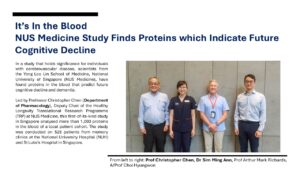
Led by Professor Christopher Chen, Deputy Chair of the Healthy Longevity Translational Research Programme (TRP) at NUS Medicine, this first-of-its-kind study in Singapore analysed more than 1,000 proteins in the blood of a local patient cohort. The study was conducted on 528 patients from memory clinics at the National University Hospital (NUH) and St Luke’s Hospital in Singapore.
The team found that people with dysregulated levels of these proteins were more likely to develop future dementia and cognitive deterioration, even after accounting for age and other health conditions. These proteins are also linked to changes in brain structure, such as shrinkage in brain volume and signs of small vessel disease—early warning signs of dementia. When these biomarkers were combined with clinical risk factors, prognosis of cognitive decline was significantly enhanced, highlighting the potential of integrating blood-based tests with routine clinical assessments for earlier and more accurate diagnosis. The team further validated these findings in a separate group of patients of Caucasian descent, using cerebrospinal fluid—which refers to fluid that surrounds the brain and spinal cord. The replicated protein markers remained strong predictors of cognitive decline, suggesting these biomarkers may be reliable across different biological fluids and diverse populations.
Prof Chen said, “The objective of our research was to identify better ways to detect and predict dementia, especially in Southeast Asian populations, who may present with unique risk profiles due to higher rates of co-existing conditions such as cerebrovascular disease.” Prof Chen is also from the Department of Pharmacology at NUS Medicine, and is the Director of the Memory, Ageing and Cognition Centre at the National University Health System (NUHS).
For more details: https://medicine.nus.edu.sg/newsletters/issue56/science-of-life/its-in-the-blood-nus-medicine-study-finds-proteins-which-indicate-future-cognitive-decline/


