

MSc in Biomedical Informatics (Coursework)
Overview
The Master of Science in Biomedical Informatics (MSc in BMI) is offered by the Yong Loo Lin School of Medicine (NUSMed) as a full time (1 year) or part-time (2 years) postgraduate degree programme by Coursework with specialisation in Analytics or Hospital Management.
The programme aims to impart to students a suite of core skills including evidence-based clinical decision making, machine learning, data visualisation, effective communication, strategic leadership, and entrepreneurship. Students would be trained to reason, critically analyse, and subsequently evaluate the effectiveness of clinical decision support systems, lead and implement production and strategic clinical innovations or projects.

Duration
1 year (full-time) / 2 years (part-time)

Next Intake
August 2027
Application Period
1 October 2026 - 2 February 2027
The MSc in Biomedical Informatics programme is a 1 year, full-time or 2 years part-time 40 units degree with 2 specialisations in Analytics or Hospital Management.
ANALYTICS SPECIALISATION:
Students will be trained to reason, critically analyse, and subsequently evaluate the effectiveness of clinical decision support systems, as well as to lead and implement strategic clinical innovations or projects.
HOSPITAL MANAGEMENT SPECIALISATION:
Aimed at training students in various aspects of hospital work, such as implementation of public health policies, evidence-based patient care and clinical decision support systems.
Programme Requirements
Core/Essential Courses (20 Units)
The core curriculum comprises five compulsory courses (totaling 20 Units), including a Capstone Project.
Students are required to:
- Complete 5 courses from the Core Course list (20 Units) and;
- Choose and complete 5 courses from the Elective Course list for each specialisation (20 Units)
| S/N | Course Title | Course code | Units |
| 1 | Advanced Biomedical Informatics | BMI5101 | 4 |
| 2 | Capstone Project | BMI5111 | 4 |
| 3 | Medical Data and Data Processing | BMI5207 | 4 |
| 4 | Advanced Agile Project Management | BMI5306 | 4 |
| 5 | Software Development Fundamentals | IT5001X | 4 |
Elective Courses
Students must choose a specialisation (either Analytics or Hospital Management) and complete five courses (20 Units) from the list of electives offered for that specialisation.
Analytics Specialisation
| S/N | Course Title | Course code | Units |
| 1 |
Health Sciences for Non-Clinicians *Not for clinicians |
BMI5102 | 4 |
| 2 | Advanced Scientific Research Methods | BMI5109 | 4 |
| 3 | Molecular Informatics | BMI5110 | 4 |
| 4 | Advanced Human Factors Engineering | BMI5206 | 4 |
| 5 | Data Structures and Algorithms | IT5003 | 4 |
| 6 | Artificial Intelligence | IT5005 | 4 |
| 7 | Fundamentals of Data Analytics | IT5006 | 4 |
| 8 | Advanced Statistical Learning | SPH6004 |
4 |
| 9 |
Advanced Statistical Methods for Bioinformatics *Not available in AY 25/26 Semester 2 |
MDG5241 |
4 |
Hospital Management Specialisation
|
S/N |
Course Title |
Course Code |
Units |
|
1 |
Health Sciences for Non-Clinicians *Not for clinicians |
BMI5102 |
4 |
|
2 |
Clinical Decision Support Systems |
BMI5106 |
4 |
|
3 |
Advanced Evidence Based Patient Care |
BMI5107 |
4 |
|
4 |
Advanced Value Based Healthcare |
BMI5108 |
4 |
|
5 |
Advanced Scientific Research Methods |
BMI5109 |
4 |
|
6 |
Advanced Clinical Data Systems |
BMI5201 |
4 |
|
7 |
Ethics of Health Data and Artificial Intelligence |
MDG5248 |
4 |
|
8 |
Artificial Intelligence |
IT5005 |
4 |
|
9 |
Fundamentals of Data Analytics |
IT5006 |
4 |
|
10 |
Implementing Public Health Programmes and Policies |
SPH5007 |
4 |
|
11 |
Economic Methods in Health Technology Assessment |
SPH5412 |
4 |
|
12 |
Health Behaviour and Communication |
SPH5003 * From AY23/24 |
4 |
|
13 |
Introduction to Integrated Care *Not available (until further notice) |
SPH5416 |
4 |
|
14 |
Health Economics and Financing |
SPH5401 |
4 |
|
15 |
Advanced Statistical Learning |
SPH6004 |
4 |
|
16 |
Digital Agility & Change Leadership |
DL5102 |
4 |
|
17 |
Strategic Thinking & Digital Foresight |
DL5201 |
4 |
|
18 |
Managing Digitalisation Complexity |
DL5302 |
4 |
- Not all the courses are offered in the same semester or in the same format every year. Students are responsible in ensuring that they do not register for courses with any timetable clashes, and are able to attend classes and sit for examinations as scheduled.
- Students may refer to NUSMODS for the course timetable and exam time.
-
Programme Duration
- Full-time students are expected to complete the programme within 12 - 24 months. The maximum candidature is 24 months; excluding Leave of Absence (LOA).
- Part-time students are expected to complete the programme within 24 - 48 months. The maximum candidature is 48 months; excluding Leave of Absence (LOA).
Applicants must fulfill the following admission requirements. Please note that meeting the minimum requirements does not imply automatic admission into the MSc in Biomedical Informatics programme.
- Fresh graduates with M.B.,B.S. degree, Bachelor (Hons) degrees in Quantitative Sciences (e.g. Mathematics, Applied Mathematics, Statistics and Physics) or Engineering or Computer Science or Business or Health Sciences related discipline.
- Candidates with other qualifications and experience may be considered on a case-by-case basis.
- Candidates should submit a Statement of Purpose of not more than 2,000 characters (about 300 words) and upload it as a document in Word or PDF format. The statement should showcase your academic strength, research interests, motivation to study and long-term development goals.
- Candidates should submit a Curriculum Vitae (CV) which provides an overview of your relevant experience, skills and qualifications and accomplishments.
- Admission is on a competitive basis and candidates with relevant industry experience will be considered favourably.
- International applicants* are to submit TOEFL or IELTS test scores as evidence which demonstrates their language ability and readiness for graduate study.
- The TOEFL/IELTS scores must be valid for two (2) years from the test date and should not have expired at the point of application. Expired scores will not be considered for the application.
*International applicants who graduated from universities where English is not the main medium of communication are required to demonstrate their English proficiency by possessing a minimum TOEFL (Test of English as a Foreign Language) score of 85 (Internet-based) or a minimum IELTS (International English Language Testing System) Academic score of 6.0.
- Students have to register courses on the ModReg@EduRec system.
- Students will bear the consequences of their decisions in adding/dropping courses, which may result in a delay in their graduation if not planned properly.
- Not all courses are offered in the same semester or in the same format every year.
- A full-time student may read up to five courses per regular semester (not including essential courses pre-designated by the programme). Part time student may read up to 2 courses per semester.
- Students are responsible in ensuring that they do not register for courses with any timetable clashes, and are able to attend classes and sit for examinations as scheduled. Course timetable can be found here.
The University has not engaged any external agencies to undertake graduate student recruitment on its behalf. Candidates interested in our graduate programmes are advised to apply directly to the University and not through any agents. Candidates who apply through agents will not have any added advantage in gaining admission and the University reserves the right to reject such applications without providing a reason.
The AY2026/27 tuition fees for newly admitted students to the Master of Science in Biomedical Informatics by Coursework programme are as follows.
| Nationality | Full-Time / Part-Time |
| Singapore Citizens/Singapore Permanent Residents/International students | S$68,538 (inclusive of prevailing GST) |
- All Singaporeans and Singapore PR (Non-alumni) will receive a 10% tuition fee rebate.
- All NUS alumni will receive a 20% tuition fee rebate
- Tuition fees may be offset using SkillsFuture Credit, please check SSG portal for more information.
- National Medical Research Council (NMRC) grant applicable, subjected to approval.
Refer here for 2026/27 payment schedule.
Refer here for 2025/26 payment schedule.
Refer here for FAQ on fee rebate.
*Acceptance fee is non-refundable.
Student Fees
Please click here for more information regarding payment of tuition fees.
Miscellaneous fees is compulsory and payable every semester, for which information can be found here.
Company Sponsorship
Students who are company sponsored, please perform the steps below to have your sponsorship updated in EduRec:
- Complete the attached corporate sponsorship form.
- Have it signed off and stamped by an authorized personnel in the company.
- Student to scan a copy of the completed form and submit the form at OFN NUService Hub (FSS Student Finance > Bill Corporate Sponsor). For companies submitting the form directly, please email the completed form to ofnbox3@nus.edu.sg.
Please note:
- Billing to your company will take place in Sep/Oct for Semester 1 fees and Feb/Mar for Semester 2 fees.
- If the miscellaneous fees are not covered by your company, the student has to pay the miscellaneous fees by the payment due dates.
Refer to the SFC application guide here: https://www.nus.edu.sg/finance/students/student-finance-matters.html
Graduation Requirement
- Read and pass five core courses and five elective courses that are in the course list.
- Obtained a minimum Grade Point Average (GPA) of 3.0 out of 5.0 or, equivalently, an average grade of at least B-.
Graduation Matters
Continuation Requirement
For continuation of candidature a student must obtain satisfactory progress during his/her candidature (Coursework), i.e.,
- Student will be issued a warning for any semester in which his/her GPA falls below 3.00. If in the following semester, the student’s GPA again falls below 3.00 but is above 2.50, he/she will be placed on probation.
- Student’s candidature may be terminated and refused re-admission if he/she obtains
- GPA < 1.5 in the first semester of study; or
- GPA < 2.50 for two consecutive semesters of study; or
- GPA < 3.00 for three consecutive semesters of study
- GPA for continuation is computed based on all modules read, be it pass or fail.

Hear From Our Students
A graduate of the Master of Science in Biomedical Informatics programme, Dr Ng Ruimin shares his motivations in pursuing an area of study outside the traditional medical field, and elaborates on how this degree has been beneficial in building his interest towards healthtech, leveraging medical data to innovate and solve real-world problems.
[Article Credit: Academic Programmes Business Unit (APB), SCALE]
 "The MSc in Biomedical Informatics has given me structured training in healthcare data, systems, digital tools and agile project management beyond what clinical practice alone offers.
Learning from experts in the field, including clinician leaders such as CMIOs and informatics practitioners, has helped me better connect my nursing background with technology and prepared me to contribute to safer, smoother, more connected healthcare and nursing informatics work." - Wong Sai Ho (Leo), AY2526
 "Coming from a non-informatics background, the MSc in Biomedical Informatics provided me with a solid foundation in biomedical data science. Its interdisciplinary curriculum allowed me to engage with projects that aligned with my interests, offering hands-on experience in data analytics and machine learning. The practical skills and communication training deepened my understanding of healthcare systems and AI.
This programme has advanced my career by equipping me with the tools to bridge my background in brain sciences with data science, and to pursue research at the intersection of human and computers." - Evelyn Zhang, AY2425
 "The MSc in Biomedical Informatics programme is rich in technical and healthcare industry knowledge. Many courses are taught by faculty and guest lecturers such as senior clinicians, biomedical researchers, informaticians, analysts and senior management.
Insights gained were valuable and applicable to my career." - Joseph Liew, AY2324
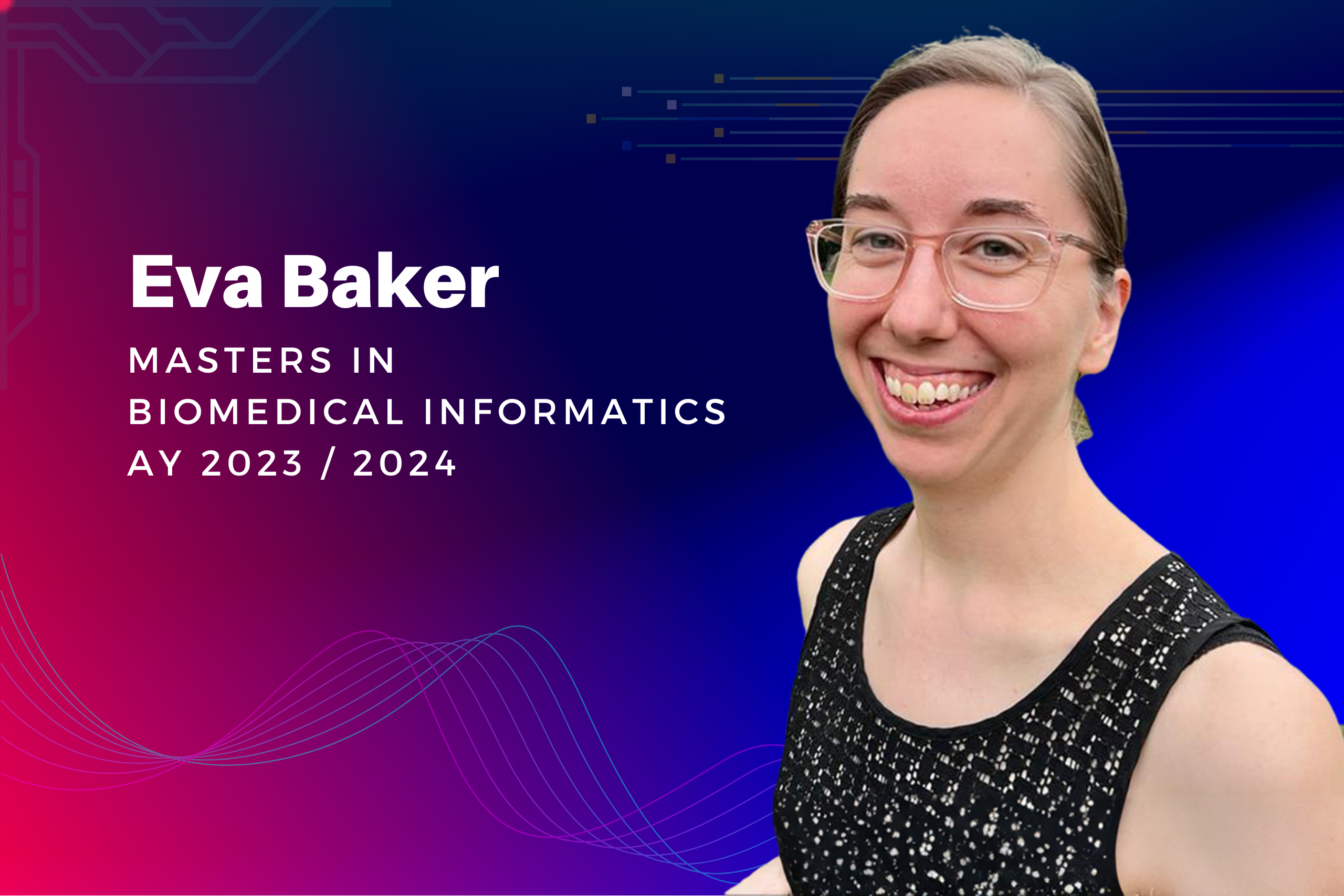 "The MSc in Biomedical Informatics programme has helped to formalise some of my work experience and knowledge into structured courses and allowed me to fill in gaps for areas of healthcare data.
Another key benefit for me has been the networking - the programme was great for meeting people working in healthcare data and getting a sense of which skills are currently in demand." - Eva Baker, MSc in BMI, AY2324