


Singapore’s healthcare system is 18% more sustainable than previously estimated — delivering world-class care at 20% lower carbon intensity than other advanced economies.
First National Health Sector Emissions Report
In a milestone for Southeast Asia’s healthcare sector, Singapore’s Ministry of Health (MOH), MOH Holdings Pte Ltd (MOHH), and the Centre for Sustainable Medicine (CoSM) at the Yong Loo Lin School of Medicine, National University of Singapore (NUS Medicine), have released the nation’s first comprehensive National Health Sector Emissions Report.
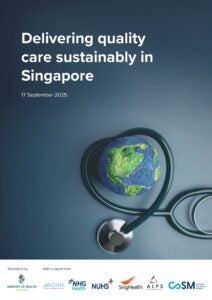
The joint NUS–MOH study finds that Singapore’s healthcare system is 18% more sustainable than previously estimated, delivering world-class healthcare at 20% lower carbon intensity than other advanced economies. This achievement is driven by several factors — including negligible refrigerant emissions despite Singapore’s tropical climate and rapid reductions in anaesthetic gas emissions in recent years, thanks to the dedication of healthcare professionals across the system.
The study estimates the healthcare sector’s footprint at 4.1 million tonnes of carbon dioxide equivalent (Mt CO₂e) per year — roughly the same as powering all 1.4 million households in Singapore for over a year. This provides vital evidence on where emissions occur across the sector, enabling healthcare leaders to target high-impact areas while safeguarding patient care.

A Collaborative,
System-Wide Effort
This landmark report draws on data across the entire national healthcare system, including contributions from MOH; MOHH and its subsidiaries — National Healthcare Group (NHG), National University Health System (NUHS), Singapore Health Services (SingHealth), and the Agency for Logistics and Procurement Services (ALPS). Research and modelling were led by CoSM.
With data contributions spanning hospitals, clusters, procurement, and emergency services, the report lays the analytical foundation for a whole-of-healthcare response to the health emergency of climate change. It positions Singapore to lead globally — not only in delivering high-quality care, but also in advancing sustainable medicine.
The report was officially launched on 17 September 2025 by Mr Tan Kiat How, Senior Minister of State for Health and for Digital Development and Information, at the inaugural Western Pacific Action Forum on Climate-Resilient and Sustainable Health Systems, co-hosted by the World Health Organization (WHO) and CoSM.
“This report marks a significant step forward in our sustainability journey. Importantly, this is also a call to action. Thus far, Singapore has been able to deliver world-class healthcare at a carbon intensity that is 20% below that of other advanced economies’ healthcare systems. This is driven by several factors, such as negligible levels of refrigerant emissions despite our hot climate, and rapid reductions in anaesthetic gas emissions in recent years through the dedication of our healthcare partners."
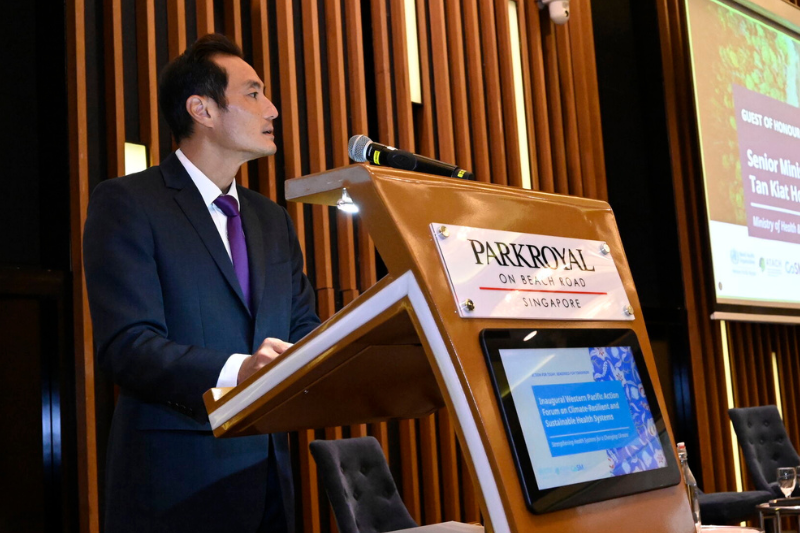
Mr Tan Kiat How
Senior Minister of State, Ministry of Digital Development and Information & Ministry of Health
This report marks a pivotal step in supporting Singapore’s national commitment to achieve net-zero emissions by 2050, as outlined in the Singapore Green Plan 2030.