

Despite the clear and growing evidence of climate change’s devastating impact on health, from heatwaves and infectious diseases to air pollution and food insecurity, health has only recently claimed its rightful place at the heart of climate negotiations.
Health at COP30 was marked by the Ministry of Health of Brazil’s release of the Belém Health Action Plan, a roadmap that consolidates key actions on health system adaptation in one document. This move was made possible due to preceding efforts such as the COP26 Health Programme and first official Health Day at COP28, and the persisting push for representation of the health sector by health professionals from around the world. Due to these strides, climate and health are rising up on the official agenda.

The road to recognition
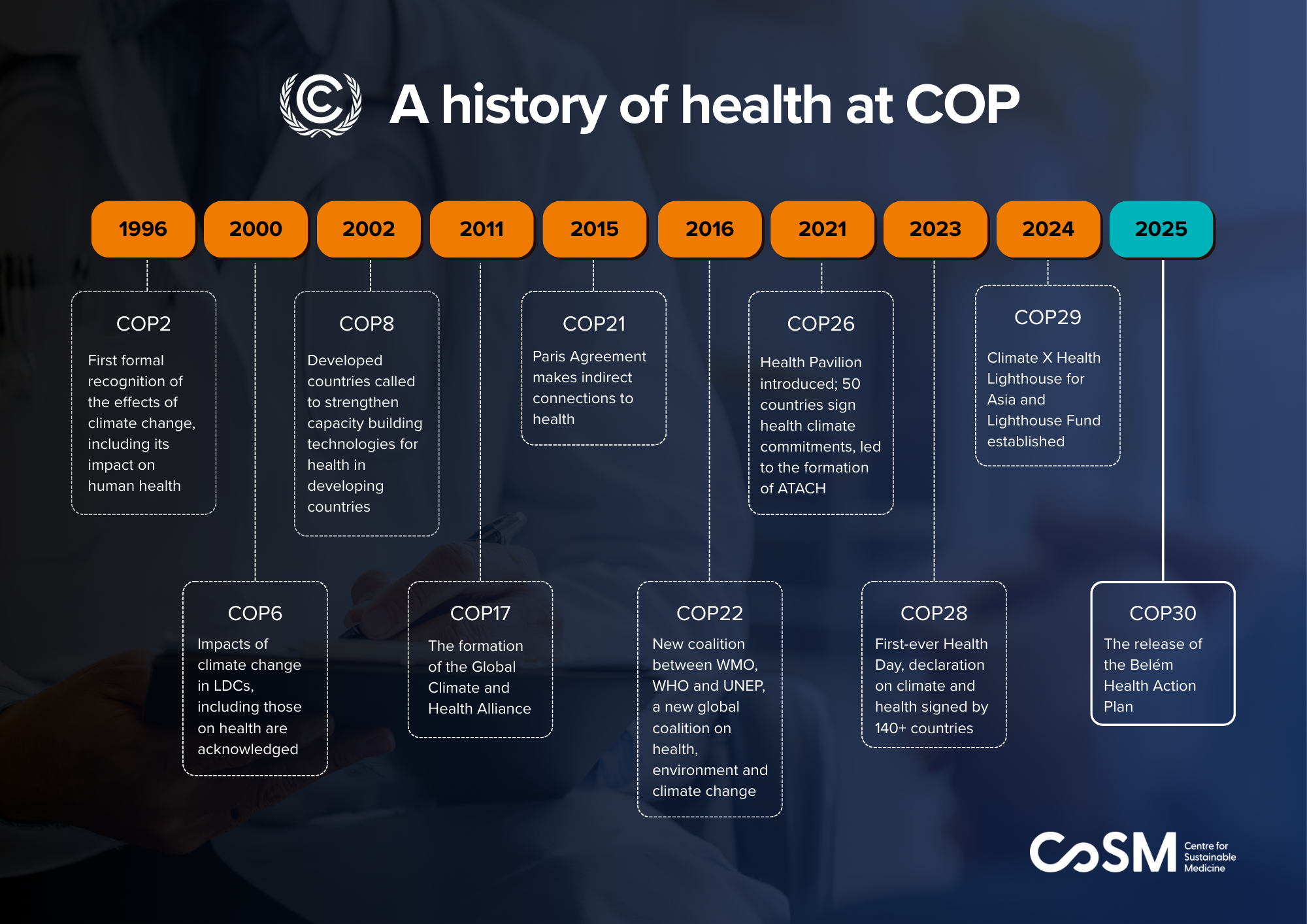
The first formal acknowledgement of climate change’s health impacts came in 1996, at COP2 in Geneva. The declaration noted that climate change could lead to “significant, often adverse, impacts” on human health, particularly for developing countries and small island nations.
As subsequent COPs progressed, momentum was lost until COP17 in 2011 where the Global Climate and Health Alliance (GCHA) formed at the first-ever Climate and Health Summit in Durban. Today, GCHA unites over 200 organisations, representing more than 46 million health workers, advocating for fossil fuel phase-out, policy reform, and public engagement.
Another milestone came about during the landmark Paris Agreement in 2015 at COP21, which acknowledged health within its adaptation agenda. However, health actions were left to the discretion of individual nations, with no binding requirements. The real shift began in 2016 at COP22, ushering in a series of positive, concrete developments in the climate and health nexus. Calls for stronger global coordination led to the formation of the Health, Environment, and Climate Change Coalition (HECCC). COP26 went even further: it introduced a formal health programme that allowed countries to commit to building climate-resilient, low-carbon health systems. This paved the way for the formation of the Alliance for Transformative Action on Climate and Health (ATACH) which now counts over 100 member countries.
COP28 marked a turning point for health in the climate agenda. The first climate-health ministerial was held, a global political declaration on health and climate was signed by 149 countries, and more than US$1 billion was committed toward health-related climate action, including US$778 million for neglected tropical diseases. However, there was more to be done. Two-thirds of NDCs still did not identify health co-benefits of climate action, and only 11% of NDCs included unconditional domestic finance for health actions. To truly safeguard human health in a changing climate, health must be more than a footnote in global policy.
The story continues in Belém
At COP30, we gathered for Health Day on 13 November with a long-overdue recognition: that the climate crisis is also a health crisis. For the first time at this scale, global leaders, researchers, community advocates, and frontline practitioners jointly acknowledged that rising temperatures, extreme weather, air pollution, and ecosystem degradation are already driving serious threats to human well-being. Health is finally at the centre of the conversation, where it has always belonged.
Against this backdrop, CoSM was proud to be a key partner in the launch of major contributions to the global climate and health agenda:
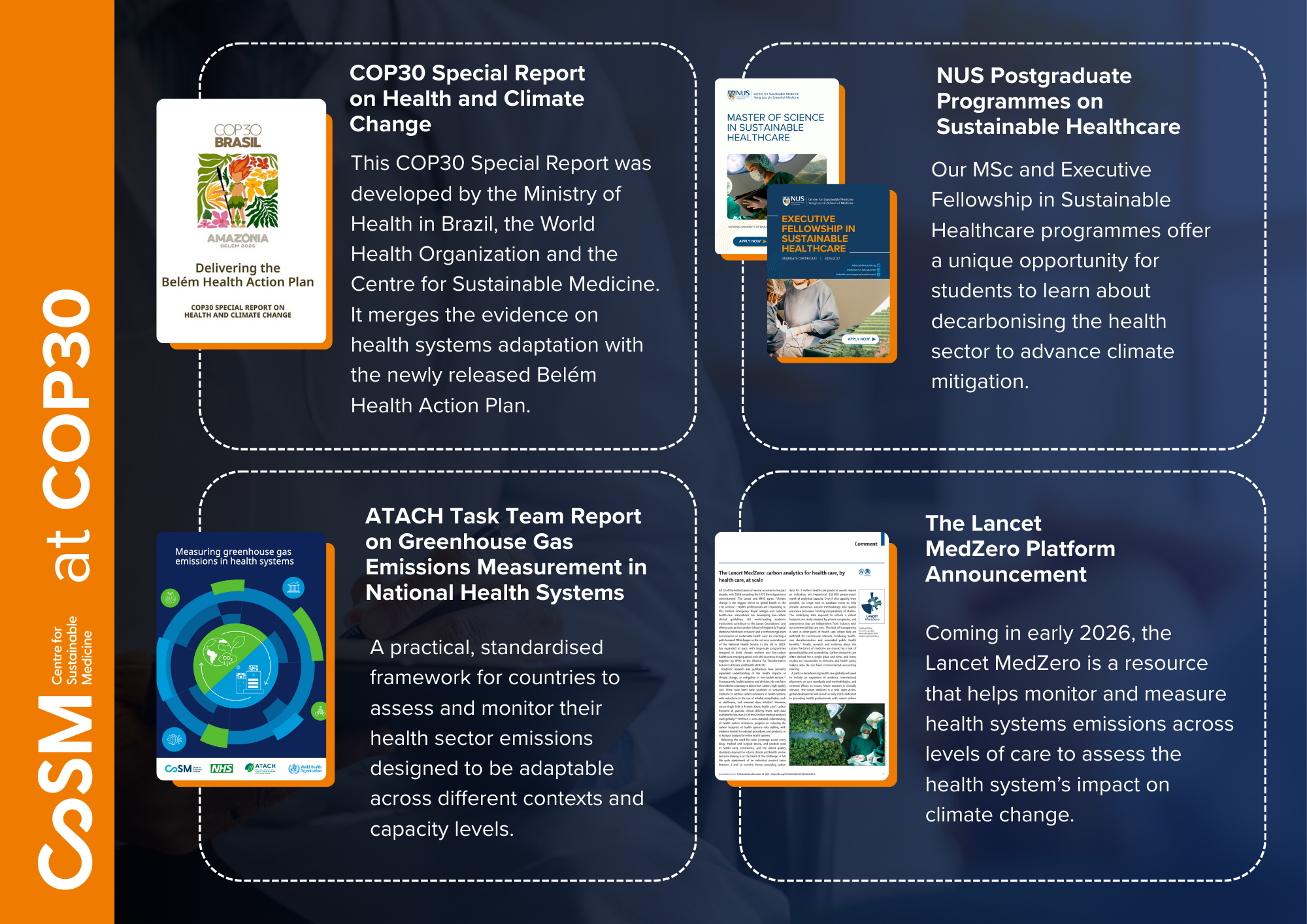
- COP30 Special Report on Health and Climate Change: With the leadership of the Ministry of Health of Brazil and the World Health Organization, CoSM has developed a technical document that merges the evidence on health system adaptation with the Belém Health Action Plan. This report was designed to help guide international action on climate-resilient health systems, grounded in climate science, equity, and real-world impact. In the lead-up to COP30, our team engaged with global climate and health experts, health leaders, and civil society to ensure this plan reflects diverse perspectives and shared priorities. Read the report here and explore the Belém Health Action Library here.
- Measuring Greenhouse Gas Emissions in National Health Systems: In partnership with WHO and NHS England, CoSM created a global guidance to provide a practical, standardised framework for countries to assess and monitor their health sector emissions. Designed to be adaptable across different contexts and capacity levels, this guidance fills a critical gap in guidance around health sector emissions monitoring, equipping policymakers with the tools to track progress and drive emissions reductions in a sector responsible for 5-8% of global GHG emissions. Read the guidance here.

- Launch of applications for the MSc in Sustainable Healthcare and Executive Fellowship in Sustainable Healthcare for Academic Year 2026/27: Our key educational programmes with NUS have reopened for its second year. These flagship programmes offer a unique opportunity for students of all backgrounds and seasoned professionals in their field to learn about how they can make meaningful contributions to decarbonising the health system. Our aim is to build a global community of established leaders to lead the sector’s transformation. Learn more about our programmes here.
- The Lancet MedZero Platform: In collaboration with The Lancet and esteemed global partners, CoSM announced the Lancet MedZero – an upcoming platform that will offer the sustainable healthcare community a novel data resource to monitor and measure health system emissions across all levels of care. Its open source and user-friendly experience will enhance the transparency and capacity to assess the health system’s impact on climate change so that we are better able to assess healthcare’s carbon footprint. Learn more about the Lancet MedZero and our partners here and join the global consultation here.
These endeavours represent a crucial step forward. Shaped by international collaboration and designed for implementation, we are honoured to have participated in this opportunity to drive health-centred climate leadership across Asia and the rest of the world.