


Speakers Abstract
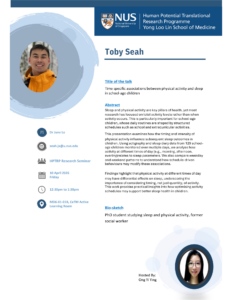
Mr Toby Seah
Sleep and physical activity are key pillars of health, yet most research has focused on total activity levels rather than when activity occurs. This is particularly important for school-age children, whose daily routines are shaped by structured schedules such as school and extracurricular activities.
This presentation examines how the timing and intensity of physical activity influence subsequent sleep outcomes in children. Using actigraphy and sleep diary data from 129 school-age children monitored over multiple days, we analyse how activity at different times of day (e.g., morning, afternoon, evening) relates to sleep parameters. We also compare weekday and weekend patterns to understand how schedule-driven behaviours may modify these associations.
Findings highlight that physical activity at different times of day may have differential effects on sleep, underscoring the importance of considering timing, not just quantity, of activity. This work provides practical insights into how optimising activity schedules may support better sleep health in children.
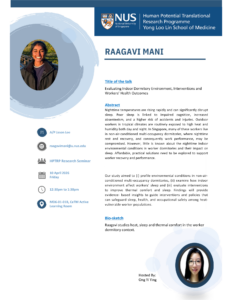
Ms Raagavi Mani
Nighttime temperatures are rising rapidly and can significantly disrupt sleep. Poor sleep is linked to impaired cognition, increased absenteeism, and a higher risk of accidents and injuries. Outdoor workers in tropical climates are routinely exposed to high heat and humidity both day and night. In Singapore, many of these workers live in non-air-conditioned multi-occupancy dormitories, where nighttime rest and recovery, and consequently work performance, may be compromised. However, little is known about the nighttime indoor environmental conditions in worker dormitories and their impact on sleep. Affordable, practical solutions need to be explored to support worker recovery and performance.
Our study aimed to (i) profile environmental conditions in non-air-conditioned multi-occupancy dormitories, (ii) examine how indoor environment affect workers’ sleep and (iii) evaluate interventions to improve thermal comfort and sleep. Findings will provide evidence-based insights to guide interventions and policies that can safeguard sleep, health, and occupational safety among heat-vulnerable worker populations.
Speakers Biosketch
Mr Toby Seah is a PhD student studying sleep and physical activity, former social worker.
Ms Raagavi Mani studies heat, sleep and thermal comfort in the worker dormitory context.