Rethinking professionalism: A plural, not singular, concept
https://doi.org/10.29060/TAPS.2026-11-1/TT005
Tim Wilkinson
Professor of Medicine and Medical Education,
Dean’s Department (Christchurch),
University of Otago, New Zealand
“My student is not very professional.”
“They failed their OSCE station because they need to be more professional.”
“What’s the best tool to assess professionalism?”
These kinds of comments and questions are common in medical education – and they reflect an unhelpful tendency to treat professionalism as a singular, all-encompassing trait. In reality, professionalism is not one thing. It’s many things. It’s time we started talking about professionalisms – plural.
A student might be honest but disorganised. Another might communicate beautifully with patients but struggle to take feedback from colleagues. Being professional in one domain doesn’t mean being professional in all. Just as we wouldn’t assess clinical knowledge with a single multiple-choice test, we can’t evaluate or develop professionalism with a single lens.
In my systematic review (Wilkinson et al., 2009), I found that while definitions of professionalism vary, most can be clustered into five broad domains:
- Ethical practice – Honesty, integrity, and respect for confidentiality.
- Interpersonal behaviour with patients and families – Empathy, rapport, communication.
- Teamwork and collaboration – Collegiality, accountability to the wider health system.
- Reliability – Following through, being prepared, respecting deadlines.
- Commitment to improvement – Reflectiveness, lifelong learning, system contributions.
Different cultures, institutions, and disciplines may emphasise some of these more than others, but none of them captures professionalism alone. What matters most is not drawing hard boundaries, but being clear and specific – with ourselves, our colleagues, and our students – about which dimensions we are referring to in a given context.
When we shift from thinking about professionalism as a singular trait to seeing it as a set of behaviours and commitments that evolve over time, we create more space for growth.
Here are some useful questions to ask ourselves:
- What specific behaviour or value am I referring to when I talk about “professionalism”?
- How can I name and model that behaviour clearly for learners?
- What would the learner need to do to convince me the concern about professionalism has resolved?
- Where might I be expecting students to “just know” what’s expected?
By embracing professionalism in the plural, we make it more meaningful, teachable, and explicit.
Reference
Wilkinson, T. J., Wade, W. B., & Knock, L. D. (2009). A blueprint to assess professionalism: Results of a systematic review. Academic Medicine, 84(5), 551-558. https://doi.org/10.1097/acm.0b013e31819fbaa2
https://doi.org/10.29060/TAPS.2025-10-4/TT004
Lambert Schuwirth
Professor of Medical Education
NewMedSchool, Australia
We are currently living in a time in which different assessment paradigms co-exist. There are contexts in which assessment is purely seen as a measurement, for instance national licensing. There are contexts in which assessment is predominantly judgement, such as in VIVAs and there are contexts in which these are combined to form an integral programmatic assessment for learning program.
Although a programmatic assessment for learning aims to combine both measurements and judgements, the manner in which all assessment data is synthesised and fed back to the learner is always through judgement and narratives. That is inevitable because numerical outcomes without added narratives are as meaningless as a scientific paper without an introduction, methods and discussion section and only the tables of the results. Numerical outcomes can only drive learning purely by punishment and reward and cannot provide the learner agency or support with meaningful self-regulation of their learning. Modern professionals, however, need capabilities to self-regulate their learning.
Assessment for learning therefore always needs to be programmatic – as opposed to formative assessment which can simply be a test that does not count.
But are narratives defensible? This is a common concern as we tend to trust quantitative outcomes more than qualitative. I find this odd. We trust healthcare as a system, even though the history, physical examination results, pathology and imaging reports and even contextualised lab values are all narratives, as are the diagnosis and management plan.
In an educational context, I would therefore plea that assessment should be more like a diagnostic and therapeutic relationship with the medical student. Assessment should guide them to become the best doctor they can be, and with our intake of the brightest and most hard-working young people the vast majority are. But what about the minority? Yes, they need to be identified as well but focusing an entire system on an issue with a low prevalence (the irremediable student) creates a huge NNT problem and is a waste of money and resources.
But assessment needs to be credible and fair. That is where programmatic assessment differs from a testing approach. Testing defines fairness as equality – everybody receives the same standardised test. Programmatic assessment defines fairness as equity – everybody receives the same quality of assessment. Just like we don’t push all patients through the same template in healthcare, but offer bespoke and high-quality diagnostic and therapeutic care, we should do the same with assessment.
https://doi.org/10.29060/TAPS.2025-10-3/TT003
Gominda Ponnamperuma
MBBS, MMEd, PhD
Professor in Medical Education
Faculty of Medicine, University of Colombo, Sri Lanka
Standard setting is the process of deciding the boundary or standard that separates the candidates into two (e.g. pass and fail) or more groups, based on their ability shown at an assessment. Standard setting methods can be broadly grouped into four clusters (see table below).
When to use which method, though a crucial decision for any Board of Examiners, is inadequately explored in the literature. The following brief guide attempts to bridge this literature gap.
|
Cluster of methods |
Key features |
Issues |
When to use |
|
Arbitrary standards and norm-referenced standards |
|
The pass mark is unrelated to the difficulty of assessment items. |
|
|
Test-centred methods |
|
Although the pass mark is directly related to the difficulty of test items,
Due to the above difficulties, the pass mark can be unrealistic. |
|
|
Partially results-based methods-I: Examinee-centred methods |
|
Although judgements are realistic, the introduction of actual test results tends to make the standard cohort-dependent, i.e., norm-referencing features influence the standard. |
|
|
Partially results-based methods-II: Compromise methods |
|
|
|
|
Results-based methods |
|
Due to the norm-referencing |
These methods should be used in high-stakes assessment only when an adequate evidence base is built by conducting them parallelly with another more established method. |
References
Angoff, W. H. (1971). Scales, norms, and equivalent scores. In R. L. Thorndike (Ed.), Educational measurement (2nd ed., pp. 508-600). American Council on Education.
Ebel, R. L. (1972). Essentials of educational measurement. Prentice Hall.
Nedelsky, L. (1954). Absolute grading standards for objective tests. Educational and Psychological Measurement, 14(1), 3-19. https://doi.org/10.1177/001316445401400101
Karantonis, A., & Sireci, S. G. (2006). The bookmark standard-setting method: A literature review. Educational Measurement Issues and Practice, 25(1), 4-12. https://doi.org/10.1111/j.1745-3992.2006.00047.x
Jaeger, R. M. (1982). An iterative structured judgment process for establishing standards on competency test: Theory and application. Educational Evaluation and Policy Analysis, 4(4), 461-476. https://doi.org/10.3102/01623737004004461
Smee, S. M., & Blackmore, D. E. (2001). Setting standards for an Objective Structured Clinical Examination: The borderline group method gains ground on Angoff. Medical Education, 35(11), 1009-1010. https://doi.org/10.1111/j.1365-2923.2001.01047.x
Kramer, A., Muijtjens, A., Jansen, K., Dusman, H., Tan, L., & van der Vleuten, C. (2003) Comparison of a rational and an empirical standard setting procedure for an OSCE. Medical Education, 37(2), 132-139. https://doi.org/10.1046/j.1365-2923.2003.01429.x
Livingston, S. A., & Zieky, M. J. (1982). Passing scores: A manual for setting standards of performance on educational and occupational tests. Educational Testing Service.
Hofstee, W. K. B. (1973). Een alternatief voor normhandhaving bij toetsen. Nederlands Tijdschrift voor de Psychologie, 28, 215-227.
Cohen-Schotanus, J., & van der Vleuten, C. P. M. (2010). A standard setting method with the best performing students as point of reference: Practical and affordable. Medical Teacher, 32(2), 154-160. https://doi.org/10.3109/01421590903196979
Wijnen, W. H. F. W. (1971). Onder of boven de maat. Amsterdam: Swets & Zeitlinger.
https://doi.org/10.29060/TAPS.2025-10-2/TT002
Neil Osheroff
Department of Biochemistry, Vanderbilt University School of Medicine, United States of America; Department of Medicine (Hematology/Oncology), Vanderbilt University School of Medicine, United States of America
Since the time of the Flexner report, it has been accepted that science is the foundation of clinical practice (Finnerty et al., 2010; Flexner, 1910; Grande, 2009; Haramati et al., 2024; Lindsley et al., 2024; Slivkoff et al., 2019; Weston, 2018; Woods et al., 2006). However, the methods traditionally used to teach sciences to medical students have been questioned in the post-Flexner era (AAMC-HHMI Committee, 2009; Cooke et al., 2010; Fulton et al., 2012; Slivkoff et al., 2019). For nearly 100 years, the foundational sciences were taught in a discipline-oriented fashion, primarily through passive learning approaches (lectures), and largely separated from clinical practice (AAMC-HHMI Committee, 2009; Flexner, 1910). Consequently, in the pre-clerkship phase, scientific details were often overtaught and disconnected from clinical applications. This approach frequently required students to “re-learn” their foundational sciences in the setting of patient care. The disconnect between science and medicine was further exacerbated in the later phases of medical training by physicians who taught in a manner that emphasized pattern recognition over scientific underpinnings. We have come to understand that these pedagogical approaches to medical education were neither efficient nor optimal.
Adult learning theory has provided strong evidence that medical trainees are better at learning, applying information to new circumstances, and making informed clinical decisions when the foundational and clinical sciences are taught side-by-side in an integrated fashion (Bandiera et al., 2018; Bucklin et al., 2021; Kulasegaram et al., 2015; Kulasegaram et al., 2013; Lisk et al., 2016; Mylopoulos & Woods, 2014). Learning is also heighted when active rather than passive approaches are employed. In the pre-clerkship phase, small group active learning sessions (problem-based learning, team-based learning, case-based learning, etc.) provide outstanding platforms for integrating foundational and clinical sciences (Bucklin et al., 2021). Similarly, in the clinical workplace, practitioners can integrate science and medicine by probing or explaining the underlying basis of disease and treatment or employing other forms of active learning (Dahlman et al., 2018; Daniel et al., 2021; Hashmi et al., 2024; Spencer et al., 2008).
Some have questioned the need for pre-clerkship science education in medical schools, professing that the heart of medical education is the clinical experience (Emanuel, 2020). However, in the post-genomic era, this perspective would seem to be the antithesis of modern medical practice (AAMC-HHMI Committee, 2009; Haramati et al., 2024). Now more than ever, to ensure the best quality of care for their patients, physicians need to understand the scientific underpinnings of their actions.
If we truly believe that science is the foundation of clinical practice, we should not teach either in isolation. As a first step, we need to stop thinking about foundational and clinical sciences as being separate. I would argue that they are both on the spectrum of “biomedical sciences,” represent two sides of the same coin, and should be taught in an integrated fashion across the entirety of the medical school curriculum. Although this integration has been (or is being) addressed in the pre-clerkship phases at most medical schools, it has proven more challenging in the clinical phases (Brauer & Ferguson, 2015; Pettepher et al., 2016; White & Ghobadi, 2022). While science and medicine are inherently intertwined, interactions between the two in the latter phases of training are often more casual than causal. It is time for the foundational and clinical sciences to be integrated across the continuum of medical training to ensure that future physicians have the skills necessary to provide the highest caliber of care for their patients.
Acknowledgements
Work in the author’s laboratory is funded in part by NIH grants R01 GM126363 and R01 AI170546. The author is grateful to Dr. Emily Bird for critical reading of the manuscript and insightful comments.
Declaration of Interest
The author declares no conflict of interest.
References
Bandiera, G., Kuper, A., Mylopoulos, M., Whitehead, C., Ruetalo, M., Kulasegaram, K., & Woods, N. N. (2018). Back from basics: integration of science and practice in medical education. Medical Education, 52(1), 78-85. https://doi.org/10.1111/medu.13386
Brauer, D. G., & Ferguson, K. J. (2015). The integrated curriculum in medical education: AMEE Guide No. 96. Medical Teacher, 37(4), 312-322. https://doi.org/10.3109/0142159X.20 14.970998
Bucklin, B. A., Asdigian, N. L., Hawkins, J. L., & Klein, U. (2021). Making it stick: Use of active learning strategies in continuing medical education. BMC Medical Education, 21(1), Article 44. https://doi.org/10.1186/s12909-020-02447-0
AAMC-HHMI Committee (2009). Scientific foundations for future physicians.
Cooke, M., Irby, D. M., & B’Brien, B. C. (2010). Educating physicians: A call for reform of medical school and residency. Jossey-Bass.
Dahlman, K. B., Weinger, M. B., Lomis, K. D., Nanney, L., Osheroff, N., Moore, D. E., Jr., Estrada, L., & Cutrer, W. B. (2018). Integrating foundational sciences in a clinical context in the post-clerkship curriculum. Medical Science Educator, 28(1), 145-154.
Daniel, M., Morrison, G., Hauer, K. E., Pock, A., Seibert, C., Amiel, J., Poag, M., Ismail, N., Dalrymple, J. L., Esposito, K., Pettepher, C., & Santen, S. A. (2021). Strategies from 11 U.S. medical schools for integrating basic science into core clerkships. Academic Medicine, 96(8), 1125-1130. https://doi.org/10.1097/ACM.0000000000003908
Emanuel, E. J. (2020). The inevitable reimagining of medical education. JAMA, 323(12), 1127-1128. https://doi.org/10.1001/ jama.2020.1227
Finnerty, E. P., Chauvin, S., Bonaminio, G., Andrews, M., Carroll, R. G., & Pangaro, L. N. (2010). Flexner revisited: The role and value of the basic sciences in medical education. Academic Medicine, 85(2), 349-355. https://doi.org/10.1097/ACM.0b013e3181c88b09
Flexner, A. (1910). Medical education in the United States and Canada: A report to the Carnegie Foundation for the Advancement of Teaching. The Carnegie Foundation for the Advancement of Teaching.
Fulton, T. B., Ronner, P., & Lindsley, J. E. (2012). Medical biochemistry in the era of competencies: Is it time for the Krebs cycle to go? Medical Science Educator, 22(1), 29-32. https://doi.org/10.1007/BF03341749
Grande, J. P. (2009). Training of physicians for the twenty-first century: Role of the basic sciences. Medical Teacher, 31(9), 802-806. https://doi.org/10.1080/01421590903137049
Haramati, A., Bonaminio, G., & Osheroff, N. (2024). Professional identity formation of medical science educators: An imperative for academic medicine. Medical Science Educator, 34(1), 209-214. https://doi.org/10.1007/s40670-023-01922-9
Hashmi, S., Riaz, Q., Qaiser, H., & Bukhari, S. (2024). Integrating basic sciences into clerkship rotation utilising Kern’s six-step model of instructional design: Lessons learned. BMC Medical Education, 24(1), Article 68. https://doi.org/10.1186/ s12909-024-05030-z
Kulasegaram, K., Manzone, J. C., Ku, C., Skye, A., Wadey, V., & Woods, N. N. (2015). Cause and effect: Testing a mechanism and method for the cognitive integration of basic science. Academic Medicine, 90(11 Suppl), S63-S69. https://doi.org/10.1097/ACM.0000000000000896
Kulasegaram, K. M., Martimianakis, M. A., Mylopoulos, M., Whitehead, C. R., & Woods, N. N. (2013). Cognition before curriculum: Rethinking the integration of basic science and clinical learning. Academic Medicine, 88(10), 1578-1585. https://doi.org/10.1097/ACM.0b013e3182a45def
Lindsley, J. E., Abali, E. E., Asare, E. A., Chow, C. J., Cluff, C., Hernandez, M., Jamieson, S., Kaushal, A., & Woods, N. N. (2024). Contribution of basic science eeducation to the professional identity development of medical learners: A critical scoping review. Academic Medicine, 99(11), 1191-1198. https://doi.org/10.1097/ACM.0000000000005833
Lisk, K., Agur, A. M. R., & Woods, N. N. (2016). Exploring cognitive integration of basic science and its effect on diagnostic reasoning in novices. Perspectives on Medical Education, 5(3), 147-153. https://doi.org/10.1007/s40037-016-0268-2
Mylopoulos, M., & Woods, N. (2014). Preparing medical students for future learning using basic science instruction. Medical Education, 48(7), 667-673. https://doi.org/10.1111/medu.12426
Pettepher, C. C., Lomis, K. D., & Osheroff, N. (2016). From theory to practice: Utilising competency-based milestones to assess professional growth and development in the foundational science blocks of a pre-clerkship medical school curriculum. Medical Science Educator, 26(3), 491-497. https://doi.org/10.1007/s40670-016-0262-7
Slivkoff, M. D., Bahner, I., Bonaminio, G., Brenneman, A., Brooks, W. S., Chinn, C., El-Sawi, N., Haight, M., Hurtubise, L., McAuley, R. J., Michaelsen, V., Rowe, B., Vari, R. C., & Yoon, M. (2019). The role of basic science in 21st century medical education. Medical Science Educator, 29(3), 881-883.
Spencer, A. L., Brosenitsch, T., Levine, A. S., & Kanter, S. L. (2008). Back to the basic sciences: An innovative approach to teaching senior medical students how best to integrate basic science and clinical medicine. Academic Medicine, 83(7), 662-669. https://doi.org/10.1097/ACM.0b013e318178356b
Weston, W. W. (2018). Do we pay enough attention to science in medical education? Canadian Medical Education Journal, 9(3), e109-e114.
White, B., & Ghobadi, A. (2022). Models of clinical integration into basic science education for first-year medical students. Medical Teacher, 45(3), 333-335. https://doi.org/10.1080/ 0142159X.2022.2134002
Woods, N. N., Neville, A. J., Levinson, A. J., Howey, E. H., Oczkowski, W. J., & Norman, G. R. (2006). The value of basic science in clinical diagnosis. Academic Medicine, 81(10 Suppl), S124-S127. https://doi.org/10.1097/00001888-200610001-00031
https://doi.org/10.29060/TAPS.2025-10-1/TT001
Marcus A. Henning
Centre for Medical and Health Sciences Education, Faculty of Medical and Health Sciences, University of Auckland, New Zealand
Whenever I think about student and faculty wellness, I am reminded of two sayings. Firstly, a Taoist saying that recommends we should always “look close, not far” (Wee Kee Jin, personal communication, August 25, 2012). And secondly, William Osler’s saying, “Our main business is not to see what lies dimly in the distance but to do what lies clearly at hand” (Bryan, 1997). Both quotes suggest that the most prudent course of action for students and faculty is to always reflect on one’s own actions and focus on the tasks at hand.
There is also a strong sense of reflecting in- and on-action, whereby students and faculty need to reflect on their experiences in a timely manner to optimise the opportunity for constructive transformation (Schon, 1983). With this in mind, monitoring wellbeing engenders the prospect of the cultivation of wellbeing. To engage this mindset, it is crucial that students and faculty are aware of, and honest about, what is happening in their minds and bodies and accept that mistakes can happen, but these experiences can lead to transformation, i.e., that they invest in loss (Buchanan, 2024).
Therefore, the core principle is to solve problems and be task-oriented on what needs to be done to solve any issues as they arise, rather than attributing blame and creating a shame and blame cycle. It is further crucial that students and faculty embrace help-seeking strategies to mitigate emotional exhaustion and proactively engage health professionals when things go awry (Dyrbye et al., 2015). The earlier this engagement occurs, the more likely the outcome will be positive.
Help-seeking strategies have attitudinal components but need to be seen as an essential part of developing common-sense wellbeing strategies that enable wellbeing. Other factors include healthy eating, living in favourable accommodation, exercising regularly, and ensuring optimal sleep patterns (Trockel et al., 2000). It is also crucial that students and faculty allow for a recovery period after experiencing stress-provoking incidents to allow them to return to a healthy state. If this recovery period is not initiated, it may lay the foundation for a worsening response to future adversarial stress incidents (Sisley et al., 2010).
To summarise, students and faculty need to monitor their health status on a daily basis, create strategies that will enhance their wellbeing, and be open to seeking help if things go awry.
Bryan, C. S. (1997). Osler: Inspirations from a great physician. New York: Oxford University Press. http://ci.nii.ac.jp/ncid/BA34173998
Buchanan, M. (2024, March 17). The Chinese secret of investing in loss (with Professor Cheng Man Ching). https://morganbuchanan.substack.com/p/the-chinese-secret-of-investing-in
Dyrbye, L. N., Eacker, A., Durning, S. J., Brazeau, C., Moutier, C., Massie, F. S., Satele, D., Sloan, J. A., & Shanafelt, T. D. (2015). The impact of stigma and personal experiences on the help-seeking behaviors of medical students with burnout. Academic Medicine, 90(7), 961-969. https://doi.org/10.1097/acm.0000000000000655
Schon, D. A. (1983). The reflective practitioner: How professionals think in action. New York: Basic Books. https://stars.library.ucf.edu/cirs/1748/
Sisley, R., Henning, M. A., Hawken, S. J., & Moir, F. (2010). A conceptual model of workplace stress: The issue of accumulation and recovery and the health professional. New Zealand Journal of Employment Relations, 35(2), 3-15. https://aut.researchgateway.ac.nz/handle/10292/3011
Trockel, M. T., Barnes, M. D., & Egget, D. L. (2000). Health-related variables and academic performance among first-year college students: Implications for sleep and other behaviors. Journal of American College Health, 49(3), 125-131. https://doi.org/10.1080/07448480009596294
Announcements
- Best Reviewer Awards 2024
TAPS would like to express gratitude and thanks to an extraordinary group of reviewers who are awarded the Best Reviewer Awards for 2024.
Refer here for the list of recipients. - Most Accessed Article 2024
The Most Accessed Article of 2024 goes to Persons with Disabilities (PWD) as patient educators: Effects on medical student attitudes.
Congratulations, Dr Vivien Lee and co-authors! - Best Article Award 2024
The Best Article Award of 2024 goes to Achieving Competency for Year 1 Doctors in Singapore: Comparing Night Float or Traditional Call.
Congratulations, Dr Tan Mae Yue and co-authors! - Fourth Thematic Issue: Call for Submissions
The Asia Pacific Scholar is now calling for submissions for its Fourth Thematic Publication on “Developing a Holistic Healthcare Practitioner for a Sustainable Future”!
The Guest Editors for this Thematic Issue are A/Prof Marcus Henning and Adj A/Prof Mabel Yap. For more information on paper submissions, check out here! - Best Reviewer Awards 2023
TAPS would like to express gratitude and thanks to an extraordinary group of reviewers who are awarded the Best Reviewer Awards for 2023.
Refer here for the list of recipients. - Most Accessed Article 2023
The Most Accessed Article of 2023 goes to Small, sustainable, steps to success as a scholar in Health Professions Education – Micro (macro and meta) matters.
Congratulations, A/Prof Goh Poh-Sun & Dr Elisabeth Schlegel! - Best Article Award 2023
The Best Article Award of 2023 goes to Increasing the value of Community-Based Education through Interprofessional Education.
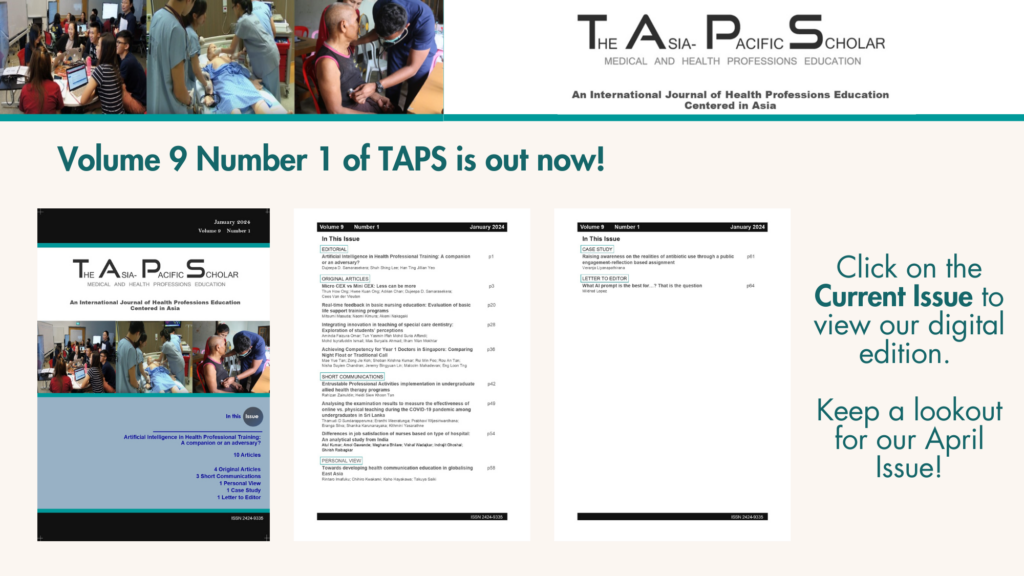
Congratulations, Dr Tri Nur Kristina and co-authors! - Volume 9 Number 1 of TAPS is out now! Click on the Current Issue to view our digital edition.
- Best Reviewer Awards 2022
TAPS would like to express gratitude and thanks to an extraordinary group of reviewers who are awarded the Best Reviewer Awards for 2022.
Refer here for the list of recipients. - Most Accessed Article 2022
The Most Accessed Article of 2022 goes to An urgent need to teach complexity science to health science students.
Congratulations, Dr Bhuvan KC and Dr Ravi Shankar. - Best Article Award 2022
The Best Article Award of 2022 goes to From clinician to educator: A scoping review of professional identity and the influence of impostor phenomenon.
Congratulations, Ms Freeman and co-authors. - Volume 8 Number 3 of TAPS is out now! Click on the Current Issue to view our digital edition.
- Best Reviewer Awards 2021
TAPS would like to express gratitude and thanks to an extraordinary group of reviewers who are awarded the Best Reviewer Awards for 2021.
Refer here for the list of recipients. - Most Accessed Article 2021
The Most Accessed Article of 2021 goes to Professional identity formation-oriented mentoring technique as a method to improve self-regulated learning: A mixed-method study.
Congratulations, Assoc/Prof Matsuyama and co-authors. - Best Reviewer Awards 2020
TAPS would like to express gratitude and thanks to an extraordinary group of reviewers who are awarded the Best Reviewer Awards for 2020.
Refer here for the list of recipients. - Most Accessed Article 2020
The Most Accessed Article of 2020 goes to Inter-related issues that impact motivation in biomedical sciences graduate education. Congratulations, Dr Chen Zhi Xiong and co-authors.