Caribbean offshore medical schools – Accreditation and financial challenges
Published online: 7 May, TAPS 2019, 4(2), 63-65
DOI: https://doi.org/10.29060/TAPS.2019-4-2/PV2058
Pathiyil Ravi Shankar
Department of Medical Education, American International Medical University, Saint Lucia
I. INTRODUCTION
A. Why This is an Issue of Global Importance
Offshore Caribbean medical schools (OCMS) were first established in the late 1970s. In 2013 more than three-quarters of the United States (US) International Medical Graduates (IMGs) graduated from OCMS (Eckhert & van Zanten, 2015). Many also admit students from Asia (predominantly from South Asia) with many graduates returning home to practice medicine (Morgan, 2017). Students from the Middle East and West Africa, especially Nigeria and Ghana are also admitted. There has been no published study on these proportions but at the medical school where the author works over 70% of students are from South Asia and over 15% from Nigeria. The proportion at other medical schools varies and a comprehensive study may be required.
The quality of these medical schools varies greatly. Certain older and well-resourced medical schools compare well with international standards while many others often lack qualified faculty, research exposure, student advising and integrated curricula (Eckhert & van Zanten, 2015). From 2023, to be eligible for Educational Commission for Foreign Medical Graduates (ECFMG) certification, physicians should graduate from an appropriately accredited medical school using criteria comparable to those accepted globally like those developed by World Federation for Medical Education (WFME).
II. PERSONAL VIEW
A. Accreditation of OCMS
The two major agencies are the Caribbean Accreditation Authority for Education in Medicine and other Health Professions (CAAM-HP), Jamaica and/or the Accreditation Commission for Colleges of Medicine, Ireland. With the 2023 deadline fast approaching, most OCMS are strongly pursuing accreditation. Recently, CAAM-HP strongly recommends that new schools seek accreditation before admitting their ‘charter class’ of students.
B. Newer OCMS
Students from North America typically attend older, more established schools which may offer an educational program of North American standards and a better chance of matching into a residency program. Students from the developing ‘South’ mainly attend new and developing schools (Morgan, 2017). The newer OCMS are smaller and have typically between 10 to 20 basic sciences faculty members. A recent article examined challenges with regard to undergraduate education in OCMS (Shankar, Balasubramanium, & Dakubo, 2017). The major focus of this article will be on issues of economic sustainability and growth of OCMS and the influence of the business model on academic decisions.
C. Competition Among OCMS
Competition among OCMS for students is fierce (Morgan, 2017). Many new entrants undercut the competition offering a relatively low tuition fee. The reported tuition fees vary widely from under USD50000 to USD250000 (Morgan, 2017) with some of the new entrants offering the entire program at around USD40000. The most cost-effective teaching-learning model predominantly uses traditional lectures in large classrooms which transmit information to a large body of students. Many OCMS use ‘agents’ for recruiting students. While published data is lacking, the author’s experience and data obtained from talking to other educators indicate that most agents earn a commission of around USD3000 per admitted student and some avail schemes like an incentive payment as students move to higher semesters. For recruiting Asian and African students, OCMS have to compete with medical schools from China, and Eastern Europe who are able to offer lower tuition and larger teaching hospitals and advertise and market aggressively. The number of students at most new OCMS is low; usually less than 40 students in an intake, creating pressure on resources. There is usually a shortage of capital for innovative small-group learning methods and modern educational technology.
D. Early Clinical Exposure and Clinical Rotations
Most OCMS do not have their own teaching hospitals. Students do their basic sciences in the Caribbean and complete their clinical rotations in the US or Canada. Not having their own teaching hospitals creates challenges for providing early clinical exposure (ECE) during the basic sciences. OCMS do not have a close linkage with the health systems of the countries where they are located. Due to financial competition, they also may struggle to pay local practitioners for providing ECE to students.
The other challenge is the increasing cost of clinical rotations. Most hospitals in metropolitan cities in the US charge around USD400 per week of clinical rotation (McLean & Charles, 2018). These hospitals accept students from a number of medical schools. The oversight of the school over the teaching programs is difficult. Teaching hospitals in the Caribbean primarily under the University of West Indies (UWI) system may charge a comparable amount and offer limited seats. Schools may have their students do their rotations in local hospitals or with local specialists. This may compromise educational quality in many ways ranging from lack of a sufficient pool of qualified faculty, small catchment populations leading to a small number of patients and in some cases reduced inpatient exposure.
E. The ‘Business’ of Education
A major challenge in a private educational institution is the ‘mixing’ of business and education. In the Caribbean, it is very easy for students to transfer from one school to the other. The OCMS vary widely in their standards and academic integrity and students not happy with their grades at one university/school easily transfer into another (van Zanten & Boulet, 2008). Each medical school is usually its own university which means external academic oversight is often minimal. Many schools try to address this issue by offering external standardised exams to their students. Many also require students to pass the United States Medical Licensing Exam (USMLE) Step 1 before starting their clinical rotations (Morgan, 2017). The teaching hospitals and the practitioners are also under pressure to admit and train a large number of students. In many hospitals, the standards of assessment may require strengthening.
F. Number and Quality of the Faculty
On examining the websites of different OCMS, the author noted that Asia and Africa account for a large percentage of the OCMS faculty. Most schools have one or two faculties per course/subject. OCMS develop their curriculum and courses of study. I personally believe that to ensure quality, OCMS should recruit only middle-level faculty members with at least five years’ teaching experience. However, lower tuition fees may entice schools to hire less experienced faculty members or those without a postgraduate degree in the subject. Online video lectures and preparatory programs are available which may partly offset some of these shortcomings. The author’s personal experience and insights obtained from talking to educators at other OCMS indicate most faculty members are also involved in teaching premedical students and sometimes other health programs as well.
G. Students Not Intending to Practice in North America
A large percentage of students intend to return to their home country outside North America to practice after graduation. This may create challenges for OCMS. CAAM-HP standards are derived mainly from those used by the General Medical Council of the United Kingdom and the US Liaison Committee on Medical Education. First-time pass rates, especially in USMLE Step 1, are used to measure the quality of the basic sciences program and widely advertised by medical schools in their promotional materials (Morgan, 2017). However, appearing in the USMLE is expensive and requires rigorous preparation. Students not intending to practice in North America may not be interested in appearing in the USMLE.
H. Physical Facilities
Though I have not come across studies in the scientific literature, my personal observations, inputs obtained from faculty and students and careful analysis of school websites indicate that OCMS vary widely in the quality of their campus and physical facilities. For full accreditation or accreditation with conditions, it is important that the school develops its own campus and physical facilities. New OCMS struggle to find funding for this major upgrade requiring millions of dollars. Facilities for sports and other extracurricular activities are often compromised due to the limited physical facilities.
The number of published studies on OCMS is low. Some of the descriptions are based on the personal experience of the author, discussions with faculty and students at different OCMS and a review of the school websites. This factor should be considered while drawing conclusions.
I. In Conclusion
Newer OCMS suffer from a variety of financial challenges. Accreditation places an increasingly heavy financial burden. Lower student intake and cut-throat competition may result in low tuition fees insufficient to ensure quality medical education. Promotion and advertising costs and commissions may also impact the bottom line. The 2023 deadline from ECFMG may also impact admissions. Other regulatory authorities may also consider making regional accreditation for OCMS mandatory. The future looks challenging for new, developing OMCS. Hopefully, many of them will be able to weather the challenges during the next five years.
Obtaining objective published data on various aspects of OCMS has been difficult as the number of studies is low. Studies should be conducted to address this gap in knowledge.
Note On Contributor
Dr Pathyil Ravi Shankar is Professor of Medical Education and Pharmacology at the American International Medical University, Saint Lucia, Caribbean.
Funding
The author had no source of funding for his work.
Declaration of Interest
The author works as a faculty member at an offshore Caribbean medical school.
References
Eckhert, N. L., & van Zanten, M. (2015). U.S.-citizen international medical graduates – A boon for the workforce? New England Journal of Medicine, 372, 1686-1687.
https://doi.org/10.1056/NEJMp1415239
McLean, S., & Charles, D. (2018). A global value chain analysis of offshore medical universities in the Caribbean [PDF file]. Santiago, United Nations: Economic Commission for Latin America and the Caribbean (ECLAC) Subregional Headquarters for the Caribbean. Retrieved from
https://repositorio.cepal.org/bitstream/handle/11362/43311/1/S1701281_en.pdf
Morgan, J. (2017). Caribbean offshore medical schools and the international mobility of medical education (Master’s thesis). Retrieved from
http://summit.sfu.ca/system/files/iritems1/17438/etd10197_JMorgan.pdf
Shankar, P. R., Balasubramanium, R., & Dakubo, G. (2017). Challenges with regard to undergraduate medical education in offshore Caribbean medical schools. Education in Medicine Journal, 9(4), 69-75. https://doi.org/10.21315/eimj2017.9.4.8
van Zanten, M., & Boulet, J. R. (2008). Medical education in the Caribbean: Variability in medical school programs and performance of students. Academic Medicine, 83(10 Suppl), S33-S36. https://doi.org/ 10.1097/ACM.0b013e318183e649
*Pathiyil Ravi Shankar
American International Medical University
Gros Islet, Saint Lucia
Tel: +1-758-4500130
E-mail: ravi.dr.shankar@gmail.com
Published online: 7 May, TAPS 2019, 4(2), 60-62
DOI: https://doi.org/10.29060/TAPS.2019-4-2/PV2002
Sophia Tsong Huey Chew1,2,3 & Lian Kah Ti2,4,5
1Department of Anaesthesiology, Singapore General Hospital, Singapore; 2Yong Loo Lin School of Medicine, National University of Singapore; 3Duke-NUS Graduate Medical School, Singapore; 4Department of Anaesthesia, National University Hospital, 5National University Health System, Singapore
I. INTRODUCTION
We never quite know how a scientific journey pans out, or any journey for that matter. What started for us as a scientific quest to better understand local clinical data and practice in cardiac surgery is yielding answers of value locally and beyond. But the high hanging (and greater) fruit that is already coming of age is the formation of a growing community of younger researchers who not only share success with us in publication, but beyond this are actively expanding the research community through their own networks in research and mentorship.
We knew not all patients do well with the same therapy. We started with our own local data. We aimed to follow a prospective cohort of cardiac surgical patients to understand genomics and outcomes after cardiac surgery, including that of acute kidney injury, atrial fibrillation and other outcomes. It was aptly named the mythological flying “Perioperative Genomics and Safety Outcomes Study (PEGASUS)”, for many new initiatives have likewise taken flight. We have yet to fathom the heights and the reach that our young mentees will attain on this journey.
The typical patient presenting for cardiac surgery locally is a male in his 60s with 70% of this cohort expected to be hypertensive and about half are diabetics. Acute kidney injury (AKI) is the most common postoperative complication affecting 1 in 3 patients. 1% to 3% of patients with AKI have a new need for dialysis with a 25% mortality rate.
We asked these questions: 1) Who is at risk? 2) What puts them at risk? 3) Are the risk factors modifiable? 4) What was the perioperative effect, and did it also have a longer term but less appreciated impact? Our first publication addressed the first question (Chew, Mar, & Ti, 2013). While pondering the second, we were tasked to mentor a first-year medical student in research, our “index mentee”. This was the catalyst for our journey in research mentorship. She answered the second question in her first manuscript describing anaemia as an important modifiable risk factor for AKI in our local population (Ng, Chew, Liu, Shen, & Ti, 2014). Subsequently we went on to publish a clinical risk score, and further examined the persistence of renal dysfunction and its link to end-stage renal disease (Chew, Ng, Liu, Chow, & Ti, 2017; Nah et al., 2016; Ng, Chew, Liu, & Ti, 2014). Her success was truly a shared success. Through word of mouth the research mentorship program expanded among the medical students. Our index mentee expanded her role; she turned student mentor. Through her, she helped other students to publish their first manuscript. With a growing base of students, we could simultaneously look at many other outcomes using the database. Concurrently publications have grown exponentially, shared and co-authored by these students, often as first authors. Our index mentee graduated from medical school, having already co-authored about 10 publications and also mentored other students in the program. Remarkably, as she starts her anaesthesiology residency, she has used her knowledge of AKI to conduct an AKI Quality Improvement project for cardiac surgical patients.
We are privileged to have started with one mentee from which many others joined us on this incredible journey. We share below some of the lessons learnt.
II. PLANNING THE RESEARCH
A. Research Question and Literature Review
In any research, be it a database research or randomised controlled trial, the most important task is to define the research question. Students are guided on framing and defining the question. After brainstorming, students will do a comprehensive literature review. They need to identify relevant information, extract the useful information, gauge its accuracy, assess the authority behind the information and then synthesise all the information with the aim of clearly articulating the research question.
B. Introduction and Aim
By the end of the literature review, the student should be able to articulate very clearly the research question and state the aim of the project. The student should also put on paper the introductory remarks and the aim of the project.
C. Data Mining
Data mining of relevant variables follow naturally from the aim of the project. The student is guided through the statistical analysis of de-identified data. This will typically take a few months before the results are analysed and ready for presentation. At the end of this, the student will write up the methodology and results in the manuscript.
D. Manuscript Writing
This is the most challenging aspect and as mentors, we must resist the urge to take over the writing itself. Scientific writing is new to most students and they are guided line by line, paragraph by paragraph. This will typically take numerous revisions before it is completed and ready for presentation or publication. Mentees are not the only ones who have learnt, and we have too in understanding the ecosystem in creating and motivating a healthy team. We gladly share them with our mentees.
III. TRANSPARENT COMMUNICATION IS A FUNDAMENTAL CORNERSTONE
Research mentorship is a dynamic and unpredictable process and the roadmap as outlined above must be clearly communicated with the mentee. Time is the most valuable commodity for both mentor and mentee and we both need to respect this. Spending quality time is paramount for the success of the project and maintaining continuous communication with a mentee allows for immediate accountability. Apart from face to face meetings, communication is easily aided with modern technology. Google Docs is an online platform that allows us to share a specific folder which we can both access. We can upload articles and the mentor can easily monitor the progress of the manuscript. Manuscript revisions are automatically saved with a revision history as backup. We do this at our convenience from any location and this obviates the need for printing articles or sending countless emails and attachments.
IV. WE NEED DISCRETE GOALS
Goal setting creates structure and purpose and all students in the program are expected to present an abstract at a meeting and have a publication.
Mentors also act as coaches to fine-tune presentation skills of the mentees. Even deportment skills and life skills need to be imparted to the mentees in planning for presentations at conferences.
We are proud of students who have won awards for their presentations but it is equally important to continue to motivate those who did not win. Recently, we celebrated the remarkable success of one of our young mentees who as a first-year medical student beat other more senior doctors at an international conference to win the Best Oral Poster award.
V. WE BUILD THE COMMUNITY, NOT OURSELVES
From one index mentee, the research mentorship program has grown over the years. Students with more research experience are paired with younger ones and learn to be student mentors. We also link them to the larger research community by exposing them to overseas conferences. This is always an eye opener where they can feel the adrenaline rush of the most current research and learn how to establish networks and contacts. As mentors, it is important to identify the strengths and weaknesses not only of our students but also address our own shortcomings. Thus, when we lack the answers, we use our resources and networks to seek appropriate help. In this way, we demonstrate the willingness to always upgrade our own skills and understanding. We emphasise to the students that medical practitioners cannot work in isolation but collaboration is increasingly the way forward to solve many of the issues in medicine. We always involve students when we meet other collaborators so that they can learn and be mentored by other practitioners. One notable collaboration is with the Renal Registry to look at midterm outcomes. This collaboration aptly demonstrates the need to seek cooperation and that anaesthesia as a discipline can contribute to better understanding of disease outcomes not only in the immediate perioperative period but beyond that of the hospital.
VI. ENSURE THAT REWARDS ARE EQUITABLE
One of the best ways to demonstrate the partnership between mentor and mentee is that of ensuring fair award of authorship credits. In most of the publications, mentees are given ownership and guided to their first publication. One of our mentees has remarked that: “It helps that medical students like me feel included in the research team. There is a sense that we’re all equals”. It is always an exhilarating experience for both mentors and mentees to see our work in print. This also empowers the mentee to do likewise for others in the research journey. In success, we build others up to succeed and only through such collaboration is the program sustainable in the long term. Eventually, we look forward to seeing the students take on roles as mentors in research.
VII. REALISE IT’S A JOURNEY, AND IT’S NEVER OVER
While mentoring benefits students in that they advance their research output, present at conferences, and develop research skills, it is equally rewarding to be mentors. Students keep us abreast of new knowledge and appraise us of new avenues for research and new ideas. As mentors, we must recognise that we are role models and students will realise very quickly if they are just free labour for our own gain. Over time they actually move from the place of apprentice to that of a friend. By nurturing young mentees to succeed, we also increase in professional standing and stature. The Chinese wisdom succinctly epitomises this: 青出于蓝而胜于蓝, i.e. to say, the vibrant and vivid green surpasses the original hue of indigo where it came from. The mentee can surpass the mentor; indeed he should, for this is the desire of the mentor!
Notes On Contributors
Associate Professor Lian Kah Ti is a tenured Associate Professor with the National University of Singapore. He is the Academic Head of Department of Anaesthesia and Director of Cardiac Anaesthesia in the National University Health System.
Adjunct Associate Professor Sophia Chew is a Senior Consultant at the Department of Anaesthesiology, Singapore General Hospital. She is also Director of Research in the department and the Academic Deputy Vice Chair Research (Singapore General Hospital), Anaesthesiology and Perioperative Sciences Academic Clinical Program, SingHealth.
Funding
Authors declared no funding is involved for this paper.
Declaration of Interest
Both authors declared no competing interests.
References
Chew, S. T. H., Mar, W. M. T., & Ti, L. K. (2013). Association of ethnicity and acute kidney injury after cardiac surgery in a South East Asian population. British Journal of Anaesthesia, 110(3), 397-401. https://doi.org/10.1093/bja/aes415
Chew, S. T. H., Ng, R. R. G., Liu, W., Chow, K. Y., & Ti, L. K. (2017). Acute kidney injury increases the risk of end-stage renal disease after cardiac surgery in an Asian population: A prospective cohort study. BioMed Central Nephrology, 18(1), 60-67. https://doi.org/10.1186/s12882-017-0476-y
Nah, C. W., Ti, L. K., Liu, W., Ng, R. R. G., Shen, L., & Chew S. T. H. (2016). A clinical score to predict acute kidney injury after cardiac surgery in a Southeast-Asian population. Interactive CardioVascular and Thoracic Surgery, 23(5), 757-761. https://doi.org/10.1093/icvts/ivw227
Ng, R. R. G., Chew, S. T. H., Liu, W., Shen, L., & Ti, L. K. (2014). Identification of modifiable risk factors for acute kidney injury after coronary artery bypass graft surgery in an Asian population. The Journal of Thoracic Cardiovascular Surgery, 147(4), 1356-1361. https://doi.org/10.1016/j.jtcvs.2013.09.040
Ng, R. R. G., Chew, S. T. H., Liu, W., & Ti, L. K. (2014). Persistent kidney injury at hospital discharge after cardiac surgery with cardiopulmonary bypass in patients with normal preoperative serum creatinine and normal estimated glomerular filtration rate. Journal of Cardiothoracic and Vascular Anesthesia, 28(6), 1453-1458. https://doi.org/10.1053/j.jvca.2014.05.007
*Sophia Tsong Huey Chew
Singapore General Hospital,
Department of Anaesthesiology,
Outram Road,
Academia, Level 5,
Singapore 169608
Tel: +65 6321 4220
Email: sophia.chew.t.h@singhealth.com.sg
*Lian Kah Ti
National University Hospital,
Department of Anaesthesia,
5 Lower Kent Ridge Road,
Main Building, Level 3,
Singapore 119074
Tel: +65 6772 4208
Email: anatilk@nus.edu.sg
Published online: 7 January, TAPS 2020, 5(1), 76-78
DOI: https://doi.org/10.29060/TAPS.2020-5-1/PV1083
C. Rajasoorya
Department of General Medicine, Sengkang General Hospital, SingHealth, Singapore
I. INTRODUCTION
Reflections represent exploration and explanation of events and may reveal anxieties, errors and weaknesses; they do however have positive influences highlighting strengths and successes for better future outcomes. The author reflects on his practice as a clinician-educator close to four decades and shares a perspective of his retrospectively pleasant but arduous journey into medical education.
II. BAPTISM INTO CLINICAL TEACHING
I embarked on teaching medical students because I did not want them to encounter the same struggles I had with learning voluminous medical facts and lists. Moving into clinical years and with more experience, I understood the importance and applicability of basic sciences with greater clarity. As a way of guiding juniors and preparing for my own higher examinations, I got interested in teaching clinical medicine. Repeatedly ringing in me is what a clinical-skills foundation teacher profoundly reminded us that teaching is a way to expose our knowledge gaps and help us remember better. Being fortunate to have been taught by some of the doyens of medicine as well as having a high clinical load, it surprises me on how much I learnt from both my students and patients.
III. REJUVENATION AND EVOLUTION
Once, I had wrongly succumbed to the idea “the new generation is different and is less interested in learning”. Disillusioned, I almost contemplated giving up teaching. Fortunately, I closely worked with a few brilliant, enthusiastic and hardworking interns who rekindled my interest in teaching and awakened in me the need to customise teaching to the generation we are dealing with (not vice versa). A teacher must accept that his experience in the early years will not mirror those of his students, rather than reminisce the past. The new generation is learning and practising in a different era where patient expectations are different, knowledge has been democratised and voluminous knowledge can be easily accessed via the internet and smartphones. Clinical teachers may take benefit to emphasise on clinical application and reasoning rather than factual content.
When I had a family of my own, the similarities between teacher-student and parent-child stirred in me the importance of ownership, responsibility, and avoidance of the remark “no time to teach”. It also dawned on me the extent of pressure we inflict on our students and how it contributes to vanishment of the joy of learning. I learnt that learning can be intuitive, varied and supplanted by metaphors of daily activities of life and knowledge application.
For a long time in my career, I used to go on an ordered line of questioning whenever I dealt with clinical groups. There was predictability who was going to be asked next. I learnt subsequently such an order of questioning stops the thinking process in all except the one in the “hot seat”; the rest passively “switched-off”. I have now adopted a routine (albeit, struggled) to get to know my students by name and ask questions in a random order which allows everyone to think; besides making them feel appreciated being called by their name.
I have found it useful to open difficult questions to the entire group – letting the student know it is a difficult question and providing a challenge to the brilliant to attempt it. At times I have openly admitted that I did not know the answer to that question at their age (or even later!). This resonates very well with students who feel teachers understand their difficulties. The dictum that no question is ever a stupid question cannot be overemphasised.
An experienced teacher can sense which student is struggling and distract attention quickly to another party so that the embarrassment to the individual struggling student is removed. It is important to recognise a student with the knowledge but hesitant to answer; cajoling the answer out of him is an art that comes with experience. Where a wrong answer is provided, it would be useful to ask for the reasoning rather than brush it aside with an emphatic “no”. A couple of years ago, I asked one of my rather always quiet students why she volunteered to be in the “hot seat” for a short clinical case – her answer of not being intimidated by me and having confidence that I would not embarrass her was a powerful lesson on how fear kills enthusiasm. I was fascinated to hear in later times that she had expressed a desire to be a clinical teacher!
Experienced teachers will be bold enough to admit they do not know. Admittedly, this was never easy for me during the growing years, until recent times. An occasional bright spark student may know the answer and he or she should be given credit for educating the teacher. Mutual respect promotes learning for all involved. Time and again, I had experienced and learnt from my colleagues (particularly from my overseas stints) of how protecting ego and hiding ignorance serves only to retard the process of learning. Eating humble pie may seem daunting and embarrassing, but I now accept it as fulfilling and enriching. Teaching and learning are intertwined and run in both directions – one must break the cultural barrier that the teacher has all the knowledge and the student some or none. It took a young medical officer to unravel a misconception I had for more than 20 years that chronic malaria and tropical splenomegaly syndrome were different entities.
We often do clinical teaching on cases we already know accompanied by its inherent biases. Teaching on cases we are blinded to is a mind-boggling experience. In the last few years, I have experimented and adventured with teaching on cases where I am blinded to the findings or diagnosis. Both the student and the teacher can learn a lot and we get better as we express our thoughts and disrobe our thinking processes openly. This to me is akin to practising clinical reasoning live.
Most of my initial clinical teachings concentrated on artificial situations where we selected “good cases” — this, unfortunately creates an artificial divide of what we see as clinicians and how patients present to us. I am even more convinced, over the years, that every case is a good case to teach; choosing the slant and emphasis in every situation is critical.
We tend to cram information to students, as much as I did in the past. Now, I ask myself before a tutorial or lecture on what is the primary target of my teaching. Teaching must be customised to the audience. I used to joke with my students in the early years whenever an examiner asks you for causes of a certain abnormality – a second-year student gives two, third-year student three and final year student gives five, as a rough rule. This joke highlights the need to avoid unintentionally submerging our students in a factual journey and overloading them, forgetting how we acquired skills in a graduated manner.
Leonardo da Vinci is attributed to suggesting that simplicity is the ultimate sophistication. Great teachers have a way of simplifying complex concepts. Nobel laureates Michael Brown and Joseph Goldstein likened lipoprotein traffic to navigating the maze in the London underground system while explaining lipoprotein metabolism. Prober and Heath (2012) remind us of the importance of making lessons “stickier” by making it comprehensible and memorable. Efforts to make things “simple is often harder than complex”, as profoundly highlighted by Steven Jobs (as cited in Reinhardt, 1998).
IV. PRINCIPLES AND PHILOSOPHIES
Over the decades, I have gradually moulded myself into believing in some philosophical concepts on clinical teaching shared below:
- Clinical teaching can be likened to planting a seed in a soil (student in the health care environment). We need to ensure the presence of sunshine, rain (stimulus) and fertile soil (conducive environment); as in nurturing, the wind (pressure and currents) cannot be too strong. A clinical teacher must look after the student welfare in preventing burnout, disillusionment or wilting away.
- For busy clinicians, giving committed time and effort to teaching can be challenging. It is worthwhile reminding us that to be a “doctor” means “to teach”. With ownership, we never generally say we lack time or rewards to teach and guide. Sharing our experiences and difficulties make students feel they are in good company.
- Teachers must learn to squeeze the best out of their students rather than looking negatively at their lack of knowledge. Beneath every “F-student” is an “A student” waiting in line and time to pop-out! A teacher must take part-responsibility and embarrassment for students’ failures, as much as we take pride and pleasure in their successes.
- Teachers should take extra effort to simplify concepts and to remind themselves that if they face difficulty in understanding certain concepts, it is unreasonable to expect their students to grasp these same concepts easily.
- Teaching should not concentrate on voluminous facts that are so easily accessible. It must be customised to deal with diversity in the audience as well as cater to the level of expertise of the student. Clinical teaching should focus on clinical reasoning.
- We must be bold enough to try teaching methods to reflect the plasticity we have within ourselves to adapt, grow and regenerate our knowledge and its transmission.
V. CONCLUSION
Medical education has changed over the few decades that I have practised in. The fundamentals have remained – to train our doctors as future physicians and specialists. The core values must be preserved while stimulating progress incorporating new ways of practice. Experience and reflections are excellent tools in our armamentarium of methodologies. I have never regretted my adventure into clinical teaching.
Notes on Contributors
Professor Rajasoorya is a senior consultant, endocrinologist, Campus Education Director at Sengkang General Hospital; clinical professor at NUS School of Medicine; and adjunct professor of Duke-NUS Medical School. He has undertaken various leadership, administrative/advisory positions in medical education, curriculum development and is the recipient of numerous education and teaching awards.
Acknowledgements
I gratefully acknowledge the inspiration, experience, and knowledge of my students, my patients and my teachers that has moulded my philosophy in teaching.
Funding
No funding was obtained in the preparation and production of the paper.
Declaration of Interest
The author declares no conflict of interest, including financial, consultant, institutional and other relationships that might lead to bias or a conflict of interest.
References
Reinhardt, A. (1998, May 25). Steve Jobs: ‘There’s sanity returning’. Bloomberg Businessweek. Retrieved from https://www.bloomberg.com/businessweek
Prober, C. G., & Heath, C. (2012). Lecture halls without lectures – A proposal for medical education. The New England Journal of Medicine, 366(18), 1657-1659.
*C. Rajasoorya
Department of General Medicine,
Sengkang General Hospital,
110 Sengkang East Way,
Singapore 544886
Tel: +65 6930 2221
Email: c.rajasoorya@singhealth.com.sg
Published online: 3 September, TAPS 2019, 4(3), 99-101
DOI: https://doi.org/10.29060/TAPS.2019-4-3/PV2089
Mariko Morishita1 & Hiroshi Nishigori1,2
1Medical Education Center, Graduate School of Medicine, Kyoto University, Japan; 2Center for Medical Education, Graduate School of Medicine, Nagoya University, Japan
I. INTRODUCTION
Doctors’ competency is one of the central themes of medical education, which has focused on the knowledge, skills, and morals of doctors. However, as doctors in Japan, we often wonder how we are perceived by patients and located in their belief systems. How we should be as doctors, which is often defined by lists of competencies produced by medical associations in various countries (including Japan), is not the same as what patients want us to be. This notion came to mind from anecdotes and the first author’s experience, as described below.
Since the first author entered medical school in the late 1990s in Japan, she has witnessed and heard accounts of patients joining their hands in prayer toward doctors, as if they are praying toward gods. She has thus wondered if doctors have become objects of worship for their patients. As an example, one day during her surgical rotation at a rural hospital in Japan, an elderly patient told her that she had the hands of an ogre and the heart of Buddha, “Kishu-busshin(鬼手仏心)” in Japanese. This saying is based on the idea that a surgeon needs to cut something evil out of a human body using their hands, similar to a cruel ogre, but also must take care of patients compassionately, similar to the merciful Buddha. Although perhaps just a metaphor, it was memorable. After saying these words to her, the patient joined her hands in prayer toward the author as Japanese people do when they pray to Buddha or other gods. The author was not sure if the patient expected her to use supernatural powers to cure the disease or wished for her merciful care. What she remembers is that the patient’s praying action was perplexing because she felt that she was being treated not as a human being but rather as a supernatural being or a creature with inexplicable powers.
Since this encounter, she has come to recognise that doctors sometimes become objects of worship for their patients, even though that is not our intention. Therefore, the influence of doctors’ words and behaviours on patients is considerable, which she has since always kept in mind.
In ancient times, doctors were gods across the world: for example, Horus in Egypt (Horus is known as the first ophthalmologist whose eye was sutured by another god, Toto, after his eyeball was removed; Ikeda, 1989, pp. 96-97), Asclepius in Greece (Asclepius is a son of Apollo and has a cane with a snake, which is used as a symbol of Western medicine; Ikeda, 1989, pp. 126-127), “Huang Di(黄帝)” in China (Huang Diis a god of medicine who is found in the oldest text book of Chinese herbal medicine, “Huangdi Neijing[黄帝内经]”; Ikeda, 1989, pp. 54-55), and “Ohkuninushi-no-mikoto(大国主命)” in Japan (Ohkuninushi-no-mikotois a god who is well known as a healer in “Koji-ki”, which was written around the 8th century in Japan; Ikeda, 1989, pp. 30-31). During those times, cures were mostly in the gods’ hands, and people followed specific religious practices when seeking to be cured because diseases were uncontrollable by humans. Now, in the 21st century, Western medicine appears to be universal and ubiquitous, especially in industrialised countries; however, there are a variety of alternative medicines, some of which are connected to religious beliefs. Even modernised scientific Western medicine in Japan appears to have religious aspects that remain from its origins.
In this personal view, we explore commonalities between religion and practices of Western medicine in Japan, through which we suggest we can consider our competency from a different perspective.
II. RELIGION AND MEDICINE
Because the Japanese term “religion (shu-kyo; 宗教)” is Eurocentric and derived from Christian tradition, it had to be reconceptualised at the beginning of the Meiji period (in the late 1800s) in Japan, and previous belief systems in Japan were sorted out on the basis of this concept in response to the Great Powers’ urging of the Japanese government to explain the Japanese “religion(s)” (Josephsen, 2012). Thus, Japanese belief systems and practices were not represented by the word “religion” in English, and it is still difficult to call them “religions”. Indeed, there has been a lot of academic debate about the definition of “religion”, which shows the inherent difficulty of defining it.
People in Japan have perceived that everything could have divinity and intentionality, which is the reason why our language has a specific expression for “8 million gods/goddesses (八百万の神)”. Some of them are represented as humans, but others are materials, such as stones and trees. It is historically well known that even some people were worshipped and called gods in the past (Miyata, 2006). Worshipping doctors may be similar.
Thus, Japanese belief systems and practices are different from religion in the conventional sense. However, we use the word “religion/s” for the belief systems and practices that are pervasive in our ordinary lives (It is said that Japanese traditional religions are Buddhism, Shintoism, and Confucianism. However, they all are interwoven and connected with each other. For example, Buddhist monks conducted rituals for local deities in Shintoism. The gods in Shintoism are derived from the deities of Taoism, Hinduism, and Buddhism. Worshipping and celebrating gods are embodied in everyday life as religious practices, and people conduct rituals as conventional customs without perceiving that they pray toward gods or believe in them.) and can be observed in practices of Western medicine in Japan because there are certain commonalities between them and religious concepts.
Many commonalities exist between religion and Western medical practice. Many doctors in Western medicine believe that the discipline originated in ancient Greece. Western medicine began with deities and worshipping them through “religious” practices, but it has gradually changed since one of the Saints of Medicine, Hippocrates, placed importance on patient observation and disease processes. In his approach, we find a strong connection between scientific, objective observation and medicine. From the Hippocratic era to the 21st century, Western medicine has transformed, merged with the natural sciences, and developed technologically. Japan imported Western medicine as one of its official medicines at the beginning of the Meiji era (1868) and appears to have peripheralised former systems of medicine connected with Confucianism and other belief systems. However, the relationship between traditional belief systems and Western medical practice in Japan is evident in the shrines at hospitals, in hospices with Buddhist practices, and among people worshipping doctors. In terms of structure and practices, there are “religious” aspects in Western medicine.
A French-American anthropologist, Scott Atran, who studies religious beliefs with a cognitive approach, has quoted Jean-Paul Sartre when explaining science: “Science cannot tell us what we ought to do, only what we can do” (Atran, 2002, p. 295). Considering this phrase, we wonder whether Western medicine—or more broadly, medicine itself—can try to tell patients what they should do for their salvation (for their health), which can be demarcated from science and resonates with “religion”. In this view, in some situations (not all), doctors may be regarded as priests preaching their doctrines to their patients and trying to provide salvation, but only for those who follow the doctrines (Ikeda, 1989, pp. 13-14), as not all belief systems are set for salvation.
Atran pointed out the telic event structure as one of the features of religion (Atran, 2002, pp. 63-65). Telic structure is a concept in linguistics in which we can expect the result of an event and possibly interrupt it with a controlling force. Western medicine has the same structure if we observe how doctors explain diseases and treatments to their patients. They imply possibilities of controlling the outcome with medical interventions.
Furthermore, relieving fear of death and existential anxiety is one scope of Western medicine, particularly in palliative care, which has a similar function to some religions. Although it does not appear that conducting rituals, displaying commitments, and making sacrifices are necessary in Western medicine, there are similar events, including presenting gifts to doctors, found in Western medicine in Japan.
The similarity between religion and medicine has been identified by anthropologists, including Byron Good (1993), who noted that medical anthropology considers beliefs and phenomena surrounding beliefs in medicine. In Japanese medical education, the way in which a doctor can earn patients’ trust is one of the most important issues currently being taught, based on the prioritisation of patient-doctor relationships and communication skills. However, we should ask ourselves, what does “trust” mean and what do patients believe? Why do patients sometimes worship doctors? How should doctors react to this? Taking into consideration how doctors are perceived by patients and their interactions will provoke and enrich our thoughts on how we, as doctors, can act in each context.
III. CONCLUSION
Medical education has traditionally emphasised scientific facts, logic, and rationality, and medical students are told that they are scientists. However, in medical practice, doctors encounter various religious situations, including the examples we have raised in this article. Acknowledging the fact that we are entangled in patients’ belief systems can allow us to reconsider our competency, how we react to patients, and, moreover, how we should be trained in the era of global and advanced technology in which everything is becoming ostensibly universal, but in reality is not.
Notes on Contributors
Mariko Morishita is a PhD student and teaching assistant in the Medical Education Center at the Graduate School of Medicine, Kyoto University, where she studies medical education and medical anthropology. Her research interests are doctors’ experience of becoming patients, doctors’ wellbeing, and undergraduate education for primary care.
Hiroshi Nishigori is a professor in the Center for Medical Education, Graduate School of Medicine, Nagoya University and is the Visiting Project Leader Professor in the Medical Education Center at the Graduate School of Medicine, Kyoto University. His research interests include medical professionalism, medical education within the humanities, and virtue ethics in medical education.
Acknowledgements
We thank cultural anthropologists Junko Iida, Makoto Nishi, and Sae Nakamura, who gave thoughtful comments on this paper. We also thank linguist Adam Catt, who provided the first author (MM) a lecture course on the “science of religion”, cultural anthropologist Mario Lopez for giving MM an opportunity to think about Japanese religions, and members of the Medical Education Center in the Graduate School of Medicine, Kyoto University. MM is grateful to the faculty of the college of liberal arts in her medical school (Kyoto Prefectural University of Medicine), who taught her various views on medical practice and medical faculties, as well as to colleagues and patients in the rural hospital referred to in this article, because they afforded her the opportunity to consider multiple aspects of medical practice in the workplace.
Funding
The authors have no funding to report.
Declaration of Interest
The authors have no conflict of interest to declare.
References
Atran, S. (2002). In gods we trust: The evolutionary landscape of religion.Oxford, England: Oxford University Press.
Good, B. J. (1993). Medicine, rationality, and experience: An anthropological perspective.New York, NY: Cambridge University Press.
Ikeda, M. (1989). Iryo to kamigami: Iryo jinruigaku no susume [Medicine and gods: Introduction of medical anthropology]. H. Soda (Ed.). Tokyo, Japan: Heibon-sha.
Josephsen, J. A. (2012). The invention of religion in Japan.Chicago, IL: The University of Chicago Press.
Miyata, N. (2006). Miyata Noboru nippon wo kataru; Kami to hotoke no aida [Noboru Miyata’s perspectives of Japanese folklore; Between deities and gods in Buddhism]. Tokyo, Japan: Yoshikawa kobun-kan.
*Mariko Morishita, MD
Medical Education Center,
Graduate School of Medicine,
Kyoto University, Yoshida-Konoe-cho,
Sakyo-ku, Kyoto 606-8501, Japan
E-mail: morishita.mariko.73x@st.kyoto-u.ac.jp
Announcements
- Best Reviewer Awards 2024
TAPS would like to express gratitude and thanks to an extraordinary group of reviewers who are awarded the Best Reviewer Awards for 2024.
Refer here for the list of recipients. - Most Accessed Article 2024
The Most Accessed Article of 2024 goes to Persons with Disabilities (PWD) as patient educators: Effects on medical student attitudes.
Congratulations, Dr Vivien Lee and co-authors! - Best Article Award 2024
The Best Article Award of 2024 goes to Achieving Competency for Year 1 Doctors in Singapore: Comparing Night Float or Traditional Call.
Congratulations, Dr Tan Mae Yue and co-authors! - Fourth Thematic Issue: Call for Submissions
The Asia Pacific Scholar is now calling for submissions for its Fourth Thematic Publication on “Developing a Holistic Healthcare Practitioner for a Sustainable Future”!
The Guest Editors for this Thematic Issue are A/Prof Marcus Henning and Adj A/Prof Mabel Yap. For more information on paper submissions, check out here! - Best Reviewer Awards 2023
TAPS would like to express gratitude and thanks to an extraordinary group of reviewers who are awarded the Best Reviewer Awards for 2023.
Refer here for the list of recipients. - Most Accessed Article 2023
The Most Accessed Article of 2023 goes to Small, sustainable, steps to success as a scholar in Health Professions Education – Micro (macro and meta) matters.
Congratulations, A/Prof Goh Poh-Sun & Dr Elisabeth Schlegel! - Best Article Award 2023
The Best Article Award of 2023 goes to Increasing the value of Community-Based Education through Interprofessional Education.
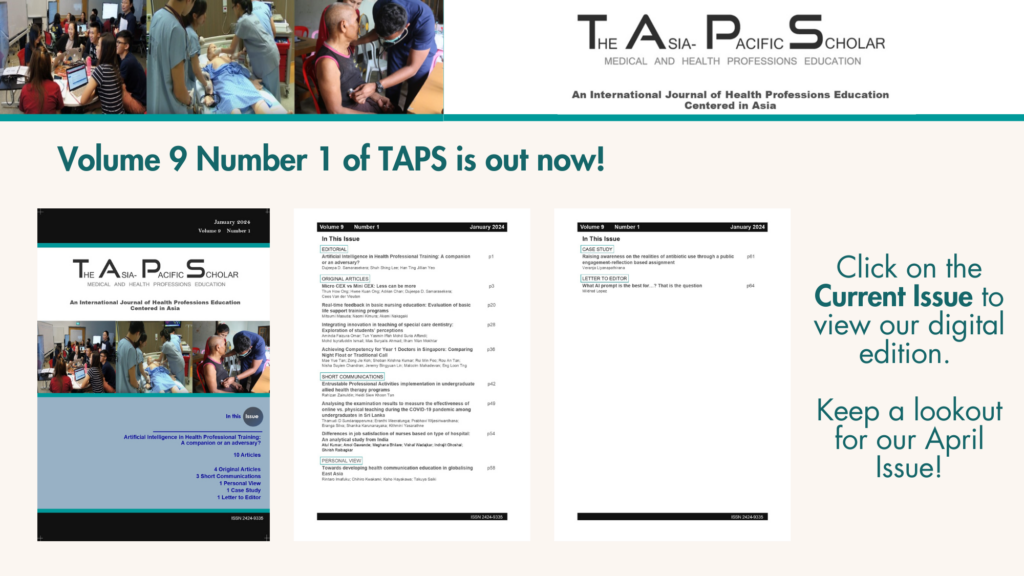
Congratulations, Dr Tri Nur Kristina and co-authors! - Volume 9 Number 1 of TAPS is out now! Click on the Current Issue to view our digital edition.
- Best Reviewer Awards 2022
TAPS would like to express gratitude and thanks to an extraordinary group of reviewers who are awarded the Best Reviewer Awards for 2022.
Refer here for the list of recipients. - Most Accessed Article 2022
The Most Accessed Article of 2022 goes to An urgent need to teach complexity science to health science students.
Congratulations, Dr Bhuvan KC and Dr Ravi Shankar. - Best Article Award 2022
The Best Article Award of 2022 goes to From clinician to educator: A scoping review of professional identity and the influence of impostor phenomenon.
Congratulations, Ms Freeman and co-authors. - Volume 8 Number 3 of TAPS is out now! Click on the Current Issue to view our digital edition.
- Best Reviewer Awards 2021
TAPS would like to express gratitude and thanks to an extraordinary group of reviewers who are awarded the Best Reviewer Awards for 2021.
Refer here for the list of recipients. - Most Accessed Article 2021
The Most Accessed Article of 2021 goes to Professional identity formation-oriented mentoring technique as a method to improve self-regulated learning: A mixed-method study.
Congratulations, Assoc/Prof Matsuyama and co-authors. - Best Reviewer Awards 2020
TAPS would like to express gratitude and thanks to an extraordinary group of reviewers who are awarded the Best Reviewer Awards for 2020.
Refer here for the list of recipients. - Most Accessed Article 2020
The Most Accessed Article of 2020 goes to Inter-related issues that impact motivation in biomedical sciences graduate education. Congratulations, Dr Chen Zhi Xiong and co-authors.