Ultrasound learning experiences in a Japanese student-led circle: A descriptive study

Submitted: 11 June 2025
Accepted: 10 June 2026
Published online: 6 October, TAPS 2026, 11(4), 34-43
https://doi.org/10.29060/TAPS.2026-11-4/OA3772
Shogo Tsuge1, Kenji Ohba2, Yasushi Matsuyama3, Shinnosuke Akeda1, Sayaka Ogawa1, Taiki Hosokawa1, Sanshiro Togo1, Takeji Saitoh4, Hiroshi Igarashi2 & Kazuo Umemura2
1Faculty of Medicine, 2Medical Education Centre, Hamamatsu University School of Medicine; 3Medical Education Centre, Jichi Medical University; 4Next Generation Creative Education Centre for Medicine, Hamamatsu University School of Medicine, Japan
Abstract
Introduction: Peer-assisted learning (PAL) is widely used to support collaborative clinical skill development. In Japan, PAL is often organised through student-led extracurricular groups known as circles or “bukatsudō”. This descriptive study examined the educational characteristics of a student-led ultrasound circle, the Hamamatsu Emergency Room Ultrasound (HERUS), and explored students’ learning experiences.
Methods: We conducted a retrospective survey of sixth-year medical students who completed their clinical clerkships. The duration and extent of HERUS members’ and non-members’ ultrasound learning were compared. Additionally, all 14 HERUS members were surveyed to examine factors associated with learning frequency and faculty recognition. Qualitative open-ended responses about perceived educational benefits were analysed using content analysis.
Results: HERUS members gained earlier ultrasound experience in the cardiac, abdominal, and neck regions, and were more likely to have performed cardiac ultrasound on patients during clerkship, than non-members. HERUS members with ≥30 months of participation reported more departments where HERUS was discussed with faculty. Half of the HERUS members practiced ultrasound with peers at least weekly. Content analysis indicated that wearing scrubs helped faculty identify HERUS members and provide them with opportunities for ultrasound practices on real patients. Self-motivating factors were collaborative PAL, perceived competence in ultrasound examinations in clinical settings, and self-paced, repetitive practice.
Conclusion: HERUS provided a culturally grounded, practical environment for student-led ultrasound learning. Qualitative patterns reflected factors corresponding to relatedness, competence, and autonomy in self-determination theory. These preliminary insights may help refine student-led PAL initiatives.
Keywords: Peer-Assisted Learning, Extracurricular Activities, Student-Led Ultrasound Circle, Japanese Student Circles
Practice Highlights
- A student-led ultrasound group offers early and frequent hands-on experience beyond the curriculum.
- Longer participation may be associated with increased opportunities for interaction with faculty.
- Culturally rooted activities could help sustain effective peer-assisted learning.
- Custom-designed attires may increase faculty visibility and signal students’ interest in ultrasound.
I. INTRODUCTION
In recent years, peer-assisted learning (PAL) has been increasingly recognised in medical education as an effective collaborative learning approach for knowledge and skills sharing. Numerous studies have demonstrated that PAL enhances learners’ comprehension and fosters autonomy and confidence in educational contexts (Ross & Cameron, 2007). Specifically, in acquiring clinical skills, peer-led instruction creates a psychologically safe environment conducive to repeated practice and immediate feedback. Such features are instrumental in consolidating practical knowledge and improving technical competence, making PAL a valuable strategy across various medical educational settings, including ultrasound training (Bapuji et al., 2024; Hirsch et al., 2025; Weimer et al., 2025).
In Japan, PAL has been uniquely developed within the framework of student-led extracurricular activities, commonly referred to as circles or “bukatsudō”. These activities have long been institutionalised in Japanese primary and secondary education and encompass both athletic and cultural pursuits (Cave, 2004; Onoda & Omi, 2023). Although technically extracurricular, circle activities are often intensive and long-term, emphasising discipline, perseverance, and hierarchical senior–junior student (senpai–kōhai) relationships, thereby playing a central role in students’ socialisation and character development (Sekiguchi & Ikeda, 2025).
Compared with their Western counterparts, Japanese student circles involve significantly more frequent participation, with regular meetings held over weekends and during school holidays. Although officially voluntary, circle activities witness significant participation from students, whereby they develop a strong sense of belonging and achievement through shared challenges and commitments (Cave, 2004; Onoda & Omi, 2023). Unlike mentoring between independent individual learners and teachers in Western contexts, Japan provides a culturally supportive environment for peer mentoring that does not rely on formal authority (Darling et al., 2002). This has led to the emergence of peer-supported learning environments in Japanese education.
Undergraduate medical education primarily occurs at tertiary level, wherein faculty-imposed regulations and hierarchical enforcement tend to be more relaxed. Upon entering university, students are expected to assume greater autonomy and responsibility for their learning, and student-led circles consequently become increasingly important peer-supported learning environments that help students navigate this transition. These circles not only foster autonomous learning and group cohesion but also provide a culturally familiar structure through which students can exercise self-direction within a supportive peer community. These activities often preserve cultural elements inherited from school-based circle activities, such as vertical relationships and shared goals (Sekiguchi & Ikeda, 2025). Beyond recreation, student circles function as informal educational platforms that foster leadership development, peer mentoring, and social integration – skills highly valued in both academic and professional contexts (Onoda & Omi, 2023). Thus, understanding Japan’s circle culture offers valuable insights into how educational practices shape emotional resilience, collectivism, and long-term commitment, which subsequently influence workplace culture and interpersonal dynamics in adulthood. These cultural factors are closely linked to the enduring informal hierarchical structures – senpai (seniors), kōhai (juniors), and dōki (same-year peers) – which significantly shape the development and sustainability of PAL in Japan (Sekiguchi & Ikeda, 2025).
Moreover, in Japan and several other East Asian contexts, undergraduate medical education has traditionally been characterised by teacher-centred instruction, frequent summative assessments, and limited opportunities for learner autonomy (Matsuyama et al., 2019). Rather than contradicting the autonomy observed in student-led circles, this teacher-centred structure may in fact heighten the value of extracurricular peer-driven learning spaces, where students can practice self-initiated learning, experiment with new skills, and support each other outside the constraints of formal curricula. These cultural and structural features have contributed to a growing interest in educational approaches that allow students to take more initiative and responsibility in their learning.
Building on this cultural and institutional context, our institution has supported a student-initiated ultrasound education circle, the Hamamatsu Emergency Room Ultrasound (HERUS), which was established in 2021 (Tsuge et al., 2024). Through a retrospective survey of student participants, this study examines how HERUS functions as a student-led learning environment and explores learning experiences that may relate to concepts discussed in motivation and social learning research.
II. METHODS
A. Overview of HERUS: A Student-Led Ultrasound Education Initiative
The HERUS Society was established in 2021 by six third-year undergraduate medical students and a certified echocardiologist during a period when clinical training was limited due to the coronavirus disease 2019 pandemic.
HERUS launched several innovative educational activities. The first was a weekly PAL session, in which peers served as simulated patients to facilitate hands-on practice (Figure 1a). The second involved periodic anatomical training sessions using porcine hearts, which have been recognised as effective instructional tools for learning cardiac anatomy and ultrasound techniques (White et al., 2021) (Figures 1b and 1c). In both sessions, senior students often instructed junior students; however, capable peers or junior students occasionally instructed their classmates or even senior students. In the third educational initiative, members wore custom-designed scrubs featuring probe illustrations during their clinical clerkships (Figure 1d).
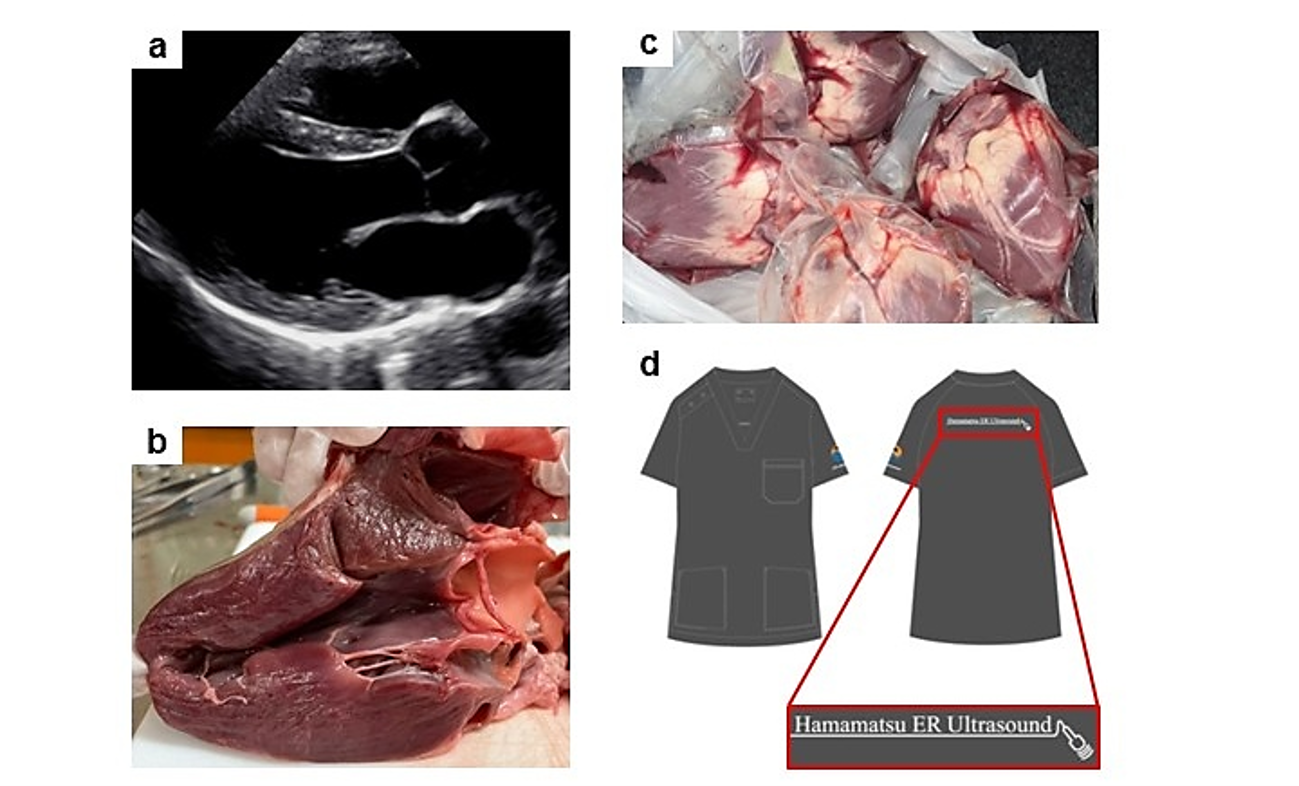
(a) Sonographic image of the long-axis view from a male undergraduate student obtained during a PAL session.
(b) Porcine heart section, mimicking the long-axis view, obtained during an anatomical training session.
(c) Edible porcine hearts purchased from a butcher shop.
(d) Custom-designed original scrubs from our student society, HERUS, featuring a probe logo to enhance the visibility of our society’s activities and encourage faculty engagement, resulting in increased echocardiography learning opportunities with real patients during clinical clerkships and a rise in purchases or donations of ultrasound-related devices
Figure 1. Integration of peer learning, anatomical simulation, and visual identity to promote undergraduate ultrasound education.
By March 2024, when the founding members graduated, HERUS had expanded to include more than 80 students. TS, one of the authors of this manuscript, has served as the faculty advisor for the student group since 2022, and KO, the corresponding author, has served as the associate advisor since 2023.
B. Study Design
This study combines results from quantitative and qualitative data in a manner similar to a convergent parallel design in mixed methods research (Moeller, 2016). A pragmatic paradigm was adopted, prioritising methodological choices that best address the research question (Shannon-Baker, 2016). Pragmatism was appropriate because the study aimed to obtain a comprehensive and practically meaningful understanding of how HERUS participation relates to ultrasound learning opportunities and faculty recognition. From a pragmatic perspective, qualitative and quantitative approaches are viewed as complementary, and their integration enables insights that are both contextually grounded and actionable for educational improvement.
C. Participants and Data Collection
1) Questionnaire Survey of HERUS Members and Non-Members:
To examine the differences in ultrasound learning opportunities between HERUS members and non-members, a cross-sectional survey was administered to sixth-year medical students who had completed their clinical clerkships. The survey was distributed in July 2023 to all sixth-year students at our institution (N = 116): 14 HERUS members and 102 non-members. Only the responses from participants who provided consent for research use were included in the analysis.
Participants were asked to report the timing of their first ultrasound experience (including practice with peers or simulators) across three anatomical regions: cardiac, abdominal, and neck. Responses were categorised into three periods: (1) Year 1–2; (2) Year 3 to the beginning of the clinical clerkship; and (3) from the beginning of the clinical clerkship to graduation. Additionally, the extent of ultrasound experience during clerkship was classified into three categories: (1) performed on patients, (2) performed on peers, and (3) observed only.
2) Questionnaire Survey of HERUS Members:
To further identify the factors influencing ultrasound learning opportunities and faculty recognition of HERUS activities, a follow-up survey was conducted among the 14 HERUS members. The questionnaire included the following items (response options in parentheses):
- Timing of HERUS enrolment
- Frequency of scrub wear during clerkship (≥ once per week, < once per week)
- Frequency of ultrasound practice on non-patient models (e.g., peers, phantoms) during clerkship (≥ once per week, < once per week)
- Number of departments in which HERUS was discussed with faculty during the clerkship
- Number of ultrasound scans performed on patients during the clerkship
- Open-ended responses regarding perceived educational benefits of HERUS activities
HERUS membership duration was calculated in months from the time of enrolment to graduation (March of Year 6) and categorised as < 30 months or ≥ 30 months.
D. Data Analysis
1) Quantitative Analysis:
Responses from HERUS and non-HERUS students were compared using chi-square (χ²) tests to examine differences in ultrasound experience across three anatomical regions. For the follow-up survey of HERUS members, independent samples t-tests were performed to evaluate differences in items iv and v according to scrub-wearing frequency, membership duration, and frequency of non-patient practice. All statistical analyses were conducted using GraphPad PRISM v7.0 (GraphPad Software, Inc., San Diego, CA, USA). Statistical significance was defined as two-sided p < 0.05.
2) Qualitative Analysis:
Open-ended item (vi) was analysed using qualitative content analysis, following conventional content analysis approaches (Castro et al., 2023). Two investigators (KO and YM) independently categorised all responses, compared their classifications, discussed discrepancies, and reached a consensus. After finalising the categories, other coauthors reviewed the raw data and category structure to confirm consistency. This process constituted investigator triangulation, thereby enhancing the credibility and trustworthiness of the qualitative findings.
Category labels were generated through an iterative abstraction process and were grounded in students’ descriptive accounts. Labels such as “Sense of belonging and mutual support,” “Sharing tips among students,” or “Self-paced repetitive practice,” were selected to reflect the meanings conveyed in the raw data rather than to map onto predetermined theoretical constructs. The terminology used was chosen for clarity and interpretability in reporting the descriptive qualitative results.
Integrating these qualitative categories with quantitative indicators allowed the examination of not only whether HERUS involvement was associated with enhanced learning opportunities, but also how students experienced these opportunities and why they perceived them as beneficial.
E. Use of Generative Artificial Intelligence
During the preparation of this work, the authors used ChatGPT-5.1(OpenAI; San Francisco, CA) to improve the language and readability of the text. After using ChatGPT-5.1, the authors have reviewed and edited the content as needed and take full responsibility for the content of the publication.
III. RESULTS
A. Comparison Between HERUS Members and Non-Members
Of the 116 sixth-year medical students invited to participate in the survey (14 HERUS members and 102 non-members), 99 responded (13 HERUS members and 86 non-members), yielding an overall response rate of 85.3%. HERUS members reported a significantly earlier ultrasound experience than non-members across all three anatomical regions (cardiac, abdominal, and neck) (Figure 2a). Most HERUS members gained hands-on ultrasound experience before beginning their clinical clerkship.
Regarding ultrasound experience during clerkship, HERUS members were significantly more likely to have performed cardiac ultrasound on patients compared to non-members (Figure 2b). A similar trend was observed for abdominal ultrasound; however, the difference was not statistically significant. While a small number of non-members only observed ultrasound procedures during graduation, none of the HERUS members reported such limited exposure.
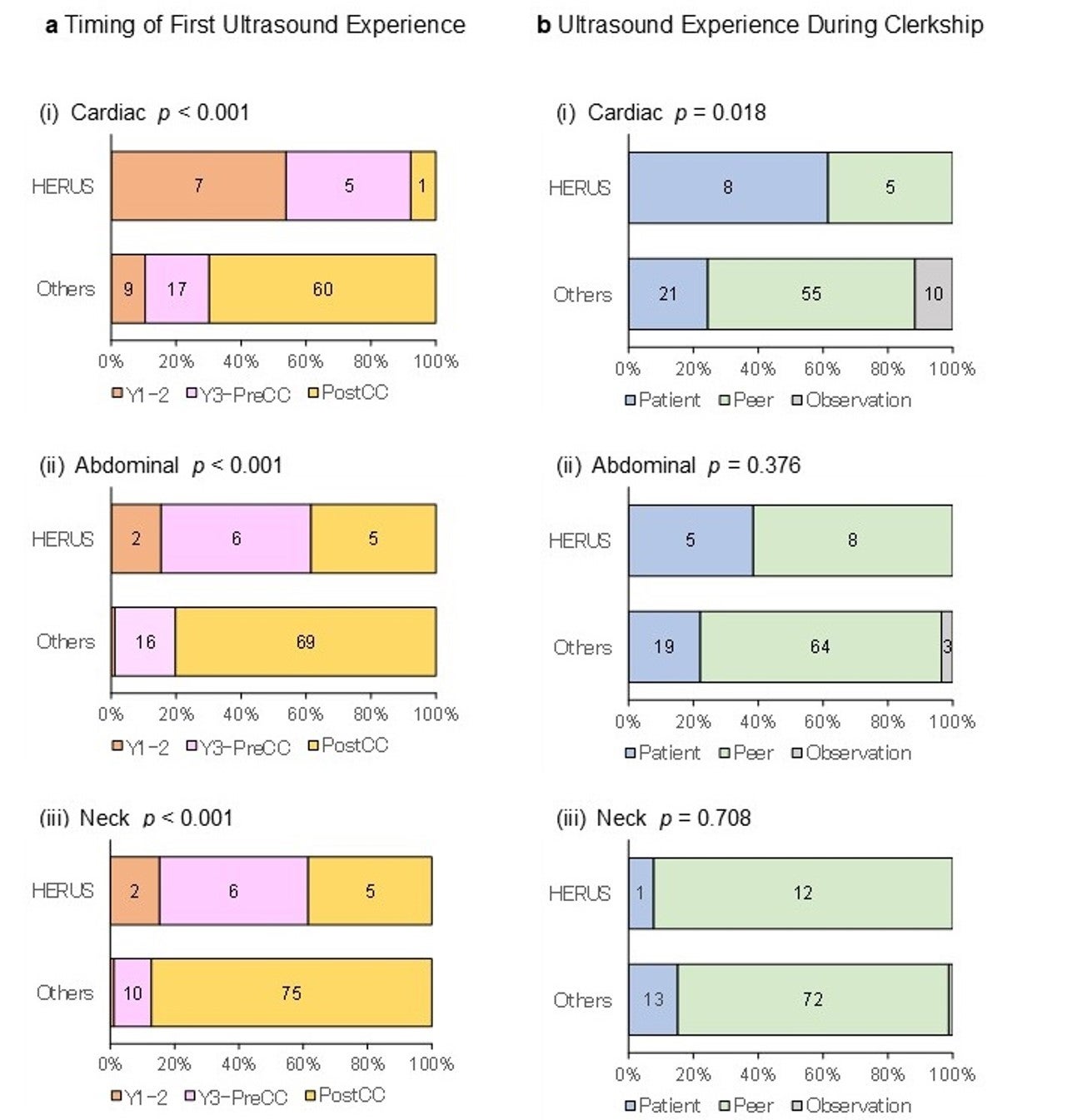
(a) Timing of first ultrasound experience (cardiac, abdominal, and neck ultrasound) among HERUS members (n = 13) and non-members (n = 86). Y1–2: performed during Years 1–2; Y3–PreCC: performed during Year 3 to pre–clinical clerkship; PostCC: performed after the beginning of clinical clerkship through graduation. p-values were calculated using the chi-square test.
(b) Extent of ultrasound experience during clinical clerkship. “Patient” denotes practice on patients, “Peer” represents practice with peers, and “Observation” denotes observation only.
Figure 2. Differences in ultrasound experience between HERUS members and non-members.
B. Findings from HERUS Member Survey
All 14 HERUS members completed the survey. One student could not recall the number of departments mentioned by HERUS during faculty conversations, leaving only 13 responses.
Students who wore HERUS scrubs at least once a week reported recognition of HERUS by faculty members in more departments, although this difference was not statistically significant (Figure 3a). Conversely, students with ≥ 30 months of HERUS membership reported significantly more departments discussing HERUS during clerkship than those with < 30 months (Figure 3b).
Seven students (50%) reported practicing ultrasound on non-patient models at least once a week (Figure 3c, f). However, no significant association was found between the practice frequency and the number of departments in which HERUS was discussed (Figure 3c).
No statistically significant associations were found between the number of patients who underwent ultrasound and any of the following factors: scrub wear frequency, HERUS membership duration, or non-patient practice frequency (Figure 3d–f).
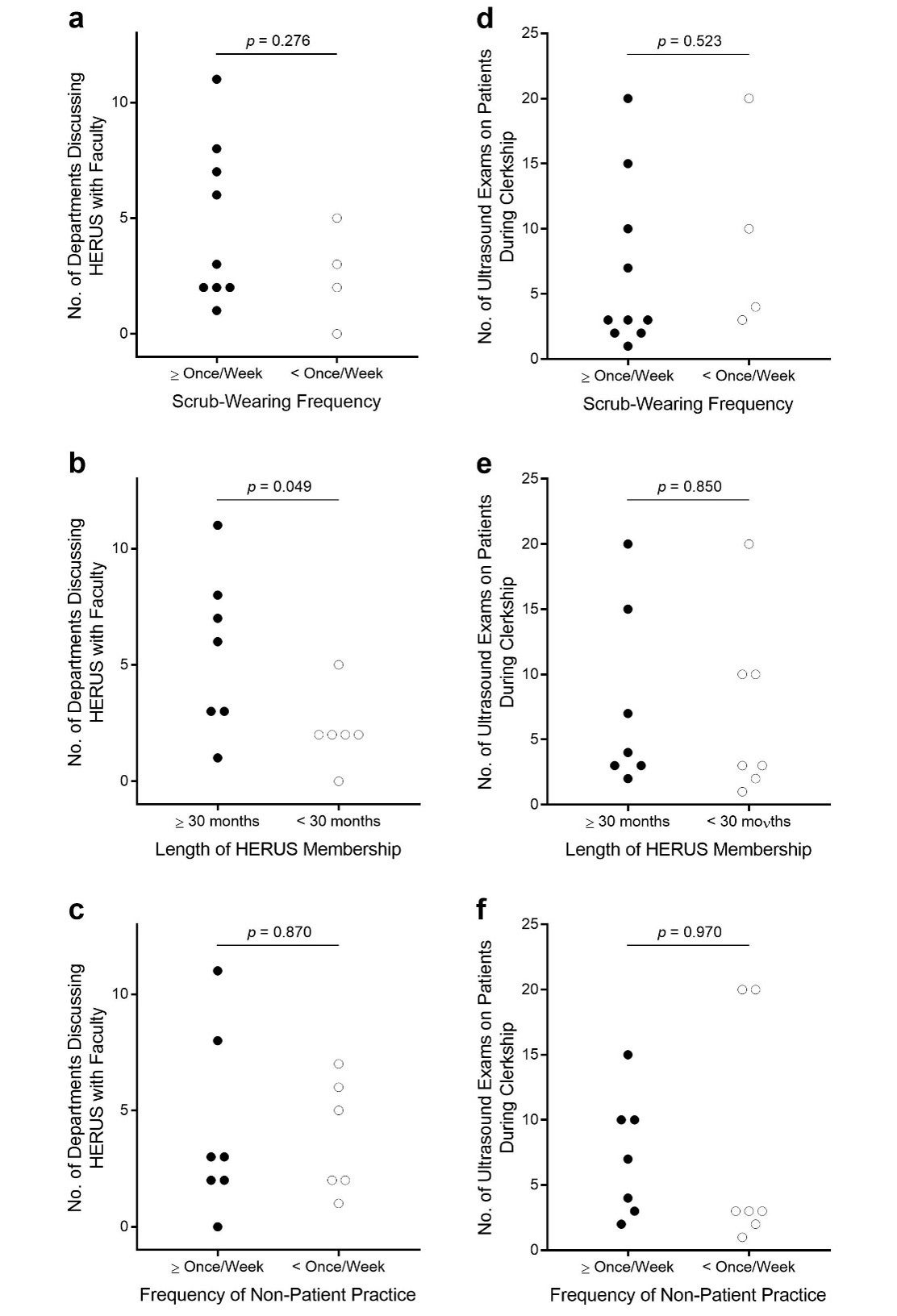
(a–c) Associations of scrub-wearing frequency, HERUS membership duration, and frequency of non-patient practice with faculty recognition of HERUS.
(d–f) Associations of the same three factors with ultrasound experience involving real patients during clinical clerkship.
Figure 3. Influence of student engagement and visibility on faculty recognition and ultrasound experience during clinical clerkship.
|
Category |
Subcategory |
Representative Student Excerpts |
|
Collaborative PAL in the HERUS |
Sense of belonging and mutual support |
“Teaching other students also enhanced the learning of those who served as instructors.” |
|
Sharing tips among students through teaching and learning |
“We could share ultrasound techniques and knowledge we had individually learned, which helped us acquire skills more broadly than practicing alone.” |
|
|
Perceived competence when given the opportunity to perform ultrasound examinations in real clinical settings |
Expanded opportunities through HERUS identity |
“Wearing the HERUS scrubs, I was invited several times— ‘Do you want to try the ultrasound?’” |
|
Confidence gained from repeated experience in real clinical settings |
“I received many more chances to perform procedures, especially during the emergency term.” / “When offered a chance to perform ultrasound, I could confidently take it.” |
|
|
Students’ self-paced repetitive practice toward self-motivation in real settings |
Self-paced repetitive practice |
“We had weekly ultrasound study sessions.” / “Daily ultrasound practice.” |
|
Motivation gained from repeated practice in preparation for real settings |
“By practicing several times, I learned the basics and felt more confident.” / “Since I had learned the basic movements, I could easily try taking an ultrasound during ward rotations.” |
Abbreviations: HERUS, Hamamatsu Emergency Room Ultrasound; PAL, peer-assisted learning.
Table 1. Categories Derived from Students’ Reflections on the HERUS Ultrasound Initiative.
Qualitative analysis of the open-ended responses identified three descriptive categories that illustrated how students perceived educational benefits from participating in HERUS (Table 1).
First, Collaborative PAL in the HERUS were noted, including mutual support and the sharing of tips and techniques among peers. These interactions were described as enhancing approachability and reinforcing understanding.
Second, students reported increased perceived competence in real clinical settings, including confidence when invited to perform an ultrasound and expanded opportunities linked to visible HERUS affiliation. Authentic participation contributed to a sense of growth.
Third, students described self-paced repetitive practice as an important component of their learning, noting that regular independent or group practice sessions helped them acquire foundational skills and initiate scans more readily during clerkship.
Together, these categories highlight how HERUS provided students with practical opportunities that supported their skill development, confidence, and engagement in clinical learning environments.
IV. DISCUSSION
This descriptive study examined the educational characteristics of a student-led ultrasound initiative and explored how participants experienced ultrasound learning opportunities. Rather than interpreting the findings using predetermined theoretical frameworks, we focused on documenting the actual tasks undertaken by the students, the emergent learning opportunities, and the development of these experiences within their clinical environment. Additionally, we conducted a data-driven qualitative content analysis to describe students’ reflections in their own terms, which represented multiple ways in which HERUS members perceived educational benefits (Table 1). The quantitative findings showed that, compared to non-members, HERUS participants gained significantly earlier experiences with ultrasound scans across multiple anatomical regions, such as the cardiac, abdominal, and neck regions (Figure 2). Cardiac ultrasound is inherently challenging because of the dynamic nature of the heart, and its educational effectiveness is limited by the low fidelity of phantom models and high cost of dedicated simulators (Weimer et al., 2023). Within such constraints, HERUS members could enhance their skills through repeated PAL sessions, where students alternately played the roles of examiner and examinee. These sessions enabled real-time peer feedback and visible skill progression, which aligns with the qualitative findings indicating the students’ growing sense of competence (Table 1).
In the quantitative analysis, half of the members practiced ultrasound on non-patient models (e.g., peers or phantoms) at least once per week during clerkship, with some performing additional scans on patients (Figure 3). These quantitative patterns align with the qualitative descriptions (Table 1), indicating that students engaged in repeated, self-directed practice and sought opportunities to apply their skills in clinical settings.
Despite this variability, practice frequency was not associated with faculty recognition (Figure 3c), suggesting that interpersonal factors such as membership duration or clinical context may have a greater influence than practice frequency alone. Longer membership duration (≥ 30 months) was associated with discussions on HERUS across a greater number of departments (Figure 3b). This suggests that sustained participation not only provides continuity of practice but may also increase students’ visibility to the faculty. If longer membership and broader discussions on HERUS across departments translated into more opportunities to perform ultrasound examinations in real clinical settings, this could provide a meaningful explanation for the qualitative category in which students described a perceived sense of competence when given such opportunities (Table 1).
Although the scrub-wearing frequency was not statistically associated with faculty recognition or the number of scans performed (Figure 3a, d), one student reported that wearing HERUS scrubs prompted the faculty to invite them to undergo ultrasound examinations (Table 1). Prior research has suggested that medical students’ attire can serve as a social signal of professionalism and engagement (Ahmed et al., 2020). Visible affiliation may therefore function as a practical cue that signals students’ interest in and readiness to participate in ultrasound-related tasks.
Overall, integrating the quantitative and qualitative findings suggests that the categories derived from the qualitative content analysis (Table 1)—(a) collaborative PAL within HERUS, (b) perceived competence when given opportunities to perform ultrasound examinations in real clinical settings, and (c) self-directed repetitive practice—help explain how earlier and more frequent learning opportunities observed in the quantitative results (Figure 2) were experienced and interpreted by the students.
Self-determination theory (SDT) posits that human motivation and sustained engagement are supported by the fulfilment of three basic psychological needs (Deci & Ryan, 1985): autonomy (experience of self-directed action), competence (sense of effectiveness in one’s activities), and relatedness (feeling of connection with others). In this study, the three categories identified through the qualitative content analysis (Table 1) aligned conceptually with the elements commonly discussed in SDT. Educational relationships in PAL resemble relatedness; perceived competence, when given opportunities to perform ultrasound examinations in real clinical settings, corresponds to competence; and self-directed repetitive practice reflects aspects of autonomy. These connections do not constitute a theoretical claim; however, they suggest that student-led ultrasound activities may naturally foster learning conditions that parallel SDT’s three basic psychological needs, even though SDT did not guide data collection or analysis in this study.
Although these conceptual parallels remain exploratory and were not empirically evaluated, building on these descriptive observations, future program development could intentionally structure PAL learning activities to further support relatedness, competence, and autonomy. Despite the growing body of literature demonstrating the effectiveness and wide application of peer teaching in ultrasound education, training approaches remain heterogeneous, and no unified framework has yet been established (Winter et al., 2024). In this context, student-led ultrasound circles may offer a potential avenue for gradually refining PAL practices. By modestly incorporating elements that could enhance relatedness, competence, and autonomy, such initiatives may contribute to the development of more coherent and sustainable approaches to undergraduate ultrasound education, although further investigation will be needed to clarify their broader impact.
This study had several limitations. First, the sample size of the HERUS members was small, which might have limited the statistical power of the analyses. Second, the students who chose to join HERUS may have had a higher baseline level of motivation, introducing a potential selection bias. Third, faculty recognition of HERUS activities was based on student self-reports and may not reflect objective evaluations. Fourth, although qualitative comments were interpreted in relation to concepts discussed in motivational research, the study was not designed to measure psychological constructs such as autonomy, competence, or relatedness, and no validated scales were used. Therefore, these qualitative patterns should be understood as being descriptive rather than as evidence of underlying theoretical mechanisms. Finally, because this was a retrospective, self-reported survey, recall bias and variability across clerkship environments may have influenced responses. To build on these preliminary observations, future studies should incorporate larger samples, validated motivation measures, and prospective designs that can more rigorously evaluate how structured PAL environments influence learner development.
V. CONCLUSION
This preliminary descriptive study highlights that the educational value of HERUS lies in its ability to provide frequent practice opportunities, promote peer collaboration, enhance visibility to faculty, and encourage active participation during undergraduate education. These features suggest that HERUS can serve as a practical and sustainable complement to formal ultrasound education. Content analysis of the open-ended questions in the questionnaire showed that students experienced benefits in terms of peer relationships, perceived competence in authentic clinical settings, and self-directed practice. Taken together, these elements align with relatedness, competence, and autonomy as described in self-determination theory. Future program development may build on these observations to further strengthen these elements and explore their potential effects on learners’ motivation and skill development.
Notes on Contributors
Shogo Tsuge reviewed the literature, designed the study, collected and analysed the data, and drafted the manuscript.
Kenji Ohba reviewed the literature, designed the study, collected and analysed the data, and drafted the manuscript.
Yasushi Matsuyama reviewed the literature, designed the study, analysed the data, and provided critical feedback on the manuscript.
Shinnosuke Akeda contributed to the study design and facilitated data collection.
Sayaka Ogawa contributed to the study design and facilitated data collection.
Taiki Hosokawa contributed to the study design and facilitated data collection.
Sanshiro Togo contributed to the study design and facilitated data collection.
Takeji Saitoh contributed to the study design and facilitated data collection.
Hiroshi Igarashi contributed to the study design and facilitated data collection.
Kazuo Umemura designed the study and provided critical feedback on the manuscript.
Ethical Approval
Approval to conduct this study was obtained from the Ethics Committee of Hamamatsu University School of Medicine (approval number: 24-095), and informed consent was obtained from all participants.
Data Availability
The data that support the findings of this study, including the qualitative data written in Japanese, are available from the authors upon reasonable request.
Acknowledgement
The authors wish to express their sincere gratitude to all those who contributed to this study, including the participants. In particular, they would like to thank Dr. Naoto Toda and Dr. Noriaki Shimamoto, who, together with the four author-members (Shogo Tsuge, Shinnosuke Akeda, Taiki Hosokawa, and Sanshiro Togo) were part of the “Original Six” founding members of HERUS. The authors also thank Dr. Hiromitsu Kataoka and Prof. Yuko Suzuki for their invaluable guidance during the early development of the group.
Funding
This research did not receive any specific grant from funding agencies in the public, commercial, or non-profit sectors.
Declaration of Interest
The authors declare that they have no commercial or financial relationships that could be construed as a potential conflict of interest.
References
Ahmed, A., Israr, S., Chapple, K. M., Wang, W., Jamjoom, A., & Mahmud, A. (2020). Patient perception of medical student professionalism: Does attire matter? Journal of Surgical Education, 77(6), 1345–1349. https://doi.org/10.1016/j.jsurg.2020.04.016
Bapuji, R., Eagles, D., Ferreira, N., Hecht, N., Zhang, Y., Woo, M. Y., Cheung, W. J., Ly, V., & Pageau, P. (2024). Comparison of peer-assisted learning with expert-led learning in medical school ultrasound education: A systematic review and meta-analysis. Canadian Journal of Emergency Medicine, 26(3), 188–197. https://doi.org/10.1007/s43678-024-00663-x
Castro, L., Gessler, T., & Majó-Vázquez, S. (2023). Content analysis in mixed method approaches. In F. Oehmer-Pedrazzi, S. H. Kessler, E. Humprecht, K. Sommer, & L. Castro (Eds.), Standardized content analysis in communication research (pp. 37–58). Springer VS. https://doi.org/10.1007/978-3-658-36179-2_4
Cave, P. (2004). “Bukatsudô”: The educational role of Japanese school clubs. Journal of Japanese Studies, 30(2), 383–415. https://doi.org/10.1353/jjs.2004.0041
Darling, N., Hamilton, S. F., Toyokawa, T., & Matsuda, S. (2002). Naturally occurring mentoring in Japan and the United States: Social roles and correlates. American Journal of Community Psychology, 30(2), 245–270.https://doi.org/10.1023/A:1014684928461
Deci, E. L., & Ryan, R. M. (1985). Conceptualizations of intrinsic motivation and self-determination. In Intrinsic motivation and self-determination in human behaviour (pp. 11–40). Springer. https://doi.org/10.1007/978-1-4899-2271-7_2
Hirsch, C., Audet, E., Dawood, E., Beardmore, F., Hussain, N., Wong, W. C., Barry, R. J., & Buckley, S. (2025). Participation in a pre-registration student interprofessional education (IPE) society: Influence on subsequent professional practice. Frontiers in Medicine, 11, Article 1497799. https://doi.org/10.3389/fmed.2024.1497799
Matsuyama, Y., Nakaya, M., Okazaki, H., Lebowitz, A. J., Leppink, J., & van der Vleuten, C. (2019). Does changing from a teacher-centred to a learner-centred context promote self-regulated learning? A qualitative study in a Japanese undergraduate setting. BMC Medical Education, 19, Article 152.https://doi.org/10.1186/s12909-019-1550-x
Moeller, A. J. (2016). The confluence of language assessment and mixed methods. In A. J. Moeller, J. W. Creswell, & N. Saville (Eds.), Second language assessment and mixed methods research (pp. 3–16). Cambridge University Press.
Onoda, R., & Omi, Y. (2023). The value of extracurricular activities to Japanese junior high school students: Focusing on the expression of a school’s attractiveness in writing. Frontiers in Education, 8, Article 1284618. https://doi.org/10.3389/feduc.2023.1284618
Ross, M. T., & Cameron, H. S. (2007). Peer assisted learning: A planning and implementation framework: AMEE Guide No. 30. Medical Teacher, 29(6), 527–545. https://doi.org/10.1080/01421590701665886
Sekiguchi, T., & Ikeda, M. (2025). The informal structure of senpai (seniors), kohai (juniors), and doki (peers) in Japanese organizations. Encyclopedia, 5(2), Article 49. https://doi.org/10.3390/encyclopedia5020049
Shannon-Baker, P. (2016). Making paradigms meaningful in mixed methods research. Journal of Mixed Methods Research, 10(4), 319–334. https://doi.org/10.1177/1558689815575861
Tsuge, S., Hosokawa, T., Togo, S., Toda, N., Ohba, K., & Kataoka, H. (2024, August 24–28). Student-centred unique learning activities in undergraduate ultrasound education [Conference presentation abstract]. AMEE 2024 Annual Conference, Basel, Switzerland. https://doi.org/10.21955/mep.1115494.1
Weimer, J., Rolef, P., Müller, L., & Löffler, S. (2023). FoCUS cardiac ultrasound training for undergraduates based on current national guidelines: A prospective, controlled, single-centre study on transferability. BMC Medical Education, 23, Article 80. https://doi.org/10.1186/s12909-023-04062-1
Weimer, J., Yilmaz, D., Ille, C., Weinmann-Menke, J., Müller, L., Büchner, H., Buggenhagen, H., Stäuber, M., Neubauer, R., Winter, L., Weimer, A., Dirks, K., Künzel, J., Rink, M., Dionysopoulou, A., Lorenz, L., Kloeckner, R., Recker, F., & Schiestl, L. (2025). Quality assessment of a training program for undergraduate sonography peer tutors: Paving the future way for peer-assisted learning in medical ultrasound education. Frontiers in Medicine, 12, Article 1492596. https://doi.org/10.3389/fmed.2025.1492596
White, A., Singh, G., Moon, M. C., & Frohlich, J. (2021). Current status of simulation use in Canadian cardiac surgery training programs. Canadian Journal of Cardiology, 37(10), 1639–1643. https://doi.org/10.1016/j.cjca.2021.04.020
Winter, L., Neubauer, R., Weimer, J., Dietrich, C. F., Wittek, A., Schiestl, L., Marinova, M., Schäfer, V. S., Strizek, B., & Recker, F. (2024). Peer teachers as ultrasound instructors? A systematic literature review of peer teaching concepts in undergraduate ultrasound education. BMC Medical Education, 24(1), Article 1369. https://doi.org/10.1186/s12909-024-06345-7
*Kenji Ohba
Medical Education Center,
Hamamatsu University School of Medicine,
1-20-1 Handayama, Chuo-ku,
Hamamatsu, Shizuoka 431-3192, Japan
Email: ohbak@hama-med.ac.jp
Announcements
- Best Reviewer Awards 2025
TAPS would like to express gratitude and thanks to an extraordinary group of reviewers who are awarded the Best Reviewer Awards for 2025.
Refer here for the list of recipients. - Most Accessed Article 2025
The Most Accessed Article of 2025 goes to Analyses of self-care agency and mindset: A pilot study on Malaysian undergraduate medical students.
Congratulations, Dr Reshma Mohamed Ansari and co-authors! - Best Article Award 2025
The Best Article Award of 2025 goes to From disparity to inclusivity: Narrative review of strategies in medical education to bridge gender inequality.
Congratulations, Dr Han Ting Jillian Yeo and co-authors! - Best Reviewer Awards 2024
TAPS would like to express gratitude and thanks to an extraordinary group of reviewers who are awarded the Best Reviewer Awards for 2024.
Refer here for the list of recipients. - Most Accessed Article 2024
The Most Accessed Article of 2024 goes to Persons with Disabilities (PWD) as patient educators: Effects on medical student attitudes.
Congratulations, Dr Vivien Lee and co-authors! - Best Article Award 2024
The Best Article Award of 2024 goes to Achieving Competency for Year 1 Doctors in Singapore: Comparing Night Float or Traditional Call.
Congratulations, Dr Tan Mae Yue and co-authors! - Best Reviewer Awards 2023
TAPS would like to express gratitude and thanks to an extraordinary group of reviewers who are awarded the Best Reviewer Awards for 2023.
Refer here for the list of recipients. - Most Accessed Article 2023
The Most Accessed Article of 2023 goes to Small, sustainable, steps to success as a scholar in Health Professions Education – Micro (macro and meta) matters.
Congratulations, A/Prof Goh Poh-Sun & Dr Elisabeth Schlegel! - Best Article Award 2023
The Best Article Award of 2023 goes to Increasing the value of Community-Based Education through Interprofessional Education.
Congratulations, Dr Tri Nur Kristina and co-authors! - Best Reviewer Awards 2022
TAPS would like to express gratitude and thanks to an extraordinary group of reviewers who are awarded the Best Reviewer Awards for 2022.
Refer here for the list of recipients. - Most Accessed Article 2022
The Most Accessed Article of 2022 goes to An urgent need to teach complexity science to health science students.
Congratulations, Dr Bhuvan KC and Dr Ravi Shankar. - Best Article Award 2022
The Best Article Award of 2022 goes to From clinician to educator: A scoping review of professional identity and the influence of impostor phenomenon.
Congratulations, Ms Freeman and co-authors.