The TRUST framework: Five pillars for rebuilding health professions education systems

Submitted: 26 July 2026
Accepted: 7 August 2026
Published online: 6 October, TAPS 2026, 11(4), 1-6
https://doi.org/10.29060/TAPS.2026-11-4/SP102026
Dujeepa D. Samarasekera1, Jillian Yeo1, Gominda Ponnamperuma1,2 & Shuh Shing Lee1
1Centre for Medical Education (CenMED), Yong Loo Lin School of Medicine, National University of Singapore, Singapore; 2Department of Medical Education, University of Colombo, Sri Lanka
I. INTRODUCTION
Health professions education is facing a crisis. Workforce shortages are widening across medicine, nursing, dentistry and allied health. This inequity is reflected not only in absolute shortages, but also in the maldistribution of resources, with urban centres often better served than rural and underserved communities. The World Health Organization estimates a projected shortfall of 10 million health workers by 2030, concentrated largely in low- and middle-income countries and in rural regions of wealthier nations (World Health Organization, 2016, 2026). These projections are not confined to a single discipline or geography.
However, the workforce challenge is not simply one of numbers, but of preparedness. Health professions education must produce holistic clinical practitioners who can meet the needs of the communities they serve professionals who think critically, recognise their own limits, practise safely, communicate effectively, and work collaboratively within interprofessional teams.
When such practitioners are absent, unevenly distributed or insufficiently prepared for community-based care, the consequences extend well beyond waiting lists. Preventable conditions progress into chronic disease and patients in rural and underserved settings often present later, with more advanced pathology and poorer outcomes. This challenge is intensified by the rising global burden of non-communicable diseases cardiovascular disease, diabetes, cancer and chronic respiratory illness while training remains too often centred on tertiary hospitals, urban settings and standardised models insufficiently responsive to local health needs.
Even where practitioners are available, many have been prepared in systems that privilege technical proficiency over empathy, communication, teamwork, contextual judgement and safe practice. The Lancet Global Health Commission, drawing on 73 experts from 25 countries, called for training quality to be updated with renewed emphasis on competency and for enabling working environments to be created (Burton et al., 2021). Yet most reform efforts continue to address isolated components a new simulation laboratory here, a revised assessment rubric rather than the education system as a whole. What appears to be a workforce crisis is, at its root, an education systems crisis. And what appears to be a technology gap is, in fact, an education gap. Together, these reframings present educational reform as a key lever for reducing the global burden of disease and narrowing rural-urban disparities in healthcare access.
This paper proposes the TRUST Framework (Figure 1): five interdependent pillars for Technology-Enhanced Learning, Readiness through Graded Responsibility, Upskilling Educators, Safe Learning Environments and Team-Based and Institutional Support designed to function as an integrated system rather than a collection of standalone initiatives. The goal is not simply to produce more graduates, but to nurture practitioners who are clinically competent, empathetic, safe and able to work as part of interprofessional teams in an era defined by artificial intelligence and accelerating technological change.
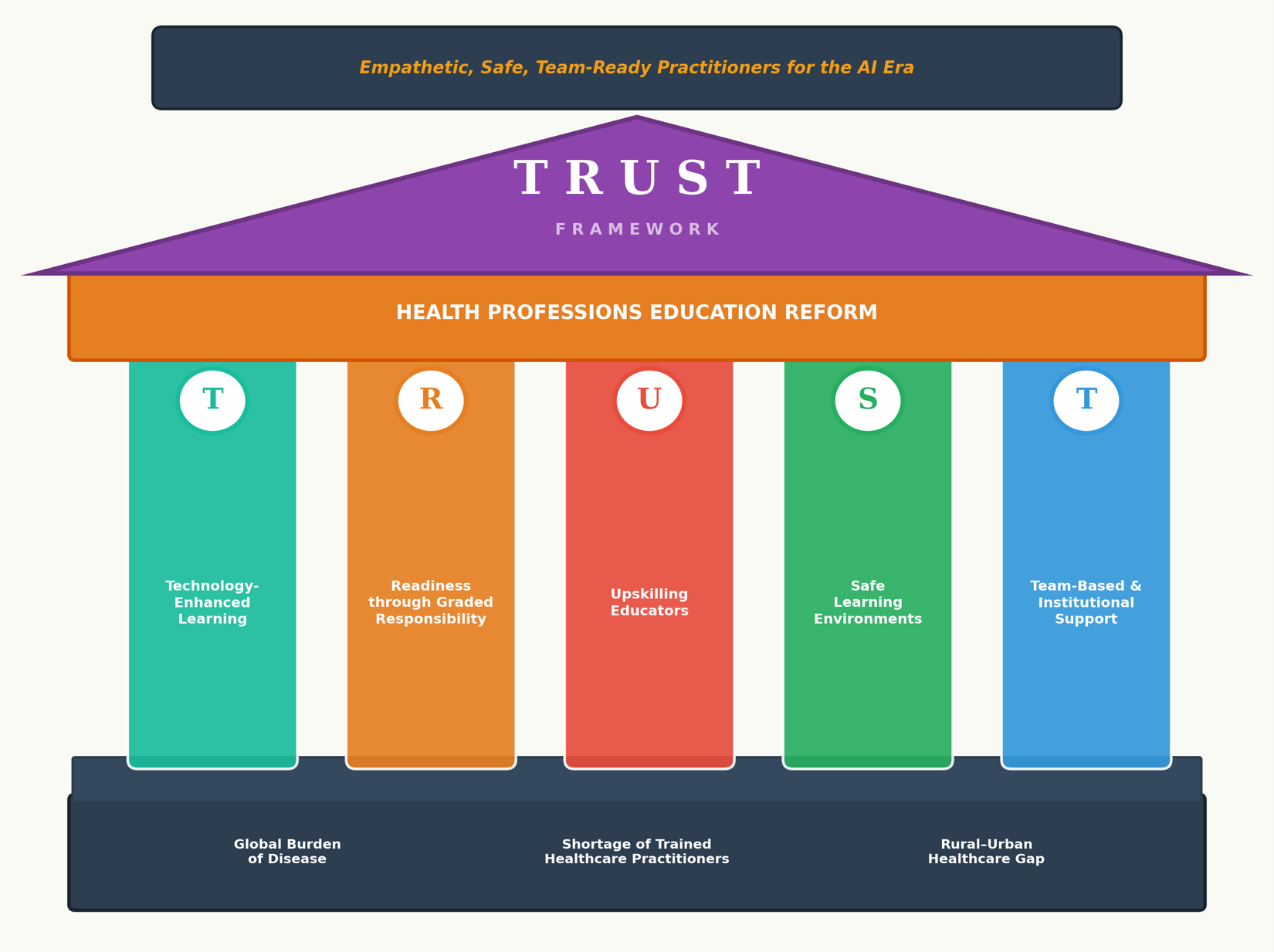
Figure 1. The TRUST Framework: Five interdependent pillars for health professions education reform addressing the global burden of disease, shortage of trained healthcare practitioners, and the rural-urban healthcare gap to nurture empathetic, safe, and team-ready practitioners for the era of AI and technological change.
Note: This figure was generated using OpenAI GPT-5.5 to create a conceptual illustration. The authors reviewed and edited all generated outputs and take full responsibility for the integrity and final content.
II. THE FIVE PILLARS
A. Pillar 1: Technology-Enhanced Learning
The gap between what technology can do and what educators actually use it for remains wide. In a 2025 international survey, nearly 70% of clinicians recognised the potential of artificial intelligence to improve clinical outcomes, yet only 7.2% reported regular use, with familiarity significantly higher among those in academic settings (Desideri et al., 2025). The barrier is not access to technology alone, but its meaningful integration into training.
Three functions matter most. First, AI-assisted learning can accelerate diagnostic training by exposing trainees to thousands of cases that would take years to encounter in clinical rotations alone. Second, real-time feedback systems using AI can allow learners to refine clinical reasoning through immediate error correction and deliberate practice at scale. Third, adaptive tutoring platforms can personalise learning trajectories without requiring one-to-one faculty time, identifying gaps and adjusting difficulty in response to individual performance.
None of this replaces the clinical teacher. It reclaims clinical time for what only humans can do: supervised practice with real patients, the modelling of professional judgement and the cultivation of empathy and communication qualities that no algorithm can replicate. The COVID-19 pandemic demonstrated that knowledge-transfer teaching can and should move online and asynchronously, freeing face-to-face time for supervised deliberate practice (Samarasekera et al., 2022). In a period when health systems worldwide need practitioners who can work alongside AI rather than be displaced by it, training programmes must equip graduates to use these tools critically and responsibly.
B. Pillar 2: Readiness through Graded Responsibility
Traditional training models often require learners to complete a fixed number of years, accumulate a required case volume and pass a summative examination, treating time as a proxy for competence. It is a poor proxy. Two trainees with identical case logs can possess very different levels of skill and judgement. The entrustability model, grounded in Entrustable Professional Activities (EPAs) introduced by ten Cate (2005), asks a different question: not “how long have you trained?” but “can you be trusted to perform this task independently?”.
EPAs define units of professional practice, and trainees progress from full supervision to independence as they demonstrate competence through direct observation and developmental feedback. This approach has been adopted across multiple professions. Nursing education has developed undergraduate EPA frameworks translating competencies into observable clinical practice (Lau et al., 2020) and physiotherapy, dentistry and surgical training have followed similar paths.
The challenge is not conceptual buy-in. A 2026 survey found that while most programme directors support competency-based education, only 22% of residency programmes use EPA-based assessments, with time for observation and documentation cited as the primary barrier (Jenkins et al., 2026). This implementation gap is not a flaw in the model, it signals that investment in the educators who use these tools remains insufficient. Critically, the entrustability model also shifts the relationship between supervisor and trainee from surveillance to developmental partnership, creating space for the graduated autonomy that builds competence, confidence and professional identity.
C. Pillar 3: Upskilling Educators
Faculty development is the single highest-leverage intervention in any education system. Train one educator well and the effect cascades across hundreds of trainees over a career and, through them, to thousands of patients. Yet faculty development remains under-resourced and is frequently treated as peripheral to the core business of clinical departments.
An environmental scan across five countries in the Asia Pacific region revealed that while faculty development programmes exist, they vary considerably in structure and sustainability, and that year-round collaborative approaches such as writing retreats and peer networks of the Asia Pacific Medical Education Network produce more durable outcomes than isolated workshops (Samarasekera et al., 2020).
Faculty development must now extend beyond teaching methods. Educators need AI literacy not to become data scientists, but to understand what these tools can and cannot do and to model critical appraisal of algorithmic outputs for their trainees. They need simulation-based teaching competence, so that expensive simulation facilities do not sit underused for lack of trained facilitators. They also need the skills to foster psychologically safe learning spaces, creating the conditions under which trainees can admit uncertainty, ask for help and learn from error rather than conceal it. Without this investment in educators, every other reform such as better technology, better assessment frameworks and better curricula will stall at the point of implementation.
D. Pillar 4: Safe Learning Environments
Entrustability presupposes trust, and trust presupposes safety. A trainee cannot demonstrate readiness for independent practice in a culture where admitting uncertainty invites humiliation. Clark’s four-stage model (Clark, 2020) of psychological safety Inclusion Safety, Learner Safety, Contributor Safety and Challenger Safety has been applied to health professions education by a global community of practice (Dong et al., 2025). The progression is sequential: a learner must first feel that they belong, then that they can make mistakes without punishment, then that they can contribute to clinical decisions, and finally that they can respectfully question a supervisor (Figure 2).
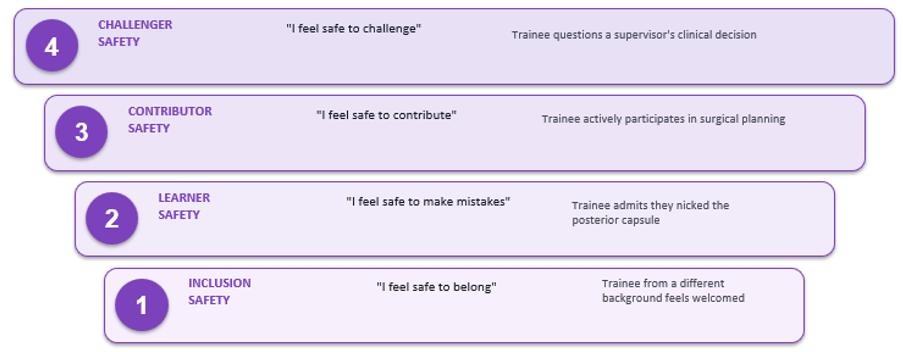
Figure 2. Timothy Clark’s model – Four stages of Psychological Safety
Note: This figure was generated using OpenAI GPT-5.5 to create a conceptual illustration. The authors reviewed and edited all generated outputs and take full responsibility for the integrity and final content.
Clinical training environments have historically privileged endurance over vulnerability and silence over inquiry. Hierarchical and punitive cultures impair error disclosure, suppress speaking-up behaviours, reduce feedback uptake and increase cognitive load during performance. A psychologically unsafe environment does not merely harm the learner; it harms the patient. For the health professions to produce practitioners who are genuinely empathetic and safe who listen to patients, disclose errors and collaborate rather than defer blindly to hierarchy the training environment itself must model these values. Safety is not a soft add-on; it is a prerequisite for every other pillar in this framework.
E. Pillar 5: Team-Based and Institutional Support
The preceding four pillars cannot be sustained by individual educators alone. They require institutional infrastructure. Four enabling conditions stand out.
First, interprofessional education must become structural rather than aspirational. Integrating teamwork and collaboration across health professions curricula has been associated with improved competence and collaborative practice (Samarasekera et al., 2024). Patients in rural and underserved settings are rarely treated by a single profession. Their care depends on teams of doctors, nurses, pharmacists, allied health professionals and community health workers functioning in coordination. Training must reflect this reality.
Second, institutions need systematic programmes of assessment supported by infrastructure such as e-portfolios, longitudinal developmental records and progress committees to evaluate trainees’ competence and performance levels, replacing reliance on single high-stakes examinations.
Third, institutions must invest in educators by providing protected time and adequate resources, including simulation facilities and digital platforms. Equally important, teaching must be recognised as scholarly work and rewarded through promotion criteria on par with research.
Fourth, curricula must be designed around the needs of the communities graduates will ultimately serve, recognising the social, economic and cultural determinants of health. Focusing predominantly on tertiary hospital practice in metropolitan centres leaves graduates underprepared for the challenges of district hospitals, community clinics and caring for patients managing chronic disease at home with limited resources.
Institutions must also invest in the digital and artificial intelligence infrastructure needed to support contemporary health professions education. Effective implementation requires strong institutional governance, including clear policies, regulatory oversight, accountability mechanisms and quality assurance processes to ensure that technology- and AI-based teaching, learning and assessment can be deployed ethically, transparently and in compliance with legal and professional standards.
III. CONNECTING THE PILLARS
The TRUST Framework is not a menu from which institutions select convenient items. Its value lies in the interdependence of its components. Technology without faculty development produces tools that sit unused. EPAs without psychological safety produce assessment forms that generate compliance rather than growth. Faculty development without institutional support produces trained educators who lack the mandate to apply what they have learned. Safe environments without team structures produce pockets of good practice that cannot spread beyond a single ward or department.
When these pillars function in concert, a very different educational trajectory emerges. A trainee refines and extends procedural competence through simulation-based learning (Technology), progressively demonstrates capability by achieving EPAs with increasing levels of autonomy (Readiness), and is guided by faculty who are skilled in delivering high-quality feedback, making robust assessments of competence and supporting performance development (Upskilling). She learns within a psychologically safe environment where acknowledging uncertainty, seeking guidance and learning from mistakes are viewed as essential components of professional growth rather than signs of weakness (Safety).
This journey is sustained by an institution that provides the necessary infrastructure and resources including simulation facilities, digital portfolios, interprofessional learning environments and protected teaching time to enable both learners and educators to thrive (Institutional Support). The outcome is not merely a technically proficient graduate, but a practitioner who is empathetic, safe, able to work in teams and prepared to serve communities, including the rural and underserved communities where the workforce gap is widest, in an era of AI and continuous technological change.
IV. CONCLUSION
The health professions workforce crisis is, at its root, an education systems crisis. Producing more graduates through the same training models will not close the gap between what communities need and what the workforce can deliver. The rural-urban divide will persist. The burden of chronic disease will continue to outstrip the capacity of health systems staffed by practitioners trained in outdated models that neglect empathy, teamwork and the responsible use of technology.
The TRUST Framework offers shared language Technology, Readiness, Upskilling, Safety and Team-based support for coordinating reform across disciplines, institutions and regions. Each institution determines the “how”; the framework provides the “what.” Three immediate actions can advance this agenda: adopting the framework as a common reference for reform across health professions, establishing multi-site research collaboratives to generate evidence on what works in different settings and launching next-generation faculty development programmes that integrate AI literacy, simulation pedagogy, EPA-based assessment and psychological safety as core modules.
The infrastructure exists. The evidence exists. What is needed now is the collective commitment to connect the pillars and to build training systems that produce the practitioners our communities deserve.
Notes on Contributors
Dujeepa D. Samarasekera is Senior Director of the Centre for Medical Education (CenMED), Yong Loo Lin School of Medicine, National University of Singapore and Adjunct Professor in Medical Education at Griffith University, Australia. He conceptualised the TRUST Framework, drafted and revised the manuscript.
Jillian Yeo is a Medical Educationalist at the Centre for Medical Education (CenMED), Yong Loo Lin School of Medicine, National University of Singapore. She assisted in providing intellectual inputs and revised the manuscript.
Gominda Ponnamperuma is Professor and Head of Department, Faculty of Medicine, University of Colombo, Sri Lanka and Visiting Professor, Centre for Medical Education (CenMED), Yong Loo Lin School of Medicine, National University of Singapore. He reviewed the original manuscript.
Shuh Shing Lee is Senior Assistant Director at the Centre for Medical Education (CenMED), Yong Loo Lin School of Medicine, National University of Singapore. She assisted in providing intellectual inputs and revised the manuscript.
Ethical Approval
This paper is a conceptual framework and does not involve human participant data, hence, ethical approval is not required.
Acknowledgement
This manuscript was based on the symposium presentation by the first author at the 8th Asia-Pacific Glaucoma Conference and 35th Anniversary Singapore National Eye Centre International Conference, 24 July 2026.
The authors acknowledge the contributions of colleagues across the Asia Pacific Medical Education Network (APME-Net) and participants at the Future-Focused Ophthalmic Education Symposium whose discussions informed the development of this framework.
Funding
No external funding was received for this work.
Declaration of Interest
The authors declare no conflicts of interest.
Declaration of AI and AI-assisted Technologies in the Writing Process
During the preparation of this manuscript, the authors used OpenAI GPT-5.5 in July 2026 to improve language, grammar and formatting. Additionally, the tool was used to create the artworks presented in Figure 1 and Figure 2. The authors reviewed and edited all generated outputs and take full responsibility for the integrity and final content of this work.
References
Burton, M. J., Ramke, J., Marques, A. P., Bourne, R. R. A., Congdon, N., Jones, I., Ah Tong, B. A. M., Arunga, S., Bachani, D., Bascaran, C., Bastawrous, A., Blanchet, K., Braithwaite, T., Buchan, J. C., Cairns, J., Cama, A., Chagunda, M., Chuluunkhuu, C., Cooper, A., … Faal, H. B. (2021). The Lancet global health commission on global eye health: Vision beyond 2020. The Lancet Global Health, 9(4), e489–e551. https://doi.org/10.1016/S2214-109X(20)30488-5
Clark, T. R. (2020). The 4 stages of psychological safety: Defining the path to inclusion and innovation. Berrett-Koehler Publishers.
Desideri, L. F., Subhi, Y., Roth, J., Bernardi, E., Melo, G. B., Tsui, E., Fung, A. T., Sagurski, N., Wykoff, C., Al-Khersan, H., Artiaga, J. C. M., Okonkwo, O., Chou, H., Gabrielle, P., Chhablani, J., Zinkernagel, M., & Anguita, R. (2025). Global perspectives of ophthalmologists on artificial intelligence adoption in clinical practice. International Journal of Retina and Vitreous, 11(1), Article 144. https://doi.org/10.1186/s40942-025-00764-4
Dong, C., Altshuler, L., Ban, N., Wong, L. Y., Mohammed, F. E. A., Tang, C. T., & Kachur, E. (2025). Psychological safety in health professions education: Insights and strategies from a global community of practice. Frontiers in Medicine, 11, Article 1508992. https://doi.org/10.3389/fmed.2024.1508992
Jenkins, P. D., Willis, S., Doberne, J., Jesneck, J., & Thanawala, R. (2026). Entrustment signal distortion: Addressing specialty misalignment in entrustable professional activity assessment of residents. Journal of Surgical Research, 321, 266–273. https://doi.org/10.1016/j.jss.2026.03.008
Lau, S. T., Ang, E., Samarasekera, D. D., & Shorey, S. (2020). Development of undergraduate nursing entrustable professional activities to enhance clinical care and practice. Nurse Education Today, 87, Article 104347. https://doi.org/10.1016/j.nedt.2020.104347
Samarasekera, D. D., Lee, S. S., Findyartini, A., Mustika, R., Nishigori, H., Kimura, S., & Lee, Y. M. (2020). Faculty development in medical education: An environmental scan in countries within the Asia Pacific region. Korean Journal of Medical Education, 32(2), 119–130. https://doi.org/10.3946/kjme.2020.160
Samarasekera, D. D., Nyoni, C. N., Amaral, E., & Grant, J. (2022). Challenges and opportunities in interprofessional education and practice. The Lancet, 400(10362), 1495–1497. https://doi.org/10.1016/s0140-6736(22)02086-4
Samarasekera, D. D., Chong, Y. S., Ban, K., Lau, L. S. T., Gallagher, P. J., Zhi Xiong, C., Müller, A. M., Ngiam, N. S. P., Wong, M. L., Lau, T. C., Dunn, M. C., & Lee, S. S. (2024). Transforming healthcare with integrated inter-professional education in a research-driven medical school. Medical Teacher, 46(12), 1553–1560. https://doi.org/10.1080/0142159x.2024.2409293
ten Cate, O. (2005). Entrustability of professional activities and competency-based training. Medical Education, 39(12), 1176–1177. https://doi.org/10.1111/j.1365-2929.2005.02341.x
World Health Organization. (2016). Global strategy on human resources for health: Workforce 2030. https://www.who.int/publications/i/item/9789241511131
World Health Organization. (2026). National health workforce accounts: Health workforce levels and trends 2026. https://www.who.int/publications/i/item/9789240122925
*Dujeepa D. Samarasekera
Centre for Medical Education (CenMED),
Yong Loo Lin School of Medicine,
National University of Singapore, Singapore
1E Kent Ridge Road,
NUHS Tower Block Level 11,
Singapore 119228
Email: dujeepa@nus.edu.sg
Announcements
- Best Reviewer Awards 2025
TAPS would like to express gratitude and thanks to an extraordinary group of reviewers who are awarded the Best Reviewer Awards for 2025.
Refer here for the list of recipients. - Most Accessed Article 2025
The Most Accessed Article of 2025 goes to Analyses of self-care agency and mindset: A pilot study on Malaysian undergraduate medical students.
Congratulations, Dr Reshma Mohamed Ansari and co-authors! - Best Article Award 2025
The Best Article Award of 2025 goes to From disparity to inclusivity: Narrative review of strategies in medical education to bridge gender inequality.
Congratulations, Dr Han Ting Jillian Yeo and co-authors! - Best Reviewer Awards 2024
TAPS would like to express gratitude and thanks to an extraordinary group of reviewers who are awarded the Best Reviewer Awards for 2024.
Refer here for the list of recipients. - Most Accessed Article 2024
The Most Accessed Article of 2024 goes to Persons with Disabilities (PWD) as patient educators: Effects on medical student attitudes.
Congratulations, Dr Vivien Lee and co-authors! - Best Article Award 2024
The Best Article Award of 2024 goes to Achieving Competency for Year 1 Doctors in Singapore: Comparing Night Float or Traditional Call.
Congratulations, Dr Tan Mae Yue and co-authors! - Best Reviewer Awards 2023
TAPS would like to express gratitude and thanks to an extraordinary group of reviewers who are awarded the Best Reviewer Awards for 2023.
Refer here for the list of recipients. - Most Accessed Article 2023
The Most Accessed Article of 2023 goes to Small, sustainable, steps to success as a scholar in Health Professions Education – Micro (macro and meta) matters.
Congratulations, A/Prof Goh Poh-Sun & Dr Elisabeth Schlegel! - Best Article Award 2023
The Best Article Award of 2023 goes to Increasing the value of Community-Based Education through Interprofessional Education.
Congratulations, Dr Tri Nur Kristina and co-authors! - Best Reviewer Awards 2022
TAPS would like to express gratitude and thanks to an extraordinary group of reviewers who are awarded the Best Reviewer Awards for 2022.
Refer here for the list of recipients. - Most Accessed Article 2022
The Most Accessed Article of 2022 goes to An urgent need to teach complexity science to health science students.
Congratulations, Dr Bhuvan KC and Dr Ravi Shankar. - Best Article Award 2022
The Best Article Award of 2022 goes to From clinician to educator: A scoping review of professional identity and the influence of impostor phenomenon.
Congratulations, Ms Freeman and co-authors.