Programmatic assessment for learning and formative assessment

https://doi.org/10.29060/TAPS.2025-10-4/TT004
Lambert Schuwirth
Professor of Medical Education
NewMedSchool, Australia
We are currently living in a time in which different assessment paradigms co-exist. There are contexts in which assessment is purely seen as a measurement, for instance national licensing. There are contexts in which assessment is predominantly judgement, such as in VIVAs and there are contexts in which these are combined to form an integral programmatic assessment for learning program.
Although a programmatic assessment for learning aims to combine both measurements and judgements, the manner in which all assessment data is synthesised and fed back to the learner is always through judgement and narratives. That is inevitable because numerical outcomes without added narratives are as meaningless as a scientific paper without an introduction, methods and discussion section and only the tables of the results. Numerical outcomes can only drive learning purely by punishment and reward and cannot provide the learner agency or support with meaningful self-regulation of their learning. Modern professionals, however, need capabilities to self-regulate their learning.
Assessment for learning therefore always needs to be programmatic – as opposed to formative assessment which can simply be a test that does not count.
But are narratives defensible? This is a common concern as we tend to trust quantitative outcomes more than qualitative. I find this odd. We trust healthcare as a system, even though the history, physical examination results, pathology and imaging reports and even contextualised lab values are all narratives, as are the diagnosis and management plan.
In an educational context, I would therefore plea that assessment should be more like a diagnostic and therapeutic relationship with the medical student. Assessment should guide them to become the best doctor they can be, and with our intake of the brightest and most hard-working young people the vast majority are. But what about the minority? Yes, they need to be identified as well but focusing an entire system on an issue with a low prevalence (the irremediable student) creates a huge NNT problem and is a waste of money and resources.
But assessment needs to be credible and fair. That is where programmatic assessment differs from a testing approach. Testing defines fairness as equality – everybody receives the same standardised test. Programmatic assessment defines fairness as equity – everybody receives the same quality of assessment. Just like we don’t push all patients through the same template in healthcare, but offer bespoke and high-quality diagnostic and therapeutic care, we should do the same with assessment.
Announcements
- Best Reviewer Awards 2024
TAPS would like to express gratitude and thanks to an extraordinary group of reviewers who are awarded the Best Reviewer Awards for 2024.
Refer here for the list of recipients. - Most Accessed Article 2024
The Most Accessed Article of 2024 goes to Persons with Disabilities (PWD) as patient educators: Effects on medical student attitudes.
Congratulations, Dr Vivien Lee and co-authors! - Best Article Award 2024
The Best Article Award of 2024 goes to Achieving Competency for Year 1 Doctors in Singapore: Comparing Night Float or Traditional Call.
Congratulations, Dr Tan Mae Yue and co-authors! - Fourth Thematic Issue: Call for Submissions
The Asia Pacific Scholar is now calling for submissions for its Fourth Thematic Publication on “Developing a Holistic Healthcare Practitioner for a Sustainable Future”!
The Guest Editors for this Thematic Issue are A/Prof Marcus Henning and Adj A/Prof Mabel Yap. For more information on paper submissions, check out here! - Best Reviewer Awards 2023
TAPS would like to express gratitude and thanks to an extraordinary group of reviewers who are awarded the Best Reviewer Awards for 2023.
Refer here for the list of recipients. - Most Accessed Article 2023
The Most Accessed Article of 2023 goes to Small, sustainable, steps to success as a scholar in Health Professions Education – Micro (macro and meta) matters.
Congratulations, A/Prof Goh Poh-Sun & Dr Elisabeth Schlegel! - Best Article Award 2023
The Best Article Award of 2023 goes to Increasing the value of Community-Based Education through Interprofessional Education.
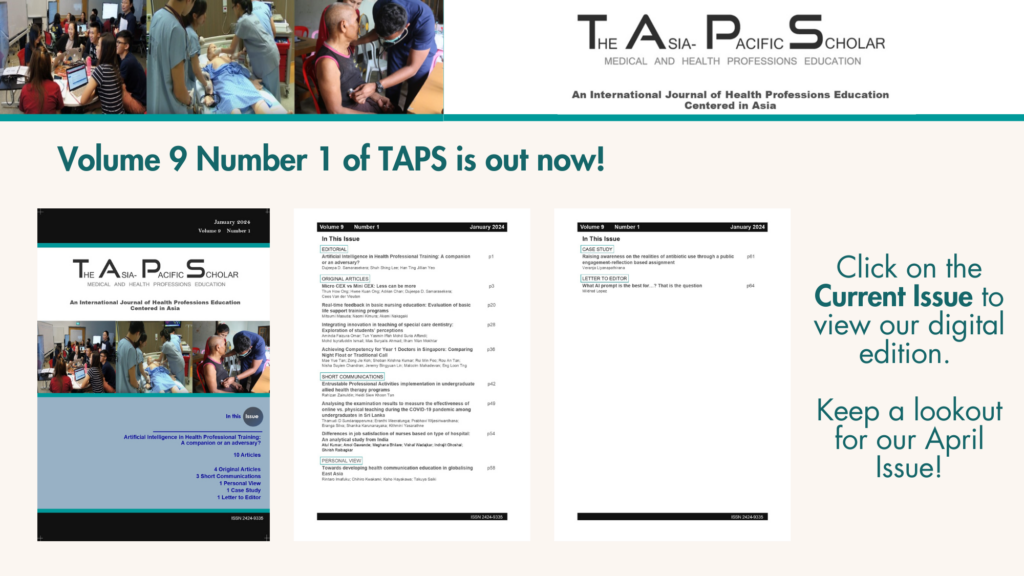
Congratulations, Dr Tri Nur Kristina and co-authors! - Volume 9 Number 1 of TAPS is out now! Click on the Current Issue to view our digital edition.
- Best Reviewer Awards 2022
TAPS would like to express gratitude and thanks to an extraordinary group of reviewers who are awarded the Best Reviewer Awards for 2022.
Refer here for the list of recipients. - Most Accessed Article 2022
The Most Accessed Article of 2022 goes to An urgent need to teach complexity science to health science students.
Congratulations, Dr Bhuvan KC and Dr Ravi Shankar. - Best Article Award 2022
The Best Article Award of 2022 goes to From clinician to educator: A scoping review of professional identity and the influence of impostor phenomenon.
Congratulations, Ms Freeman and co-authors. - Volume 8 Number 3 of TAPS is out now! Click on the Current Issue to view our digital edition.
- Best Reviewer Awards 2021
TAPS would like to express gratitude and thanks to an extraordinary group of reviewers who are awarded the Best Reviewer Awards for 2021.
Refer here for the list of recipients. - Most Accessed Article 2021
The Most Accessed Article of 2021 goes to Professional identity formation-oriented mentoring technique as a method to improve self-regulated learning: A mixed-method study.
Congratulations, Assoc/Prof Matsuyama and co-authors. - Best Reviewer Awards 2020
TAPS would like to express gratitude and thanks to an extraordinary group of reviewers who are awarded the Best Reviewer Awards for 2020.
Refer here for the list of recipients. - Most Accessed Article 2020
The Most Accessed Article of 2020 goes to Inter-related issues that impact motivation in biomedical sciences graduate education. Congratulations, Dr Chen Zhi Xiong and co-authors.