Associations between multiple mini-interview competencies and clinical reasoning performance in anaesthesia residency selection

Submitted: 20 September 2025
Accepted: 13 July 2026
Published online: 6 October, TAPS 2026, 11(4), 44-53
https://doi.org/10.29060/TAPS.2026-11-4/OA3885
Kasana Raksamani, Wathinee Phaknam, Sahatsa Mandee, Nuanprae Kitisin & Tachawan Jirativanont
Department of Anesthesiology, Faculty of Medicine Siriraj Hospital, Mahidol University, Thailand
Abstract
Introduction: The multiple mini-interview (MMI) is widely used in residency selection to assess non-cognitive competencies, whilst Key Feature Questions (KFQs) evaluate clinical reasoning at critical decision points. Understanding associations between these tools may enhance candidate evaluation.
Methods: This retrospective study included 122 anaesthesiology residency candidates from three consecutive cohorts (2023–2025). MMI scores across five domains (motivation, crisis management, stress/mood management, situational awareness and decision-making, and growth mindset), grade point average (GPA), multiple-choice question (MCQ) scores, and KFQ scores were analysed. Spearman’s correlation examined associations with KFQ performance, and multiple linear regression identified independent contributors.
Results: The mean candidate age was 27.9 years (±1.98); 76.2% were female. Moderately strong positive correlations were observed between KFQ scores and MMI domains of motivation (r = 0.577, p < 0.001), crisis management (r = 0.511, p < 0.001), and situational awareness and decision-making (r = 0.658, p < 0.001). GPA and MCQ scores showed no significant associations with KFQ performance. Regression analysis explained 56.8% of the variance in KFQ scores (R² = 0.568, p < 0.001), with motivation (B = 0.361, p < 0.001), crisis management (B = 0.300, p = 0.016), and decision-making (B = 0.621, p < 0.001) as significant contributors.
Conclusion: Key MMI domains – motivation, crisis management, and situational awareness and decision-making – were significantly associated with clinical reasoning performance as measured by KFQs, whilst GPA and MCQ scores were not. These findings support integrating structured non-cognitive assessments alongside cognitive measures in anaesthesia residency selection, highlighting the value of a multi-dimensional approach to candidate evaluation.
Keywords: Multiple Mini-Interview (MMI), Clinical Reasoning, Key Feature Questions (KFQ), Residency Selection, Anaesthesiology Education, Non-cognitive Competencies, Situational Awareness, Decision-making, Crisis Management, Academic Performance
Practice Highlights
- Situational awareness and decision-making showed the strongest association with clinical reasoning performance, underscoring their central role in anaesthesiology practice.
- Crisis management and motivation were also significantly associated with clinical reasoning ability, suggesting that adaptability and intrinsic drive support effective problem-solving in clinical contexts.
- Traditional academic measures (GPA and MCQ scores) were not significantly associated with clinical reasoning performance, highlighting their limitations as sole criteria for residency selection.
- Key Feature Questions (KFQs) complemented the MMI by capturing applied reasoning in structured, context-specific clinical scenarios.
- Integrating cognitive and non-cognitive assessments in residency selection may better identify candidates suited to the complex demands of anaesthesiology and inform competency-focused training.
I. INTRODUCTION
Residency selection is a critical responsibility of medical educators, particularly in anaesthesiology, where clinicians must integrate knowledge with rapid decision-making, teamwork, and emotional regulation in high-stakes clinical environments (Evans et al., 2016; Gaba, 2004; Niburski & Buu, 2021; Stiegler & Gaba, 2015; Stiegler & Tung, 2014). Traditional selection metrics such as grade point average (GPA) and multiple-choice question (MCQ) scores primarily assess cognitive ability, but their predictive value for clinical performance and reasoning is limited (Daniel et al., 2019; Rencic et al., 2020). Increasing recognition of the importance of non-cognitive skills has prompted the adoption of additional tools to evaluate attributes beyond academic achievement (Clapp et al., 2023; Drolet, 2015).
The multiple mini-interview (MMI) has become a widely accepted method for assessing non-cognitive competencies such as professionalism, motivation, teamwork, and stress management (Knorr & Hissbach, 2014; Pau et al., 2013; Rees et al., 2016; Sklar et al., 2015). Its structured format, incorporating multiple stations and examiners, enhances fairness and reliability compared to conventional interviews (Knorr & Hissbach, 2014; Pau et al., 2013). Evidence suggests that MMI performance is associated with subsequent success in training, particularly in domains requiring interpersonal and professional behaviours (Pau et al., 2013; Rees et al., 2016). However, its relationship to clinical reasoning ability remains less well established. Theoretically, non-cognitive competencies assessed by the MMI – such as situational awareness, crisis management, and motivation – may serve as dispositional enablers of clinical reasoning, facilitating the cognitive processes required for sound clinical decision-making (Flin et al., 2010; Stiegler & Tung, 2014). Candidates who demonstrate stronger situational awareness may be more adept at integrating contextual cues during KFQ scenarios, whilst those with greater crisis management skill may exhibit more effective problem-solving under uncertainty. Understanding these associations within the same selection process may inform how programmes design and weight assessment tools in residency admission.
Clinical reasoning is a core competency in anaesthesiology, where practitioners must analyse evolving situations, anticipate complications, and make timely decisions under uncertainty (Minehart & Katz, 2021; Reale et al., 2023; Stiegler & Tung, 2014). Key Feature Questions (KFQs) are designed to assess clinical reasoning by focusing on critical decision points within authentic clinical scenarios (Daniel et al., 2019; Hrynchak et al., 2014; Naz et al., 2025). By targeting essential elements of problem-solving rather than comprehensive knowledge recall, KFQs provide a validated measure of specific, decision-oriented aspects of clinical reasoning (Daniel et al., 2019; Hrynchak et al., 2014). Importantly, while KFQs capture reasoning at key moments of clinical decision-making, they do not represent a comprehensive assessment of all reasoning domains or real-world clinical complexity (Rencic et al., 2020).
This study examines the associations between specific MMI competencies – motivation, crisis management, stress and mood management, situational awareness and decision-making, and growth mindset – and clinical reasoning performance among anaesthesia residency candidates assessed within the same selection process. We hypothesised that competencies such as situational awareness, decision-making, crisis management, and motivation would be more strongly associated with KFQ performance than traditional academic measures, thereby underscoring the complementary value of non-cognitive assessments in residency selection. Establishing these associations may provide evidence to refine selection processes by integrating cognitive and non-cognitive domains, ultimately ensuring that candidates are better prepared for the complex demands of anaesthesiology practice.
II. METHODS
This study was reviewed and approved by the Siriraj Institutional Review Board (Si 496/2025). Given its retrospective design, informed consent was waived, and all measures were taken to safeguard candidate confidentiality.
This retrospective descriptive study was conducted within the anaesthesiology residency programme of a tertiary academic medical centre. Since 2023, the programme has employed a standardised residency selection process incorporating both cognitive and non-cognitive assessments, including a five-station multiple mini-interview (MMI) evaluating predefined non-cognitive competencies and a Key Feature Question (KFQ) examination assessing clinical reasoning at critical decision points. The same selection framework, scoring rubrics, and assessor training procedures were applied to all candidates to ensure consistency across admission cycles.
Data were obtained from applicants to the Anaesthesiology Residency Programme, Faculty of Medicine Siriraj Hospital, across three consecutive academic years (2023–2025). Eligible participants were candidates who completed both the MMI and KFQ assessments as part of the selection process. Candidates with missing or incomplete data for any relevant variables–including MMI scores, KFQ scores, grade point average (GPA), or multiple-choice question (MCQ) scores–were excluded.
Data were retrieved from the centralised institutional database after the completion of each admission cycle. Quality control measures, including double-checking entries and resolving discrepancies, were implemented to ensure dataset integrity. The MMI comprised five structured, scenario-based stations, each assessing one non-cognitive competency aligned with the redesigned 2023 curriculum: motivation, crisis management, stress and mood management, situational awareness and decision-making, and growth mindset. Interviewers received standardised training, and scoring was conducted using predefined rubrics. The KFQ assessment, conducted in parallel with the MMI, measured candidates’ clinical reasoning skills through responses to context-specific clinical scenarios. Questions were developed and reviewed by a committee of anaesthesia educators, and responses were scored using a standardised rubric to ensure objectivity and consistency. The KFQ assessment comprised five items covering key clinical decision-making domains in anaesthesia and critical care, including haemodynamic instability and shock management, perioperative resuscitation, and respiratory crisis management relevant to emergency and perioperative settings. Items were developed through a structured expert committee process, with scenarios reviewed iteratively by a panel of anaesthesiologists for content relevance and clinical authenticity. Formal content validity indices were not calculated for this dataset. Inter-rater reliability was assessed using two independent raters; the inter-rater correlation coefficient was 0.86 using Pearson’s correlation, indicating good agreement between scorers.
In addition to MMI and KFQ scores, academic records – including GPA and MCQ scores – were extracted from candidate applications. All data were anonymised prior to analysis and entered into a centralised database with double-entry verification and discrepancy resolution procedures.
The required sample size was determined a priori for correlation analysis, assuming a medium effect size, a significance level of 0.05, and 80% power. This yielded a minimum of 88 participants, ensuring sufficient statistical power.
Descriptive statistics summarised candidate demographics and academic characteristics. Continuous variables (e.g., age, GPA) were reported as means with standard deviations, while categorical variables were presented as frequencies and percentages. Data validation included normality testing using the Shapiro–Wilk or Kolmogorov–Smirnov tests and outlier detection with box plots and z-scores. Correlation analysis was used to examine associations between KFQ scores and other variables, using either Pearson’s or Spearman’s coefficients depending on data distribution. Multiple linear regression was then applied to identify independent predictors of KFQ performance. The KFQ score served as the dependent variable, while MMI competencies, GPA, and MCQ scores were included as predictors. Model performance was evaluated using adjusted R² values, and regression coefficients with corresponding p-values were reported. Multicollinearity was assessed using variance inflation factors (VIF), all of which were <2, indicating no significant multicollinearity.
Formal cross-validation was not performed, as the analysis was based on a single, complete cohort and no independent validation dataset was available; dividing the dataset into training and validation subsets would have substantially reduced statistical power and the stability of parameter estimates.
All statistical analyses were conducted using IBM SPSS Statistics for Windows, version 29.0 (IBM Corp., Armonk, NY, USA). A p-value of <0.05 was considered statistically significant.
III. RESULTS
A total of 122 candidates from three consecutive anaesthesia residency cohorts (2023–2025) were included in the analysis. The cohort comprised 32 candidates in 2023, 48 in 2024, and 42 in 2025, with an overall response rate of 100% candidates assessed. All participants completed both the KFQs and the five MMI stations. As there were no missing data, all candidate records were analysed. The mean age of participants was 27.9 years (± 1.98), and 93 (76.2%) were female (Table 1). The average cumulative GPA was 3.38 (± 0.23). The mean scores were 54.6 (± 10.9) for the 30-item MCQ, 57.1 (± 17.9) for the KFQs, and 84.6 (± 15.8), 74.9 (± 13.5), 81.9 (± 10.5), 83.3 (± 13.4), and 77.0 (± 14.8) for MMI1 (motivation), MMI2 (crisis management), MMI3 (stress and mood management), MMI4 (situational awareness and decision-making), and MMI5 (growth mindset), respectively (Figure 1).
Spearman’s correlation analysis revealed a positive but weak association between overall MMI scores and KFQ scores (r = 0.222, p = 0.014) as demonstrated in Table 2. When analysed by domain, KFQ scores demonstrated moderate to moderately strong positive correlations with MMI1 (motivation; r = 0.577, p < 0.001), MMI2 (crisis management; r = 0.511, p < 0.001), and MMI4 (situational awareness and decision-making; r = 0.658, p < 0.001). In contrast, correlations with MMI3 (stress and mood management; r = 0.096, p = 0.29) and MMI5 (growth mindset; r = 0.125, p = 0.17) were weak and not statistically significant. No significant correlations were observed between KFQ scores and traditional academic metrics, including GPA (r = 0.104, p = 0.25) and MCQ scores (r = 0.024, p = 0.79).
To further identify predictors of clinical reasoning performance, a multiple linear regression analysis was conducted with KFQ score as the dependent variable. The overall model was statistically significant (F(7,114) = 21.37, p < 0.001), explaining 56.8% of the variance in KFQ scores (R² = 0.568, adjusted R² = 0.541). Three MMI domains emerged as significant predictors: motivation (B = 0.361, β = 0.318, 95% CI [0.20, 0.52], p < 0.001), crisis management (B = 0.300, β = 0.189, 95% CI [0.06, 0.54], p = 0.016), and situational awareness and decision-making (B = 0.621, β = 0.425, 95% CI [0.40, 0.84], p < 0.001). Among these, situational awareness and decision-making was the strongest predictor. Other MMI domains (stress and mood management, growth mindset), GPA, and MCQ scores were not significant predictors of KFQ performance (all p > 0.05). Stress and mood management showed a small negative but non-significant effect (B = –0.085, p = 0.460) (Table 3).
Model diagnostics indicated no violations of regression assumptions. All VIF values were below 2, confirming the absence of multicollinearity. Residuals were normally distributed, approximately homoscedastic, and fell within ±3 standard deviations. No influential outliers were detected.
|
Variable |
Mean ± SD / n (%) |
|
Age (years) |
27.9 ± 1.98 |
|
Female |
93 (76.2%) |
|
GPA |
3.38 ± 0.23 |
|
MCQ score |
54.6 ± 10.9 |
|
KFQ score |
57.1 ± 17.9 |
|
MMI1 Motivation |
84.6 ± 15.8 |
|
MMI2 Crisis management |
74.9 ± 13.5 |
|
MMI3 Stress and mood management |
81.9 ± 10.5 |
|
MMI4 Situational awareness and decision-making |
83.3 ± 13.4 |
|
MMI5 Growth mindset |
77.0 ± 14.8 |
MCQ, KFQ, and each of the five MMI station scores were standardised to a maximum of 100 points.
Table 1. Participant characteristics and academic performance (n = 122).
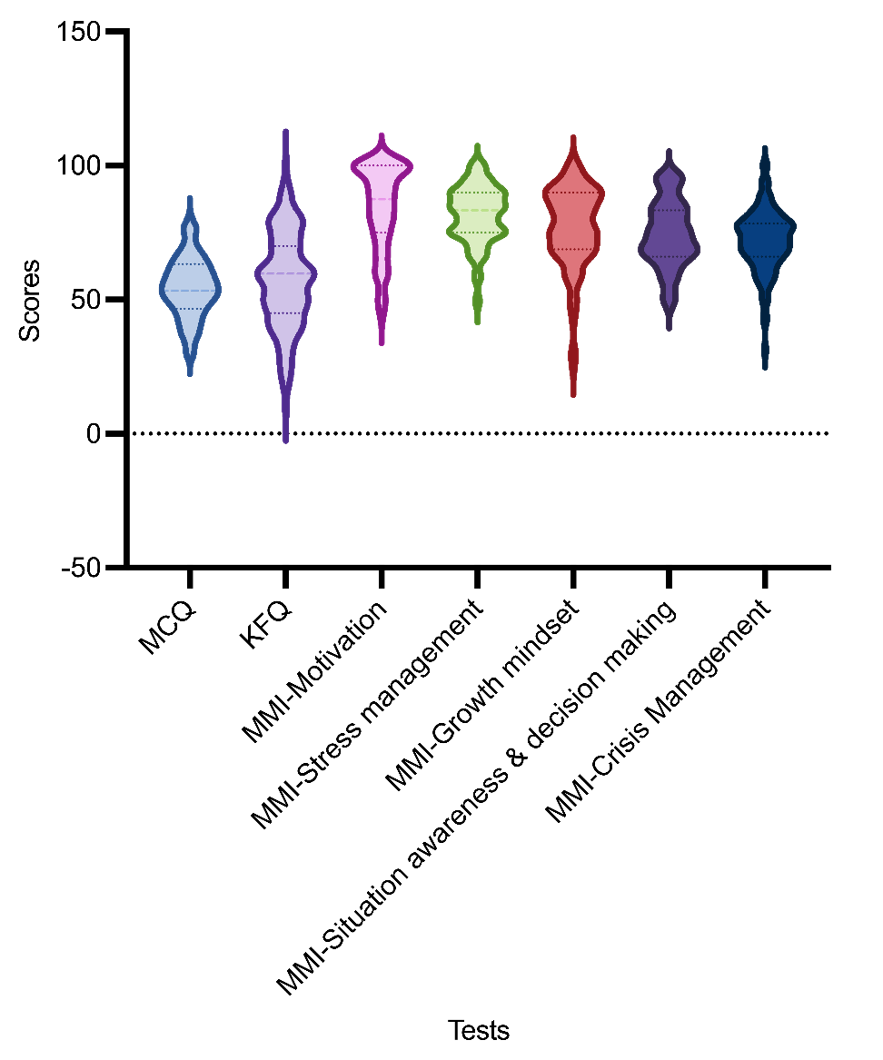
Figure 1. Violin plots showing score distributions for MMI competencies, GPA, MCQ, and KFQ. White dots indicate medians, thick bars interquartile ranges, and thin lines overall ranges.
|
Variable |
r |
p-value |
|
Overall MMI score |
0.222 |
0.014 |
|
MMI1 Motivation |
0.577 |
<0.001 |
|
MMI2 Crisis management |
0.511 |
<0.001 |
|
MMI3 Stress and mood management |
0.096 |
0.29 |
|
MMI4 Situational awareness and decision-making |
0.658 |
<0.001 |
|
MMI5 Growth mindset |
0.125 |
0.17 |
|
GPA |
0.104 |
0.25 |
|
MCQ score |
0.024 |
0.79 |
Table 2. Spearman’s correlations between KFQ and candidate variables.
|
Predictor |
B |
SE |
β |
t |
p |
95% CI (B) |
VIF |
|
Constant |
-57.21 |
18.94 |
– |
-3.02 |
0.003 |
-94.73, -19.70 |
– |
|
MMI1 Motivation |
0.361 |
0.08 |
0.318 |
4.49 |
<0.001 |
0.20, 0.52 |
1.33 |
|
MMI2 Crisis management |
0.300 |
0.123 |
0.189 |
2.45 |
0.016 |
0.06, 0.54 |
1.56 |
|
MMI3 Stress and mood management |
-0.085 |
0.115 |
-0.05 |
-0.74 |
0.46 |
-0.31, 0.14 |
1.18 |
|
MMI4 Situational awareness and decision-making |
0.621 |
0.112 |
0.425 |
5.52 |
<0.001 |
0.40, 0.84 |
1.56 |
|
MMI5 Growth mindset |
0.082 |
0.09 |
0.068 |
0.92 |
0.362 |
-0.10, 0.26 |
1.45 |
|
MCQ score |
-0.074 |
0.108 |
-0.045 |
-0.69 |
0.495 |
-0.29, 0.14 |
1.16 |
|
GPA |
6.049 |
5.631 |
0.077 |
1.07 |
0.285 |
-5.11, 17.20 |
1.37 |
Table 3. Multiple linear regression predicting clinical reasoning performance (KFQ Scores).
IV. DISCUSSION
This study examined the associations between multiple mini-interview (MMI) competencies and clinical reasoning performance, as assessed by Key Feature questions (KFQs), among anaesthesia residency candidates within the same selection process. Three MMI domains – motivation, crisis management, and situational awareness and decision-making – showed significant positive associations with KFQ scores, with situational awareness and decision-making demonstrating the strongest relationship. In contrast, GPA, MCQ scores, and the other MMI domains (stress and mood management, growth mindset) were not significantly associated with KFQ performance. These findings highlight the value of targeted non-cognitive assessments as a complement to traditional academic measures in residency selection.
Situational awareness and decision-making were the most powerful predictors of clinical reasoning, underscoring their central role in anaesthesiology practice. These competencies align directly with the specialty’s demands, where anaesthesiologists must continuously monitor dynamic environments, recognise subtle changes in patient status, and anticipate potential complications (Flin et al., 2010; Schulz et al., 2013). Situational awareness involves perceiving relevant cues, interpreting their meaning, and projecting their implications, while decision-making requires selecting appropriate actions under time pressure (Stiegler & Tung, 2014). Together, these processes reflect the dual-process theory of cognition, in which clinicians alternate between analytic reasoning – deliberate, evidence-based thinking–and heuristic reasoning – fast, experience-based judgements (Gaba et al., 1995; Schulz et al., 2013; Stiegler & Tung, 2014). The strong association between situational awareness and decision-making with KFQ performance is unsurprising, as KFQs assess the application of knowledge to context-specific problems, requiring candidates to integrate information, weigh alternatives, and justify decisions in a structured format (Hrynchak et al., 2014). Thus, performance on KFQs is likely to mirror the cognitive operations underpinning high-quality decision-making in clinical practice (Naz et al., 2025).
Crisis management also emerged as a significant predictor of reasoning performance. This domain assesses a candidate’s ability to respond to acute, high-stakes scenarios by rapidly evaluating evolving situations, prioritising competing tasks, and implementing interventions under uncertainty (Burden, 2020; Gaba et al., 1995; Minehart & Katz, 2021; Norman et al., 2017). These cognitive processes parallel the skills required in KFQs, which demand flexible thinking and the capacity to select appropriate management strategies when faced with critical problems (Hrynchak et al., 2014). Importantly, success in crisis management reflects not only technical knowledge but also the ability to remain composed, process information efficiently, and adapt decisions to rapidly changing conditions – all qualities that underpin effective clinical reasoning in anaesthesiology (Stiegler & Gaba, 2015).
Motivation to pursue anaesthesiology was another predictor of KFQ performance, highlighting the influence of intrinsic drive on reasoning ability. Candidates motivated by a genuine interest in the specialty may demonstrate greater perseverance, focus, and cognitive engagement when solving complex problems (Gaba, 2004; Niburski & Buu, 2021). Motivation may also enhance metacognitive skills, such as self-reflection and adaptive information processing, which are critical for reasoning in high-stress or ambiguous clinical situations (Flin & Patey, 2011; Flin et al., 2010; Reale et al., 2023). This finding suggests that motivation is not merely a personal attribute but an enabler of cognitive adaptability and resilience, allowing individuals to sustain effort and maintain reasoning performance even under demanding conditions.
Together, these results highlight that clinical reasoning ability is not solely dependent on factual knowledge but is shaped by a combination of cognitive adaptability, resilience under stress, and professional motivation (Smith et al., 2022). The MMI domains most strongly associated with KFQ performance – situational awareness, decision-making, crisis management, and motivation – represent a cluster of non-cognitive attributes that appear to co-occur with reasoning performance, underscoring the importance of including structured assessments of these competencies in residency selection.
In contrast, GPA and MCQ scores did not correlate with KFQ outcomes. While these measures reflect academic achievement and knowledge acquisition, they do not necessarily capture the applied reasoning and judgement required in patient care (Rencic et al., 2020). GPA may reflect long-term academic diligence, and MCQs assess factual recall and recognition, but neither provides insight into how knowledge is synthesised or applied in dynamic, uncertain contexts (Daniel et al., 2019). This explains why these traditional academic metrics, although useful, were weaker predictors of reasoning ability compared to MMI competencies. Similarly, MMI domains such as stress and mood management and growth mindset, though important for professional development and long-term adaptability, may exert more indirect effects on reasoning. Their influence may emerge later in residency training, when resilience and adaptability are tested by sustained clinical workload, rather than in reasoning-focused assessments like KFQs (Hrynchak et al., 2014).
Our findings are consistent with prior research demonstrating the predictive validity of MMIs for clinical performance and professionalism-related traits (Duff et al., 2020; Jerant et al., 2019; Kim et al., 2014). However, unlike studies showing strong associations between MMIs and academic achievement in dental and medical students (Jerant et al., 2019; Li et al., 2025; Partido & Soto, 2019), we did not observe such relationships. This discrepancy may be due to our focus on clinical reasoning, which is more closely tied to performance in practice than to traditional academic outcomes (Jerant et al., 2019; Kim et al., 2014). Clinical performance relies on situational awareness and judgement, whereas academic performance encompasses broader constructs defined by educational systems (Rencic et al., 2020; Zagury-Orly et al., 2022). While there is some overlap, reasoning does not fully account for academic achievement (Daniel et al., 2019; Smith et al., 2022; Zagury-Orly et al., 2022). Prior work also suggests a bidirectional relationship, with academic support – such as encouragement to ask questions and access to literature – enhancing reasoning, while reasoning competencies like situational judgement and decision-making predict future performance (Li et al., 2025; Zagury-Orly et al., 2022). KFQs, by emphasising the application of knowledge to context-specific problems, complement the MMI by capturing reasoning skills in a structured format (Hrynchak et al., 2014; Naz et al., 2025). Together, these tools highlight the importance of evaluating both cognitive and non-cognitive domains in the selection process.
A. Implications for residency selection and training
These findings suggest that residency selection should extend beyond academic metrics to incorporate structured non-cognitive assessments. In particular, situational awareness and decision-making showed the strongest associations with reasoning performance, reinforcing their relevance in identifying candidates likely to excel in the complex, dynamic environment of anaesthesiology. The absence of significant associations for GPA and MCQ scores emphasises the limitation of relying primarily on academic performance in resident selection. A balanced model – integrating MMIs, cognitive tests, and KFQs – may provide a more comprehensive assessment of candidate suitability.
Residency training should also reinforce the competencies identified at selection. Encouraging questioning, providing access to literature, and promoting deliberate practice can strengthen reasoning processes and decision-making. Embedding these strategies within curricula may foster both cognitive and non-cognitive skills, thereby ensuring residents are prepared for safe and effective clinical practice.
B. Strengths and limitations
A key strength of this study is its focus on the relationship between non-cognitive competencies assessed by the MMI and clinical reasoning performance measured by KFQs, an area that has received limited attention in anaesthesia residency selection research. By examining both cognitive and non-cognitive predictors, the study provides a more comprehensive perspective on candidate evaluation, highlighting the distinct contribution of situational awareness and decision-making to clinical reasoning. The use of multiple data sources – including MMI competencies, GPA, MCQ scores, and KFQs – allowed for a robust comparison of predictors, strengthening the validity of the findings. Additionally, the inclusion of a full cohort across multiple admission cycles reduces sampling bias and enhances the reliability of the results.
However, several limitations should be acknowledged. First, the study was conducted within a single institution, which may limit the generalisability of the findings to other residency programmes with different educational cultures, curricula, or selection frameworks. Institution-specific factors – such as the structure of the anaesthesiology training programme, alignment between selection tools and curricular competencies, and the design of the MMI and KFQ assessments – may have influenced applicant performance and the observed relationships. Second, the retrospective design restricts the ability to establish causal relationships between MMI competencies and clinical reasoning performance. Third, formal cross-validation was not undertaken, as the analysis was based on a single, complete cohort without an external validation dataset; as such, the findings should be interpreted as exploratory rather than confirmatory. Future multi-institutional or prospective studies with independent validation samples are needed to assess the robustness and generalisability of these associations. In addition, although KFQs are a validated and practical proxy for assessing clinical reasoning at key decision points, they cannot fully capture the complexity of real-world clinical reasoning, which is influenced by contextual, environmental, and team-based factors such as workload, time pressure, and interprofessional interactions. Finally, the study focused on short-term performance outcomes; long-term follow-up linking selection measures to clinical performance during residency and independent practice would provide stronger evidence for predictive validity. Furthermore, formal psychometric properties of the MMI stations, including inter-rater agreement and generalisability coefficients, were not available for the current dataset; for the KFQ, inter-rater reliability was assessed and reported in the Methods section (r = 0.86). This is acknowledged as a limitation, and future studies should incorporate comprehensive psychometric evaluation for both instruments. Additionally, it was not possible to include sample MMI scenarios or KFQ items as supplementary material, as both item sets remain part of the active item banking pool currently used in the department’s ongoing annual residency admission process. Public disclosure of these items could compromise the integrity of future selection cycles; this constraint is acknowledged as a limitation of this report.
C. Future directions
Future research should employ multi-institutional and prospective designs to test generalisability and causality. Longitudinal studies linking MMI and KFQ results to workplace-based assessments, simulation performance, and patient care indicators would provide stronger evidence of predictive validity. Programmes could also track whether residents who score highly in domains such as situational awareness and decision-making during selection subsequently demonstrate superior clinical reasoning and performance in training. This would not only validate the predictive utility of MMIs but also inform ongoing curriculum design and personalised learning plans. Research should further explore how educational interventions – such as structured feedback, mentoring, and deliberate practice – enhance the competencies most strongly tied to reasoning. Incorporating complementary tools, such as entrustable professional activities (EPAs) and situational judgement tests, may enrich assessment frameworks and provide a more holistic evaluation. Ultimately, aligning residency selection and curricula with competencies most relevant to clinical reasoning can better prepare residents for the demands of practice and enhance patient care outcomes.
V. CONCLUSION
This study found that key MMI domains – situational awareness and decision-making, crisis management, and motivation – were significantly associated with clinical reasoning performance as measured by KFQs among anaesthesia residency candidates, whereas GPA and MCQ scores were not. These findings underscore the value of incorporating structured non-cognitive assessments alongside cognitive measures in residency selection. However, as MMI and KFQ assessments were administered within the same selection cycle, these results reflect associations between constructs rather than predictive relationships. Further multi-institutional, prospective studies are required to determine predictive validity and long-term educational impact, and to confirm that candidates demonstrating these competencies at selection subsequently exhibit superior clinical reasoning during residency training.
Notes on Contributors
Kasana Raksamani conceptualised and designed the study, supervised the research process, curated and analysed the data, and drafted and revised the manuscript.
Wathinee Phaknam contributed to the study conceptualisation and methodology, conducted investigation and data curation, and assisted in manuscript revision.
Sahatsa Mandee participated in study design and investigation, provided resources, conducted literature review and data curation, and contributed to manuscript revision.
Nuanprae Kitisin contributed to the study conceptualisation and investigation, performed data analysis and visualisation, and revised the manuscript.
Tachawan Jirativanont contributed to conceptualisation and methodology, validated the study, and assisted in manuscript revision.
All authors have read and approved the final manuscript and agree to be accountable for all aspects of the work.
Ethical Approval
This study was conducted in accordance with Siriraj Institutional Review Board (SIRB) protocols. Ethical approval was obtained from the SIRB, and the requirement for informed consent was waived as the study involved retrospective analysis of existing data with no identifiable personal information. The IRB approval reference number/waiver confirmation is [Si 496/2025].
Data Availability
The datasets generated and analysed during the current study are not publicly available due to restrictions imposed by the Institutional Review Board (IRB), which prohibit sharing of individual-level data. Aggregated or de-identified data may be made available from the corresponding author upon reasonable request and with IRB approval.
Acknowledgement
The authors would like to express their sincere gratitude to Ms Pavinee Sareenun for her dedicated assistance with data collection, which was essential to the completion of this study. We also extend our appreciation to the Postgraduate Unit of the Department of Anesthesiology for their continuous administrative and logistical support. In addition, the authors acknowledge the use of a large language model (ChatGPT, OpenAI) to assist with English language editing. All content was reviewed and verified by the authors, who take full responsibility for the final manuscript.
Funding
This study did not receive any specific grant from funding agencies in the public, commercial, or not-for-profit sectors.
Declaration of Interest
The authors declare no conflicts of interest related to this study.
References
Burden, A. (2020). The history of crises and crisis management in anaesthesia: Prevention, detection, and recovery. International Anesthesiology Clinics, 58(1), 2–6. https://doi.org/10.1097/AIA.0000000000000258
Clapp, J. T., Dinh, C., Hsu, M., & Neuman, M. D. (2023). Clinical reasoning in pragmatic trial randomization: A qualitative interview study. Trials, 24(1), Article 431. https://doi.org/10.1186/s13063-023-07445-3
Daniel, M., Rencic, J., Durning, S. J., Holmboe, E., Santen, S. A., Lang, V., Ratcliffe, T., Gordon, D., Heist, B., Lubarsky, S., Estrada, C. A., Ballard, T., Artino, A. R., Jr., Sergio Da Silva, A., Cleary, T., Stojan, J., & Gruppen, L. D. (2019). Clinical reasoning assessment methods: A scoping review and practical guidance. Academic Medicine, 94(6), 902–912. https://doi.org/10.1097/ACM.0000000000002618
Drolet, P. (2015). Assessing clinical reasoning in anaesthesiology: Making the case for the Script Concordance Test. Anaesthesia, Critical Care & Pain Medicine, 34(1), 5–7. https://doi.org/10.1016/j.accpm.2015.01.003
Duff, R. E., Katcher, P. A., Daniels, R. M., & Ramaswamy, V. (2020). The multiple mini-interview as a dental school admission tool: Can it predict noncognitive traits associated with professional behaviors? Journal of Dental Education, 84(4), 478–485. https://doi.org/10.21815/JDE.019.184
Evans, F. M., Mallepally, N. R., Dubowitz, G., Vasilopoulos, T., McClain, C. D., & Enneking, K. (2016). Factors influencing anaesthesia residency selection: Impact of global health opportunities [Facteurs influençant le choix de la résidence en anesthésie: Impact des offres de santé globale]. Canadian Journal of Anesthesia, 63(6), 674–681. https://doi.org/10.1007/s12630-016-0629-7
Flin, R., & Patey, R. (2011). Non-technical skills for anaesthetists: Developing and applying ANTS. Best Practice & Research Clinical Anaesthesiology, 25(2), 215–227. https://doi.org/10.1016/j.bpa.2011.02.005
Flin, R., Patey, R., Glavin, R., & Maran, N. (2010). Anaesthetists’ non-technical skills. British Journal of Anaesthesia, 105(1), 38–44. https://doi.org/10.1093/bja/aeq134
Gaba, D. M. (2004). What makes a “good” anesthesiologist? Anesthesiology, 101(5), 1061–1063. https://doi.org/10.1097/00000542-200411000-00003
Gaba, D. M., Howard, S. K., & Small, S. D. (1995). Situation awareness in anesthesiology. Human Factors, 37(1), 20–31. https://doi.org/10.1518/001872095779049435
Hrynchak, P., Takahashi, S. G., & Nayer, M. (2014). Key-feature questions for assessment of clinical reasoning: A literature review. Medical Education, 48(9), 870–883. https://doi.org/10.1111/medu.12509
Jerant, A., Henderson, M. C., Griffin, E., Hall, T. R., Kelly, C. J., Peterson, E. M., Wofsy, D., Tancredi, D. J., Sousa, F. J., & Franks, P. (2019). Do admissions multiple mini-interview and traditional interview scores predict subsequent academic performance? A study of five California medical schools. Academic Medicine, 94(3), 388–395. https://doi.org/10.1097/ACM.0000000000002440
Kim, J. K., Kang, S. H., Lee, H. J., & Yang, J. (2014). Can the multiple mini-interview predict academic achievement in medical school? Korean Journal of Medical Education, 26(3), 223–229. https://doi.org/10.3946/kjme.2014.26.3.223
Knorr, M., & Hissbach, J. (2014). Multiple mini-interviews: Same concept, different approaches. Medical Education, 48(12), 1157–1175. https://doi.org/10.1111/medu.12535
Li, N., Wang, L., Fang, Q., & Hou, L. (2025). Clinical reasoning profiles in nursing students: Associations with academic performance, encouragement for questioning, and access to relevant literature. Nurse Educator, 50(6), E390–E395. https://doi.org/10.1097/NNE.0000000000001951
Minehart, R. D., & Katz, D. (2021). Decision making in obstetric anesthesia. Anesthesiology Clinics, 39(4), 793–809. https://doi.org/10.1016/j.anclin.2021.08.013
Naz, N., Hussain, K., Bari, V., Rafiq, N., & Afzal, A. (2025). Innovative assessment strategies: Image-based key feature questions for radiology postgraduate trainees. BMC Medical Education, 25(1), Article 488. https://doi.org/10.1186/s12909-024-06487-8
Niburski, K., & Buu, N. (2021). Criteria for selection to anesthesia residency programs: A survey of Canadian anesthesia program directors. Canadian Medical Education Journal, 12(4), 89–97. https://doi.org/10.36834/cmej.71385
Norman, G. R., Monteiro, S. D., Sherbino, J., Ilgen, J. S., Schmidt, H. G., & Mamede, S. (2017). The causes of errors in clinical reasoning: Cognitive biases, knowledge deficits, and dual process thinking. Academic Medicine, 92(1), 23–30. https://doi.org/10.1097/ACM.0000000000001421
Partido, B. B., & Soto, I. (2019). Association between critical thinking and academic performance in dental hygiene students. Journal of Dental Education, 83(1), 32–38. https://doi.org/10.21815/JDE.019.004
Pau, A., Jeevaratnam, K., Chen, Y. S., Fall, A. A., Khoo, C., & Nadarajah, V. D. (2013). The Multiple Mini-Interview (MMI) for student selection in health professions training – A systematic review. Medical Teacher, 35(12), 1027–1041. https://doi.org/10.3109/0142159X.2013.829912
Reale, C., Salwei, M. E., Militello, L. G., Weinger, M. B., Burden, A., Sushereba, C., Torsher, L. C., Andreae, M. H., Gaba, D. M., McIvor, W. R., Banerjee, A., Slagle, J., & Anders, S. (2023). Decision-making during high-risk events: A systematic literature review. Journal of Cognitive Engineering and Decision Making, 17(2), 188–212. https://doi.org/10.1177/15553434221147415
Rees, E. L., Hawarden, A. W., Dent, G., Hays, R., Bates, J., & Hassell, A. B. (2016). Evidence regarding the utility of multiple mini-interview (MMI) for selection to undergraduate health programs: A BEME systematic review: BEME Guide No. 37. Medical Teacher, 38(5), 443–455. https://doi.org/10.3109/0142159X.2016.1158799
Rencic, J., Schuwirth, L. W. T., Gruppen, L. D., & Durning, S. J. (2020). Clinical reasoning performance assessment: Using situated cognition theory as a conceptual framework. Diagnosis, 7(3), 241–249. https://doi.org/10.1515/dx-2019-0051
Schulz, C. M., Endsley, M. R., Kochs, E. F., Gelb, A. W., & Wagner, K. J. (2013). Situation awareness in anaesthesia: Concept and research. Anesthesiology, 118(3), 729–742. https://doi.org/10.1097/ALN.0b013e318280a40f
Sklar, M. C., Eskander, A., Dore, K., & Witterick, I. J. (2015). Comparing the traditional and Multiple Mini Interviews in the selection of post-graduate medical trainees. Canadian Medical Education Journal, 6(2), e6–e13. https://doi.org/10.36834/cmej.36676
Smith, S. K., Benbenek, M. M., Bakker, C. J., & Bockwoldt, D. (2022). Scoping review: Diagnostic reasoning as a component of clinical reasoning in the U.S. primary care nurse practitioner education. Journal of Advanced Nursing, 78(12), 3869–3896. https://doi.org/10.1111/jan.15414
Stiegler, M. P., & Gaba, D. M. (2015). Decision-making and cognitive strategies. Simulation in Healthcare, 10(3), 133–138. https://doi.org/10.1097/SIH.0000000000000093
Stiegler, M. P., & Tung, A. (2014). Cognitive processes in anaesthesiology decision making. Anesthesiology, 120(1), 204–217. https://doi.org/10.1097/ALN.0000000000000073
Zagury-Orly, I., Kamin, D. S., Krupat, E., Charlin, B., Fernandez, N., & Fischer, K. (2022). The student-Generated Reasoning Tool (SGRT): Linking medical knowledge and clinical reasoning in preclinical education. Medical Teacher, 44(2), 158–166. https://doi.org/10.1080/0142159X.2021.1967904
*Kasana Raksamani
Department of Anesthesiology,
Faculty of Medicine Siriraj Hospital,
Mahidol University, Thailand, 10700
Contact No: +66 967841010
Email: kasana.rak@mahidol.ac.th
Announcements
- Best Reviewer Awards 2025
TAPS would like to express gratitude and thanks to an extraordinary group of reviewers who are awarded the Best Reviewer Awards for 2025.
Refer here for the list of recipients. - Most Accessed Article 2025
The Most Accessed Article of 2025 goes to Analyses of self-care agency and mindset: A pilot study on Malaysian undergraduate medical students.
Congratulations, Dr Reshma Mohamed Ansari and co-authors! - Best Article Award 2025
The Best Article Award of 2025 goes to From disparity to inclusivity: Narrative review of strategies in medical education to bridge gender inequality.
Congratulations, Dr Han Ting Jillian Yeo and co-authors! - Best Reviewer Awards 2024
TAPS would like to express gratitude and thanks to an extraordinary group of reviewers who are awarded the Best Reviewer Awards for 2024.
Refer here for the list of recipients. - Most Accessed Article 2024
The Most Accessed Article of 2024 goes to Persons with Disabilities (PWD) as patient educators: Effects on medical student attitudes.
Congratulations, Dr Vivien Lee and co-authors! - Best Article Award 2024
The Best Article Award of 2024 goes to Achieving Competency for Year 1 Doctors in Singapore: Comparing Night Float or Traditional Call.
Congratulations, Dr Tan Mae Yue and co-authors! - Best Reviewer Awards 2023
TAPS would like to express gratitude and thanks to an extraordinary group of reviewers who are awarded the Best Reviewer Awards for 2023.
Refer here for the list of recipients. - Most Accessed Article 2023
The Most Accessed Article of 2023 goes to Small, sustainable, steps to success as a scholar in Health Professions Education – Micro (macro and meta) matters.
Congratulations, A/Prof Goh Poh-Sun & Dr Elisabeth Schlegel! - Best Article Award 2023
The Best Article Award of 2023 goes to Increasing the value of Community-Based Education through Interprofessional Education.
Congratulations, Dr Tri Nur Kristina and co-authors! - Best Reviewer Awards 2022
TAPS would like to express gratitude and thanks to an extraordinary group of reviewers who are awarded the Best Reviewer Awards for 2022.
Refer here for the list of recipients. - Most Accessed Article 2022
The Most Accessed Article of 2022 goes to An urgent need to teach complexity science to health science students.
Congratulations, Dr Bhuvan KC and Dr Ravi Shankar. - Best Article Award 2022
The Best Article Award of 2022 goes to From clinician to educator: A scoping review of professional identity and the influence of impostor phenomenon.
Congratulations, Ms Freeman and co-authors.