Impact of a longitudinal student-initiated home visit programme on interprofessional education
Submitted: 22 September 2021
Accepted: 27 April 2022
Published online: 4 October, TAPS 2022, 7(4), 1-21
https://doi.org/10.29060/TAPS.2022-7-4/OA2785
Yao Chi Gloria Leung1*, Kennedy Yao Yi Ng2*, Ka Shing Yow3*, Nerice Heng Wen Ngiam4, Dillon Guo Dong Yeo4, Angeline Jie-Yin Tey5, Melanie Si Rui Lim6, Aaron Kai Wen Tang7, Bi Hui Chew8, Celine Tham9, Jia Qi Yeo10, Tang Ching Lau11,12, Sweet Fun Wong13,14, Gerald Choon-Huat Koh15,16** & Chek Hooi Wong14,17**
1Department of Anaesthesiology, Singapore General Hospital, Singapore; 2Department of Medical Oncology, National Cancer Centre Singapore, Singapore; 3Department of General Medicine, National University Hospital, Singapore; 4Department of General Medicine, Singapore General Hospital, Singapore; 5Department of General Medicine, Tan Tock Seng Hospital, Singapore; 6Department of General Paediatrics, Kandang Kerbau Hospital, Singapore, 7Department of Psychiatry, Singapore General Hospital, Singapore; 8Tan Tock Seng Hospital, Singapore; 9Ng Teng Fong General Hospital, Singapore, 10National Healthcare Group Pharmacy, Singapore, 11Department of Medicine, NUS Yong Loo Lin School of Medicine, Singapore; 12Division of Rheumatology, University Medicine Cluster, National University Hospital, Singapore; 13Medical Board and Population Health & Community Transformation, Khoo Teck Puat Hospital, Singapore; 14Department of Geriatrics, Khoo Teck Puat Hospital, Singapore; 15Saw Swee Hock School of Public Health, National University of Singapore, Singapore; 16Future Primary Care, Ministry of Health Office of Healthcare Transformation, Singapore; 17Health Services and Systems Research, Duke-National University of Singapore Medical School, Singapore
*Co-first authors
**Co-last authors
Abstract
Introduction: Tri-Generational HomeCare (TriGen) is a student-initiated home visit programme for patients with a key focus on undergraduate interprofessional education (IPE). We sought to validate the Readiness for Interprofessional Learning Scale (RIPLS) and evaluate TriGen’s efficacy by investigating healthcare undergraduates’ attitude towards IPE.
Methods: Teams of healthcare undergraduates performed home visits for patients fortnightly over six months, trained by professionals from a regional hospital and a social service organisation. The RIPLS was validated using exploratory factor analysis. Evaluation of TriGen’s efficacy was performed via the administration of the RIPLS pre- and post-intervention, analysis of qualitative survey results and thematic analysis of written feedback.
Results: 79.6% of 226 undergraduate participants from 2015-2018 were enrolled. Exploratory factor analysis revealed four factors accounting for 64.9% of total variance. One item loaded poorly and was removed. There was no difference in pre- and post-intervention RIPLS total and subscale scores. 91.6% of respondents agreed they better appreciated the importance of interprofessional collaboration (IPC) in patient care, and 72.8% said MDMs were important for their learning. Thematic analysis revealed takeaways including learning from and teaching one another, understanding one’s own and other healthcare professionals’ role, teamwork, and meeting undergraduates from different faculties.
Conclusion: We validated the RIPLS in Singapore and demonstrated the feasibility of an interprofessional, student-initiated home visit programme. While there was no change in RIPLS scores, the qualitative feedback suggests that there are participant-perceived benefits for IPE after undergoing this programme, even with the perceived barriers to IPE. Future programmes can work on addressing these barriers to IPE.
Keywords: Interprofessional Education, Student-Initiated Home Visit Programme, RIPLS, Validation
Practice Highlights
- We validated the Readiness for Interprofessional Learning Scale (RIPLS) in Singapore, a multi-ethnic Asian country.
- A student-initiated, interprofessional, longitudinal home visit program is feasible.
- While there was no significant change in RIPLS scores, participants reported qualitative benefits of the programme in their attitudes towards IPE.
- Qualitative feedback highlighted four main barriers to IPE: Time constraints, unmotivated teammates, administrative burden, and unsuitable patients.
I. INTRODUCTION
Interprofessional education (IPE) aims to prepare healthcare professionals for effective collaboration, and while becoming increasingly common, is challenging to initiate, implement, evaluate and sustain (Fahs et al., 2017). Key challenges include designing a curriculum that integrates IPE with traditional academic frameworks, active engagement of facilitators and students, and accommodating various professions (Sunguya et al., 2014). IPE is context-specific, evolving, and involves continuous interaction and interdependence, and many traditional top-down approaches such as forums and lectures do not effectively teach it (Briggs & McElhaney, 2015).
Experiential IPE programmes employ a ground-up approach and potentially tackle some of the aforementioned challenges. Students involved in on-the-ground interprofessional healthcare visits to older adults showed that such experiences improved student collaboration and students’ self-perception of interprofessional team care-related skills (Blythe & Spiring, 2020; Conti et al., 2016; McManus et al., 2017; Toth-Pal et al., 2020; Vaughn et al., 2014). Therefore, a group of undergraduates from the National University of Singapore (NUS) Yong Loo Lin School of Medicine initiated an experiential student-led IPE programme which is aimed at improving health outcomes in older people with frequent hospital readmissions. This longitudinal service-learning programme was anchored by several educational aims including enhancing students’ IPE outcomes and improving attitudes towards IPE.
Formal evaluation of such programmes and investigating student IPE attitudes after being involved in a longitudinal home visit programmes are lacking in the current IPE literature (Grice et al., 2018). This study aims to evaluate TriGen’s effectiveness by investigating student IPE attitudes through the use of the Readiness for Interprofessional Learning Scale (RIPLS). Since the RIPLS has not been validated in the Singapore context, this study also aims to validate this scale.
II. METHODS
A. Programme Design
TriGen is a collaboration between NUS Yong Loo Lin School of Medicine, Khoo Teck Puat Hospital, a Northern regional hospital in Singapore, and North West Community Development Council, a grassroots organisation (Ng et al., 2020a, 2020b). A non-profit ground-up social initiative by healthcare undergraduates, it has the dual aim of i) serving the medical and social needs of older patients by providing longitudinal home visits by interprofessional student teams; ii) educating and empowering undergraduate students through a service-learning approach, with a key focus on improving attitudes towards IPE. The programme was designed under the mentorship of university faculty members, and was earmarked as a co-curricular activity aimed at improving students’ attitudes towards IPE and IPC. Older patients with frequent hospital readmissions (three or more times over six months) were followed up by healthcare undergraduates enrolled in Medicine, Nursing, Pharmacy, Social Work, Physiotherapy or Occupational Therapy courses in Singapore.
The programme begins with healthcare undergraduates undergoing didactic, skill-based training and team-based simulation training covering possible scenarios encountered during home visits (Annex 1). Each team comprising 2-3 interdisciplinary undergraduates conduct fortnightly visits to 1-2 patients over 6 months. At the midpoint and endpoint of the programme, healthcare undergraduates assessed the patients’ needs and presented at multi-disciplinary meetings (MDMs) chaired by healthcare professionals and grassroots staff, who guided the undergraduates to execute a management plan.
This IPE programme was designed based on educational principles for adult learners outlined by Knowles (1984). First, it provided healthcare undergraduates with opportunities for experiential learning anchored in the service-learning approach. Second, it was largely problem-based group learning with most training sessions being team-based and scenario-based. MDMs were also problem-based and encouraged undergraduates to brainstorm ideas to address their patients’ issues. Third, the service they provided in this programme modelled the work they may engage in after graduation. What they learned in this programme was of immediate relevance to their current study and future practice. Lastly, the programme provided autonomy to healthcare undergraduates to direct their own learning. This programme was voluntary and allowed participants’ flexibility for further self-study of topics of interest. Key student outcomes include readiness for IPE (including teamwork and collaboration, professional identity, roles and responsibility), and a better appreciation for IPC.
B. Evaluation Approach
This study used the framework by Kirkpatrick (1959) expanded by Barr et al. (2005) to evaluate the effectiveness of TriGen in improving healthcare undergraduates’ attitudes towards IPE, particularly in evaluation levels 1, 2a and 2b, which centre on learner’s reactions, attitude perceptions, and acquisition of knowledge or skills (Table 1). The use of quantitative and qualitative data collection in a survey was thought to be most appropriate in capturing the data and making the evaluation richer, and was hence the approach utilised for this research (Figure 1).
|
Evaluation Level |
Methods and Measures |
Timeframe |
|
Level 1: Learners’ reactions Participants’ views of their learning experience and opinions about the program |
Participants’ self-reported feedback of IPE learning |
Post-intervention |
|
Qualitative feedback |
Post-intervention |
|
|
Level 2a: Modification of attitudes perceptions |
Participants’ self-reported feedback of IPE learning |
Post-intervention |
|
Qualitative feedback |
Post-intervention |
|
|
|
Readiness for Interprofessional Learning Scale |
Pre- and post-intervention |
|
Level 2b: Acquisition of knowledge/skills Concepts, procedures, principles, and skills |
Qualitative feedback |
Post-intervention |
Table 1: Components of Kirkpatrick/Barr et al. evaluation framework as applied to TriGen
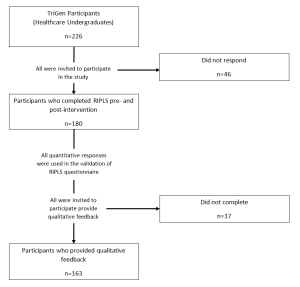
Figure 1: Flowchart of study components
C. Quantitative Measures
The RIPLS (Parsell & Bligh, 1999) was among the first scales developed for measurement of attitudes towards interprofessional learning. It assesses student readiness for IPE and IPC with other health care professionals and has been reported to be sensitive to differences in the students’ attitude towards IPE (Berger-Estilita et al., 2020). While there are a few studies validating it in Asian countries (China, Indonesia, Japan), none have been performed in Singapore (a multi-ethnic Asian country with English language as a predominant language of instruction (Ganotice & Chan, 2018; Lestari et al., 2016; Li et al., 2018; Tamura et al., 2012).
The RIPLS, a 19-item questionnaire comprising 4 subscales (“Teamwork and Collaboration”; “Positive Professional Identity”; “Negative Professional Identity” and “Roles and Responsibilities”), was administered pre- and post-intervention (McFadyen et al., 2005). Higher RIPLS scores imply greater readiness for interprofessional learning. This study validates the RIPLS in the Singapore context for the first time, then employs it for quantitative evaluation of TriGen. Additionally, separate from the RIPLS, three questions were added as a direct measure of participants’ reaction (Level 1), “I better appreciate the importance of IPC in the care of patients through the programme”, “The multidisciplinary meetings organised were important for my learning”, and “I would recommend the programme to my friends.”
1) Statistical Analysis: The Shapiro-Wilk test was used to assess if the data followed a normal distribution (Shapiro & Wilk, 1965). Factor analysis was conducted to explore the construct validity of the RIPLS, and Cronbach’s alpha was computed to determine internal consistency. The suitability of the correlation matrix was determined by the Kaiser-Meyer-Olkin (KMO) measure of sampling adequacy and Bartlett’s test of sphericity. The numbers of factors retained for the initial solutions and entered into the rotation were determined with the application of Kaiser’s criterion (eigenvalues >1). The initial factor extraction was performed using principal component analysis. Exploratory factor analysis was then conducted based on the RIPLS four-subscale structure. A paired t-test comparing baseline and post-intervention responses was computed for each survey item to determine significant differences (p ≤ 0.05). One-way ANOVA was performed to assess for demographic factors that correlated with pre-intervention and magnitude of change in RIPLS scores; if it demonstrated an overall difference between groups, post-hoc Tukey’s HSD was performed. For all statistical analyses, the Statistical Package for Social Sciences (SPSS, Version 23.0, Chicago, Illinois) was used.
D. Qualitative Measures
Post-intervention qualitative feedback regarding participants’ learning experiences was collected through online surveys. Questions include: What did you learn about interprofessional collaboration? What are your learning points after completing the project? Would you recommend this project to your peers, and what are your reasons? These questions were chosen to better understand participants’ reaction to the programme, their attitudes toward IPE and IPC, and other key learning points they may have.
1) Thematic Analysis: All survey participants were encouraged to participate in the qualitative research, with a total of 163 recruited to give written qualitative feedback on the programme. Given the relatively large sample of data, thematic analysis was chosen to explore and interpret the dataset, distilling it into recurring ideas (Braun & Clarke, 2006; Kiger & Varpio, 2020). Analysis was performed on participants’ qualitative descriptions of their learning experiences, with constant comparison analysis used to identify patterns in participants’ responses and develop a coding schema. Two coders independently identified major themes from the text within all transcripts, with reference to the research questions. They discussed and resolved any disagreements. No member checking was performed. A common coding schema was generated and applied to all the transcripts.
E. Ethical Approval
Ethical approval was obtained from the NUS institutional review board (B-15-272). Study participation was entirely voluntary and anonymous. Informed consent was taken from participants before data collection commenced, and they were allowed to withdraw from the research at any point in time. No incentives were provided to study participants.
III. RESULTS
226 healthcare undergraduates participated in TriGen from 2015-2018. Response rate for the RIPLS was 79.6%.
A. Demographics
Median age was 21 (range 18-41). 62.2% of participants were female, 37.8% were male. 31.7% were medical students, 12.8% nursing students, 42.2% pharmacy students, 10.0% social work students, and 3.3% therapy students. First- and second-year students comprised 62.2% of participants, while third- to fifth-years comprised 37.8%. 65.0% participated in previous IPE activities.
B. Construct Validity
The KMO index was 0.902, indicating sampling adequacy. The chi-square index for Barlett’s test of sphericity was 1919.445 (df171, p<0.001), indicating suitability for factor analysis.
Principal component analysis yielded four components largely consistent with the four-subscale model of the RIPLS (Barr et al., 2005) (Annex 2). However, one item, “I am not sure what my professional role will be”, had a low loading value of 0.285 under the original subscale of “Roles and Responsibility” and a borderline low loading value of 0.459 under the subscale of “Negative Professional Identity”. It was removed from subsequent analyses in view of its poor fit into the theoretical construct (Table 2).
|
No |
Statements |
Teamwork and Collaboration |
Negative Professional Identity |
Positive Professional Identity |
Roles and Responsibilities |
|
1 |
Shared learning will help me to think positively about other healthcare professionals. |
0.794 |
|
|
|
|
2 |
Learning with other health and social care students before qualification would improve relationships after qualification. |
0.781 |
|
|
|
|
3 |
Team-working skills are essential for all health and social care students to learn. |
0.773 |
|
|
|
|
4 |
Shared learning will help me to understand my own limitations. |
0.767 |
|
|
|
|
5 |
Communication skills should be learnt with other health and social care students. |
0.746 |
|
|
|
|
6 |
Learning with other students/professionals will make me become a more effective member of a health and social care team. |
0.742 |
|
|
|
|
7 |
For small group learning to work, students need to trust and respect each other. |
0.739 |
|
|
|
|
8 |
Shared learning with other healthcare students will increase my ability to understand clinical problems. |
0.723 |
|
|
|
|
9 |
Patients would ultimately benefit if health and social care students/professionals worked together to solve patient problems. |
0.650 |
|
|
|
|
10 |
It is not necessary for undergraduate health and social care students to learn together. |
|
0.882 |
|
|
|
11 |
I don’t want to waste time learning with other health and social care students. |
|
0.854 |
|
|
|
12 |
Clinical problem-solving skills can only be learnt with students from my own department. |
|
0.799 |
|
|
|
13 |
Shared learning will help to clarify the nature of patient problems. |
|
|
0.658 |
|
|
14 |
Shared learning before qualification will help me become a better team worker. |
|
|
0.642 |
|
|
15 |
I would welcome the opportunity to work on small group projects with other health and social care students. |
|
|
0.614 |
|
|
16 |
Shared learning with other health and social care professionals will help me to communicate better with patients and other healthcare professionals. |
|
|
0.567 |
|
|
17 |
The function of nurses and therapists is mainly to provide support for doctors. |
|
|
|
0.836 |
|
18 |
I am not sure what my professional role will be. |
|
0.459* |
|
0.285 |
|
19 |
I have to acquire much more knowledge and skills than other health or social care students. |
|
|
|
0.517 |
Table 2: Exploratory Factor Analysis of the RIPLS – Contribution of Items to Each Component
*The highest loading value of each item under the four subscales are shown (except for item 18). A loading value of >0.5 was taken to be satisfactory. Item 18, “I am not sure what my professional role will be.”, was deemed borderline satisfactory at a loading value of 0.459 in the subscale Negative Professional Identity. Its loading value was lower at 0.285 in its original subscale Roles and Responsibility.
C. Internal Consistency
Cronbach’s alpha is 0.848 for RIPLS total score, suggesting good internal consistency.
D. Baseline RIPLS Score
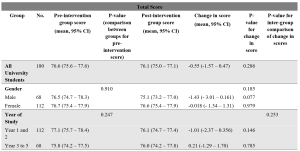
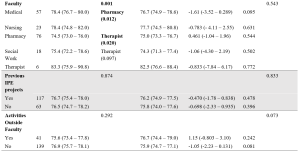
Table 3: Total RIPLS scores.
Subscale scores can be found in Annexes 3 to 6.
The mean baseline total RIPLS score was 76.6 (95% CI 75.6 – 77.6). There was a baseline difference between faculties (p=0.001), with medical and therapy undergraduates having higher scores as compared to pharmacy students (mean difference 3.85, 0.59–7.11, p=0.012 and mean difference 8.83, 0.94–16.7, p=0.020, respectively) (Table 3). As for subscales, there was a difference in “Teamwork and Collaboration” baseline scores between years of study, with Year 1–2 undergraduates had a higher baseline score of 40.8 (40.0–41.5) versus Year 3–5 undergraduates with a score of 39.5 (38.6–40.4) (p=0.038) (Annex 3). Medical undergraduates had higher baseline scores for the “Teamwork and Collaboration” 41.2 (40.2–42.2)) and “Positive Professional Identity” 17.9 (17.4–18.5) subscales compared to pharmacy undergraduates 39.3 (38.4–40.1) (p=0.034), and 17.0 (16.6–17.4) (p=0.036) respectively (Annexes 3-4). Social work undergraduates have the lowest baseline “Roles and Responsibility” score, averaging 4.94 (4.34–5.55) compared to all other faculties (Annex 6).
E. Change in RIPLS Score Post-Intervention
There was no significant difference between the pre- and post-intervention RIPLS total score and the subscale score under the “Teamwork and Collaboration” subscale (Table 3, Annex 3). Under the “Positive Professional Identity” subscale, there was a decrease in post-intervention scores of Year 1-2 students (mean difference -0.500 (-0.931– -0.069), p=0.023) and students with no participation in activities outside of the faculty (mean difference -0.403 (-0.768 – -0.037), p=0.031) (Annex 4). Under the “Negative Professional Identity” subscale, there was a decrease in post-intervention score in medical students (mean difference -0.667 (-1.31– – 0.020), p=0.44) and social work students (-0.889 (-1.70– -0.073), p=0.035) (Annex 5). There was an increase in the post-intervention score amongst female students under the “Roles and Responsibility” subscale (mean difference 0.384 (0.065–0.703), p=0.019) (Annex 6).
F. Individual Item Analysis
Negatively coded statements like “the function of nurses and therapists is mainly to provide support for doctors” (Item 17) and “I am not sure what my professional role will be” (Item 18) showed significant increases in scores post-intervention (0.23, p=0.005 and 0.17, p=0.016 respectively). Other significant findings include a decrease in scores for the statements “Shared learning with other health and social care professionals will help me to communicate better with patients and other healthcare professionals” (Item 13) (-0.14, p=0.013), and “Shared learning will help to clarify the nature of patient problems (Item 15) (-0.10, p=0.034) (Table 4).
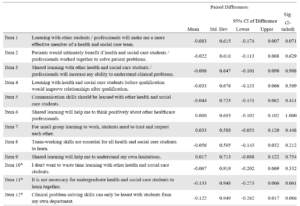
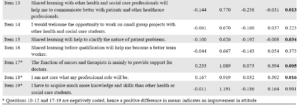
Table 4: RIPLS (Individual items analysis)
G. Self-Reported Feedback on Interprofessional Learning
91.6% participants agreed they could “better appreciate the importance of interprofessional collaboration in the care of patients”. 72.8% said MDMs were important for their learning and 91.9% of respondents would recommend the programme to their friends.
H. Qualitative Feedback
163 of 180 survey respondents participated in the qualitative research (response rate 90.6%). (Fig 1) 34.4% of respondents were male and 65.6% female. 33.1% of respondents were studying Medicine, 12.3% Nursing, 40.5% Pharmacy, 11.0% Social Work and 3.1% Therapy. 54.6% of respondents were in early years of study (Year 1–2). 74.8% had previous exposure to IPE. Thematic analysis yielded the following themes:
1) Learning and teaching one another: Healthcare undergraduates found value in learning from one another. They shared knowledge and skills gained from their respective curriculum with one another.
“I feel more equipped and prepared to teach and learn from other healthcare professionals”
21-year-old female third-year medical student
“I learnt a lot from my social work team leader and how to consider the social aspects of issues the elderly face”
20-year-old male first-year medical student
2) Understanding the role of other healthcare professionals: Healthcare undergraduates learned the role of other healthcare professionals and gained new insights into how different healthcare professionals contributed to the care of the patient.
[I have] learn[ed] … how we can tap on each other[’s] strengths to come up with a care plan for the patients
21-year-old female third-year pharmacy student
Understanding what medicine, nursing [and] pharmacy does make quite a lot of difference to how we perceive and thus, work with them.
23-year-old female second-year social work student
3) Understanding one’s own role: Healthcare undergraduates reported developing a greater understanding of the roles and responsibilities they played as a part of a multi-disciplinary team.
I am now more aware of the role and responsibility I have as a healthcare professional.
21-year-old female first-year pharmacy student
Working in a multi-disciplinary team gave me a feel of how it may be like caring for a patient as a team in my future career.
20-year-old female first-year social work student
4) Teamwork: Healthcare undergraduates appreciated the need for collaboration and teamwork within a multi-disciplinary team. They learned about the importance of compromise.
Working with different people, in terms of personality, faculty, etcetera – I learnt to give and take and be more understanding towards the others.
21-year-old second-year social work student
It has allowed me to better understand … how the different professions can come together to better serve the needs of patients.
20-year-old female second-year pharmacy student
5) Opportunity to meet people from other faculties: Healthcare undergraduates valued meeting people from other faculties and developing collaborative relationships they would otherwise not have had the opportunity to.
I got to know seniors in medicine and peers from pharmacy.
20-year-old female first-year nursing student
It is a very unique experience, having the chance to interact with … other university students from different healthcare faculties.
20-year-old female second-year pharmacy student
6) Factors limiting learning: Factors limiting learning included time constraints, unmotivated teammates, administrative burden and lack of suitable patients. For the latter, some undergraduates felt that their care was restricted to companionship for patients who were already able to manage their own chronic conditions well and did not require further help from the healthcare undergraduates.
IV. DISCUSSION
A. Validation of the RIPLS in Singapore
This study validated the RIPLS in the Singapore context. The final model is the same as proposed by McFadyen et al. (2005). without item 18 “I am not sure what my professional role will be”, from “Roles and Responsibility” subscale. The poor fit of this item into this study’s theoretical construct could be because participants are mostly in their pre-clinical years and may not understand professional roles and responsibilities due to their limited on-job experience, a reason also proposed by McFadyen et al. (2005) and Tyastuti et al. (2014). Tyastuti et al. (2014) found this item, along with “I have to acquire much more knowledge and skills than other healthcare students” (item 19) from the same subscale had loading factors of <0.5 and removed the entire “Roles and Responsibility” subscale from the Indonesian version of the RIPLS. Other studies validating the RIPLS also experienced issues with this subscale (Lauffs et al., 2008; Lestari et al., 2016; McFadyen et al., 2005).
B. Baseline RIPLS score
The mean baseline RIPLS score is comparable with that by Chua et al. (2015), another study conducted in Singapore which measured change in the RIPLS after a one-day IPE conference. They also found higher baseline RIPLS scores for medical undergraduates versus other faculties, a finding also noted in this study and another done in a culturally similar country (Lestari et al., 2016). However, this finding seems inconsistent as other studies (Aziz et al., 2011; de Oliveira et al., 2018) have found the contrary.
Chua et al. (2015) also found that prior IPE experience resulted in higher baseline RIPLS scores, a finding not replicated in this study. We hypothesise that while 65.0% of this study’s participants had previous IPE exposure (versus 10.6% in Chua et al. (2015)), the heterogenous nature of IPE programmes they previously participated in may have had differing efficacy in improving IPE attitudes.
This study found undergraduates in their later years had a lower baseline “Teamwork and Collaboration” subscale score, versus those in their early years. We postulate that undergraduates with more clinical experience better understand the challenges of IPE in practice, a finding echoed by Judge et al. (2015).
That pharmacy students, but not medical students, were mandated by their curriculum to fulfil volunteering hours which could explain the former’s lower baseline scores for total RIPLS and subscales “Teamwork and Collaboration” and “Positive Professional Identity” since they are likely less motivated by IPE when choosing to participate.
Social work undergraduates’ low baseline “Roles and Responsibility” score likely reflects their minimal exposure to medical social work unless they elected for healthcare modules in their senior years of study.
C. Change in Pre- and Post-intervention RIPLS Scores
Our study did not show a significant difference between the pre- and post-intervention RIPLS total score and the “Teamwork and Collaboration” subscale. Additionally, there was a decrease seen in post-intervention scores under the “Positive Professional Identity” subscale for Year 1-2 students and the “Negative Professional Identity” subscale in medical students and social work students. This is in contrast with the literature, where previous studies involving conferences (Chua et al., 2015) or solitary learning modules (Wakely et al., 2013; Zaudke et al., 2016) demonstrated a significant difference in the total RIPLS score pre- and post- intervention. Possible reasons for this are further discussed in section E.
There was a significant increase in the post-intervention score amongst female students under the “Roles and Responsibility” subscale. Previous studies have suggested that there are gender specific differences in perception towards IPE with female students having a more positive attitude towards IPE (Hansson et al., 2010; Wilhelmsson et al., 2011). In addition, the individual item analysis showed that negatively coded statements relating to the subscale of “Roles and Responsibility” such as “the function of nurses and therapists is mainly to provide support for doctors” (Item 17) and “I am not sure what my professional role will be” (Item 18) had significant increases in scores post-intervention. This is encouraging and demonstrates the success of the programme in helping students understand the respective roles and responsibility of each profession which is a crucial part of IPE and eventually IPC.
Other significant findings in the individual item analysis include a decrease in scores for the statements “Shared learning with other health and social care professionals will help me to communicate better with patients and other healthcare professionals” (Item 13), and “Shared learning will help to clarify the nature of patient problems” (Item 15). These findings suggest that the programme can be improved by incorporating more modules on communication between healthcare professionals and shared problem-solving.
D. Qualitative Feedback
While the lack of a significant difference between the pre- and post-intervention RIPLS scores suggest no changes in attitudes, the qualitative data revealed that the majority of undergraduates better appreciated the importance of IPC for patient care and many felt that that MDMs were useful for their learning.
Qualitative analysis revealed five major themes in the undergraduates’ learning pertaining to IPE. Participants learned from and taught each other. Being able to freely learn from and teach one another requires mutual trust and respect which are key elements of collaborative practices (de Oliveira et al., 2018). Participants reported better understanding of their own and other healthcare professionals’ roles; these are recognised as crucial components of collaborative practice (Canadian Interprofessional Health Collaborative, 2010). Undergraduates also shared that they learned about teamwork, specifically, conflict resolution and compromise. Finally, undergraduates appreciated the opportunities to meet fellow undergraduates from different faculties. It has been observed in many successful IPE programmes that informal social interactions are potentially as important as the actual IPE activities (Lie et al., 2016). We observed that the relationships built between participants of the programme often persisted beyond the completion of the programme; these relationships could benefit the institution and healthcare system (Hoffman et al., 2008).
E. Possible Reasons Underlying Lack of Improvement in RIPLS Scores
First, as mentioned earlier, the RIPLS has been described to have psychometrics issues, with multiple researchers modifying the subscales (Mahler et al., 2015). Second, Schmitz and Brandt (2015) suggested that RIPLS is insensitive to course improvements and to pre- versus post-intervention change in attitudes. We chose the RIPLS at the start of 2014 as it had been widely used and validated and simple to administer, and we also sought to validate it in Singapore for the first time. Unfortunately, few studies on its potential issues had been published at the time to inform the design of this study. Third, the longitudinal nature of the programme may have permitted undergraduates greater insight to the challenges of IPE and realities of collaborating within interprofessional teams, tampering their idealism.
Lestari et al. (2016) described how nursing and midwifery undergraduates had lower RIPLS scores as compared to medical and dentistry undergraduates as they had prior clinical experience and likely observed less than exemplary interactions amongst members of healthcare teams. Similarly, Makino et al. (2013) found that graduates of an IPE programme had a lower mean score on the Modified Attitudes Toward Health Care Teams Scale (ATHCTS) as compared to current students. The authors suggested that the alumni’s negative attitude may be due to their real-world experience. Several structural issues in clinical practice have been identified that contribute to this trend, for example competition between professionals (Tremblay et al., 2010) and power struggles (Paradis & Whitehead, 2015).
F. Barriers to IPE
Undergraduates reported four main barriers: time constraints, unmotivated teammates, administrative burden, unsuitable patients. Other studies including Alexandraki et al. (2017) and West et al. (2016) have also faced time constraints. As this programme is voluntary, undergraduates had to take time off their already packed curriculum to participate, and the selection of volunteers was not a stringent process. Additionally, as participants were contributing to clinical care, documentation of visits is required. Multiple studies showed that physicians deemed documentation and administrative work burdensome and excessive time spent on these may be associated with physicians’ burnout (Patel et al., 2018; Wright & Katz, 2018).
In addressing these barriers, incorporating academic credits for participation, a more stringent selection of participants, streamlining administrative work and prudent choice of patients may be considered. These measures are already being implemented by the programme organisers to improve the programme.
G. Strengths and Limitations
The strength of this study lies in the use of both quantitative and qualitative data grounded on an established framework by Kirkpatrick (1959) for the evaluation of a novel experiential IPE programme. The limitations of our study include it being single-institution and that the participants are volunteers which thus form a self-selected group. Hence, the results may not be generalisable. There was also no control arm for the intervention. In addition, there was a large variation in baseline RIPLS score seen in the programme, which can be potentially improved with a more robust study design that controls for baseline differences. Lastly, the use of only a survey for data collection may limit the depth of qualitative data obtained. Further studies could include qualitative interviews.
V. CONCLUSION
We validated the RIPLS in Singapore and demonstrated the feasibility of an interprofessional student-initiated home visit programme. While there was no significant change in RIPLS scores, the qualitative feedback suggests that there are participant-perceived benefits for IPE after undergoing this programme, even with the perceived barriers to IPE. Future programmes can work on addressing these barriers to IPE.
Notes on Contributors
Gloria Yao Chi Leung contributed to the conception and design of the work, the acquisition, analysis, and interpretation of data for the work, drafting and revising the manuscript, approves of the publishing of the manuscript, and agrees to be accountable for the accuracy of the work.
Kennedy Yao Yi Ng contributed to the conception and design of the work, analysis and interpretation of data for the work, drafting and revising the manuscript, approves of the publishing of the manuscript, and agrees to be accountable for the accuracy of the work.
Yow Ka Shing contributed to the conception and design of the work, the acquisition and interpretation of data for the work, drafting and revising the manuscript, approves of the publishing of the manuscript, and agrees to be accountable for the accuracy of the work.
Nerice Heng Wen Ngiam contributed to the conception and design of the work, the acquisition of data for the work, drafting the manuscript, approves of the publishing of the manuscript, and agrees to be accountable for the accuracy of the work.
Dillon Guo Dong Yeo contributed to the conception and design of the work, drafting the manuscript, approves of the publishing of the manuscript, and agrees to be accountable for the accuracy of the work.
Angeline Jie-Yin Tey contributed to the conception and design of the work, drafting the manuscript, approves of the publishing of the manuscript, and agrees to be accountable for the accuracy of the work.
Melanie Si Rui Lim contributed to the conception and design of the work, drafting the manuscript, approves of the publishing of the manuscript, and agrees to be accountable for the accuracy of the work.
Aaron Kai Wen Tang contributed to the conception and design of the work, drafting the manuscript, approves of the publishing of the manuscript, and agrees to be accountable for the accuracy of the work.
Chew Bi Hui contributed to the conception and design of the work, drafting the manuscript, approves of the publishing of the manuscript, and agrees to be accountable for the accuracy of the work.
Celine Yi Xin Tham contributed to the conception and design of the work, drafting the manuscript, approves of the publishing of the manuscript, and agrees to be accountable for the accuracy of the work.
Yeo Jia Qi contributed to the conception and design of the work, drafting the manuscript, approves of the publishing of the manuscript, and agrees to be accountable for the accuracy of the work.
Lau Tang Ching contributed to the conception and design of the work, critical revision of the manuscript, approves of the publishing of the manuscript, and agrees to be accountable for the accuracy of the work.
Wong Sweet Fun contributed to the conception and design of the work, critical revision of the manuscript, approves of the publishing of the manuscript, and agrees to be accountable for the accuracy of the work.
Gerald Choon Huat Koh contributed to the conception and design of the work, interpretation of the data for the work, critical revision of the manuscript, approves of the publishing of the manuscript, and agrees to be accountable for the accuracy of the work.
Wong Chek Hooi contributed to the conception and design of the work, interpretation of the data for the work, critical revision of the manuscript, approves of the publishing of the manuscript, and agrees to be accountable for the accuracy of the work.
Ethical Approval
Ethical approval was obtained from the NUS institutional review board (B-15-272). Study participation was entirely voluntary and anonymous. Informed consent was taken from participants before data collection commenced, and they were allowed to withdraw from the research at any point in time. No incentives were provided to study participants.
Data Availability
According to institutional policy, research dataset is available on reasonable request to the corresponding author.
Acknowledgement
The authors would like to thank the Tri-Generational HomeCare Organising Committee from 2014 to 2018 for supporting the study. They would like to extend their thanks to the National University of Singapore, Yong Loo Lin School of Medicine, Dean’s Office; the North West Community Development Council; Khoo Teck Puat Hospital, Singapore; Geriatric Education and Research Institute, Singapore. Finally, they would like to thank the volunteers for their generosity and the patients for their hospitality.
Funding
National University of Singapore, Yong Loo Lin School of Medicine, Dean’s Office; the North West Community Development Council; Khoo Teck Puat Hospital, Singapore provided funding support for the purchase of medical consumables, refreshments and logistics for the program.
Declaration of Interest
There are no conflicts of interest.
References
Alexandraki, I., Hernandez, C. A., Torre, D. M., & Chretien, K. C. (2017). Interprofessional education in the internal medicine clerkship post-LCME standard issuance: Results of a national survey. Journal of General Internal Medicine, 32(8), 871–876.https://doi.org/10.1007/s11606-017-4004-3
Aziz, Z., Teck, L. C., & Yen, P. Y. (2011). The attitudes of medical, nursing and pharmacy students to inter-professional learning. Procedia – Social and Behavioural Sciences, 29, 639–645. https://doi.org/10.1016/j.sbspro.2011.11.287
Barr, H., Koppel, I., Reeves, S., Hammick, M., & Freeth, D. (2005). Effective interprofessional education: argument, assumption, and evidence (1st edition). Wiley-Blackwell.
Berger-Estilita, J., Fuchs, A., Hahn, M., Chiang, H., & Greif, R. (2020). Attitudes towards interprofessional education in the medical curriculum: A systematic review of the literature. BMC Medical Education, 20(1), Article 254. https://doi.org/10.1186/s12909-020-02176-4
Blythe, J., & Spiring, R. (2020). The virtual home visit. Education for Primary Care, 31(4), 244–246. https://doi.org/10.1080/14739879.2020.1772119
Braun, V., & Clarke, V. (2006). Using thematic analysis in psychology. Qualitative Research in Psychology, 3(2), 77–101. https://doi.org/10.1191/1478088706qp063oa
Briggs, M. C. E., & McElhaney, J. E. (2015). Frailty and interprofessional collaboration. Interdisciplinary Topics in Gerontology and Geriatrics, 41, 121–136. https://doi.org/10.1159/000381204
Canadian Interprofessional Health Collaborative. (2010). A national interprofessional competency framework. https://phabc.org/wp-content/uploads/2015/07/CIHC-National-Interprofessional-Competency-Framework.pdf
Chua, A. Z., Lo, D. Y., Ho, W. H., Koh, Y. Q., Lim, D. S., Tam, J. K., Liaw, S. Y., & Koh, G. C. (2015). The effectiveness of a shared conference experience in improving undergraduate medical and nursing students’ attitudes towards inter-professional education in an Asian country: A before and after study. BMC Medical Education, 15, Article 233. https://doi.org/10.1186/s12909-015-0509-9
Conti, G., Bowers, C., O’Connell, M. B., Bruer, S., Bugdalski-Stutrud, C., Smith, G., Bickes, J., & Mendez, J. (2016). Examining the effects of an experiential interprofessional education activity with older adults. Journal of Interprofessional Care, 30(2), 184–190. https://doi.org/10.3109/13561820.2015.1092428
de Oliveira, V. F., Bittencourt, M. F., Navarro Pinto, Í. F., Lucchetti, A. L. G., da Silva Ezequiel, O., & Lucchetti, G. (2018). Comparison of the readiness for interprofessional learning and the rate of contact among students from nine different healthcare courses. Nurse Education Today, 63, 64–68. https://doi.org/10.1016/j.nedt.2018.01.013
Fahs, D. B., Honan, L., Gonzalez-Colaso, R., & Colson, E. R. (2017). Interprofessional education development: Not for the faint of heart. Advances in Medical Education and Practice, 8, 329–336. https://doi.org/10.2147/AMEP.S133426
Ganotice, F. A., & Chan, L. K. (2018). Construct validation of the English version of Readiness for Interprofessional Learning Scale (RIPLS): Are Chinese undergraduate students ready for ‘shared learning’? Journal of Interprofessional Care, 32(1), 69–74. https://doi.org/10.1080/13561820.2017.1359508
Grice, G. R., Thomason, A. R., Meny, L. M., Pinelli, N. R., Martello, J. L., & Zorek, J. A. (2018). Intentional interprofessional experiential education. American Journal of Pharmaceutical Education, 82(3), Article 6502. https://doi.org/10.5688/ajpe6502
Hansson, A., Foldevi, M., & Mattsson, B. (2010). Medical students’ attitudes toward collaboration between doctors and nurses – A comparison between two Swedish universities. Journal of Interprofessional Care, 24(3), 242–250. https://doi.org/10.3109/13561820903163439
Hoffman, S. J., Rosenfield, D., Gilbert, J. H. V., & Oandasan, I. F. (2008). Student leadership in interprofessional education: Benefits, challenges and implications for educators, researchers and policymakers. Medical Education, 42(7), 654–661. https://doi.org/10.1111/j.1365-2923.2008.03042.x
Judge, M. P., Polifroni, E. C., & Zhu, S. (2015). Influence of student attributes on readiness for interprofessional learning across multiple healthcare disciplines: Identifying factors to inform educational development. International Journal of Nursing Sciences, 2(3), 248–252. https://doi.org/10.1016/j.ijnss.2015.07.007
Kiger, M. E., & Varpio, L. (2020). Thematic analysis of qualitative data: AMEE Guide No. 131. Medical Teacher, 42(8), 846–854. https://doi.org/10.1080/0142159X.2020.1755030
Kirkpatrick, D. L. (1959). Techniques for Evaluation Training Programs. Journal of the American Society of Training Directors, 13, 21–26.
Knowles, M. S. (1984). Andragogy in Action: Applying Modern Principles of Adult Learning (1st edition). Jossey-Bass.
Lauffs, M., Ponzer, S., Saboonchi, F., Lonka, K., Hylin, U., & Mattiasson, A.-C. (2008). Cross-cultural adaptation of the Swedish version of Readiness for Interprofessional Learning Scale (RIPLS). Medical Education, 42(4), 405–411. https://doi.org/10.1111/j.1365-2923.2008.03017.x
Lestari, E., Stalmeijer, R. E., Widyandana, D., & Scherpbier, A. (2016). Understanding students’ readiness for interprofessional learning in an Asian context: A mixed-methods study. BMC Medical Education, 16, Article 179. https://doi.org/10.1186/s12909-016-0704-3
Li, Z., Sun, Y., & Zhang, Y. (2018). Adaptation and reliability of the Readiness for Inter Professional Learning Scale (RIPLS) in the Chinese health care students setting. BMC Medical Education, 18(1), Article 309. https://doi.org/10.1186/s12909-018-1423-8
Lie, D. A., Forest, C. P., Walsh, A., Banzali, Y., & Lohenry, K. (2016). What and how do students learn in an interprofessional student-run clinic? An educational framework for team-based care. Medical Education Online, 21(1), Article 31900. https://doi.org/10.3402/meo.v21.31900
Mahler, C., Berger, S., & Reeves, S. (2015). The Readiness for Interprofessional Learning Scale (RIPLS): A problematic evaluative scale for the interprofessional field. Journal of Interprofessional Care, 29(4), 289–291. https://doi.org/10.3109/13561820.2015.1059652
Makino, T., Shinozaki, H., Hayashi, K., Lee, B., Matsui, H., Kururi, N., Kazama, H., Ogawara, H., Tozato, F., Iwasaki, K., Asakawa, Y., Abe, Y., Uchida, Y., Kanaizumi, S., Sakou, K., & Watanabe, H. (2013). Attitudes toward interprofessional healthcare teams: A comparison between undergraduate students and alumni. Journal of Interprofessional Care, 27(3), 261–268. https://doi.org/10.3109/13561820.2012.751901
McFadyen, A. K., Webster, V., Strachan, K., Figgins, E., Brown, H., & McKechnie, J. (2005). The Readiness for Interprofessional Learning Scale: A possible more stable sub-scale model for the original version of RIPLS. Journal of Interprofessional Care, 19(6), 595–603. https://doi.org/10.1080/13561820500430157
McManus, K., Shannon, K., Rhodes, D. L., Edgar, J. D., & Cox, C. (2017). An interprofessional education program’s impact on attitudes toward and desire to work with older adults. Education for Health, 30(2), 172–175. https://doi.org/10.4103/efh.EfH_2_15
Ng, K. Y. Y., Leung, G. Y. C., Tey, A. J.-Y., Chaung, J. Q., Lee, S. M., Soundararajan, A., Yow, K. S., Ngiam, N. H. W., Lau, T. C., Wong, S. F., Wong, C. H., & Koh, G. C.-H. (2020a). Bridging the intergenerational gap: The outcomes of a student-initiated, longitudinal, inter-professional, inter-generational home visit program. BMC Medical Education, 20(1), Article 148. https://doi.org/10.1186/s12909-020-02064-x
Ng, K. Y. Y., Leung, G. Y. C., Yow, K. S., Ngiam, N. H. W., Yeo, D. G. D., Tey, A. J.-Y., Lim, M. S. R., Tang, A. K. W., Chew, B. H., Tham, C. Y. X., Yeo, J. Q., Lau, T. C., Wong, S. F., Wong, C. H., & Koh, G. C.-H. (2020b). Impact of an interprofessional, longitudinal, undergraduate student-initiated home visit program towards interprofessional education. Research Square. https://doi.org/10.21203/rs.3.rs-23744/v1
Paradis, E., & Whitehead, C. R. (2015). Louder than words: Power and conflict in interprofessional education articles, 1954-2013. Medical Education, 49(4), 399–407. https://doi.org/10.1111/medu.12668
Parsell, G., & Bligh, J. (1999). The development of a questionnaire to assess the readiness of health care students for interprofessional learning (RIPLS). Medical Education, 33(2), 95-100. https://doi.org/10.1046/j.1365-2923.1999.00298.x
Patel, R. S., Bachu, R., Adikey, A., Malik, M., & Shah, M. (2018). Factors related to physician burnout and its consequences: A review. Behavioural Sciences, 8(11), Article 98. https://doi.org/10.3390/bs8110098
Schmitz, C. C., & Brandt, B. F. (2015). The Readiness for Interprofessional Learning Scale: To RIPLS or not to RIPLS? That is only part of the question. Journal of Interprofessional Care, 29(6), 525–526. https://doi.org/10.3109/13561820.2015.1108719
Shapiro, S. S., & Wilk, M. B. (1965). an analysis of variance test for normality (complete samples). Biometrika, 52(3/4), 591–611. https://doi.org/10.2307/2333709
Sunguya, B. F., Hinthong, W., Jimba, M., & Yasuoka, J. (2014). Interprofessional education for whom? – Challenges and lessons learned from its implementation in developed countries and their application to developing countries: A systematic review. PloS One, 9(5), Article e96724. https://doi.org/10.1371/journal.pone.0096724
Tamura, Y., Seki, K., Usami, M., Taku, S., Bontje, P., Ando, H., Taru, C., & Ishikawa, Y. (2012). Cultural adaptation and validating a Japanese version of the readiness for interprofessional learning scale (RIPLS). Journal of Interprofessional Care, 26(1), 56–63. https://doi.org/10.3109/13561820.2011.595848
Toth-Pal, E., Fridén, C., Asenjo, S. T., & Olsson, C. B. (2020). Home visits as an interprofessional learning activity for students in primary healthcare. Primary Health Care Research & Development, 21, Article e59. https://doi.org/10.1017/S1463423620000572
Tremblay, D., Drouin, D., Lang, A., Roberge, D., Ritchie, J., & Plante, A. (2010). Interprofessional collaborative practice within cancer teams: Translating evidence into action. A mixed methods study protocol. Implementation Science, 5, Article 53. https://doi.org/10.1186/1748-5908-5-53
Tyastuti, D., Onishi, H., Ekayanti, F., & Kitamura, K. (2014). Psychometric item analysis and validation of the Indonesian version of the Readiness for Interprofessional Learning Scale (RIPLS). Journal of Interprofessional Care, 28(5), 426–432. https://doi.org/10.3109/13561820.2014.907778
Vaughn, L. M., Cross, B., Bossaer, L., Flores, E. K., Moore, J., & Click, I. (2014). Analysis of an interprofessional home visit assignment: Student perceptions of team-based care, home visits, and medication-related problems. Family Medicine, 46(7), 522–526
Wakely, L., Brown, L., & Burrows, J. (2013). Evaluating interprofessional learning modules: Health students’ attitudes to interprofessional practice. Journal of Interprofessional Care, 27(5), 424–425. https://doi.org/10.3109/13561820.2013.784730
West, C., Graham, L., Palmer, R. T., Miller, M. F., Thayer, E. K., Stuber, M. L., Awdishu, L., Umoren, R. A., Wamsley, M. A., Nelson, E. A., Joo, P. A., Tysinger, J. W., George, P., & Carney, P. A. (2016). Implementation of interprofessional education (IPE) in 16 U.S. medical schools: Common practices, barriers and facilitators. Journal of Interprofessional Education & Practice, 4, 41–49. https://doi.org/10.1016/j.xjep.2016.05.002
Wilhelmsson, M., Ponzer, S., Dahlgren, L. O., Timpka, T., & Faresjö, T. (2011). Are female students in general and nursing students more ready for teamwork and interprofessional collaboration in healthcare? BMC Medical Education, 11, Article 15. https://doi.org/10.1186/1472-6920-11-15
Wright, A. A., & Katz, I. T. (2018). Beyond burnout — Redesigning care to restore meaning and sanity for physicians. The New England Journal of Medicine, 378(4), 309–311. https://doi.org/10.1056/NEJMp1716845
Zaudke, J. K., Paolo, A., Kleoppel, J., Phillips, C., & Shrader, S. (2016). The impact of an interprofessional practice experience on readiness for interprofessional learning. Family Medicine, 48(5), 371–376.
*Chek Hooi WONG
90 Yishun Central,
Khoo Teck Puat Hospital,
Singapore 768828
9 Lower Kent Ridge Rd, Level 10,
+65 6807 8001
Email: wong.chek.hooi@ktph.com.sg
Submitted: 15 March 2022
Accepted: 23 March 2022
Published online: 5 July, TAPS 2022, 7(3), 63-64
https://doi.org/10.29060/TAPS.2022-7-3/LE2777
P Ravi Shankar
IMU Centre for Education, International Medical University, Malaysia
I read with great interest the article titled ‘Humanism in Asian medical education – A scoping review’ (Zhu et al., 2021). The article provides an overview of the teaching of humanism in medical schools in Asia. Teaching humanistic values is still not common among Asian medical schools and the published literature is predominantly from a few countries.
The Himalayan country of Nepal has also taken initiatives to strengthen the learning of humanistic values by medical students.
Initiatives have been conducted at different institutions including KIST Medical College, Lalitpur, Nepal, and Patan Academy of Health Sciences (PAHS), Lalitpur, Nepal among others. I believe that the medical humanities can play an important role in fostering humanistic values among medical students. An overview of the discipline in Nepal was provided in an article published in 2014 (Dhakal et al., 2014). Recently several initiatives are being undertaken at PAHS and the undergraduate medical program at the institution has the objective of creating doctors for rural Nepal.
I do agree that there have been problems with the sustainability of these initiatives in Nepal. The language of medical education in Nepal is English like in many other Asian countries. However, the activities and material used were adapted to the Nepalese context, where possible. The scoping review about humanism in Asian medical education can be made more comprehensive by including the initiatives and publications from Nepal, a country where despite various challenges, initiatives have been undertaken in this important area. These studies do fit into the core characteristics of the Integrity, Excellence, Compassion & Collaboration, Altruism, Respect & Resilience, Empathy, and Service (IECARES) framework used by the authors.
The immediate and short-term impacts of these initiatives have been published and the medium-term impact has been studied and is under review for publication. The challenge with measuring the medium to long-term impact of these initiatives is the possibility of other activities undertaken by the student also influencing the outcomes and introducing bias. A variety of methods have been used to foster teaching-learning of humanistic values. Though there are limitations as mentioned earlier, the addition of these initiatives may add strength and greater representativeness to the scoping review.
Note on Contributor
Dr Shankar was involved in conceptualising writing, and editing the manuscript.
Funding
No funds, grants, or other support were received.
Declaration of Interest
No conflicts of interest are associated with this paper.
References
Dhakal, A. K., Shankar, P. R., Dhakal, S., Shrestha, D., & Piryani, R. M. (2014). Medical humanities in Nepal: Present scenario. Journal of the Nepal Medical Association, 52(193), 751–754.
Zhu, C. S., Yap, R. K. F., Lim, S. Y. S., Toh, Y. P., & Loh, V. W. K. (2021). Humanism in Asian medical education – A scoping review. The Asia Pacific Scholar, 7(1), 9-20. https://doi.org/10.29060/TAPS.2022-7-1/RA2460
*P Ravi Shankar
International Medical University,
Bukit Jalil, Kuala Lumpur, Malaysia
Email: ravi.dr.shankar@gmail.com
Submitted: 24 December 2021
Accepted: 23 March 2022
Published online: 5 July, TAPS 2022, 7(3), 60-62
https://doi.org/10.29060/TAPS.2022-7-3/PV2727
Ikuo Shimizu1, Shuh Shing Lee2, Ardi Findyartini3, Kiyoshi Shikino4, Yoshikazu Asada5 & Hiroshi Nishigori6
1Center for Medical Education and Clinical Training, Shinshu University Hospital, Matsumoto, Japan; 2Centre for Medical Education, Yong Loo Lin School of Medicine, National University of Singapore, Singapore; 3Department of Medical Education & Medical Education Center-Indonesia Medical Education & Research Institute, Faculty of Medicine Universitas Indonesia; 4Department of General Medicine, Chiba University Hospital, Chiba, Japan; 5Center for Information, Jichi Medical University, Shimotsuke, Japan; 6Center for Medical Education, Nagoya University, Nagoya, Japan
I. INTRODUCTION
After the “To err is human” report in 1999, health care systems have become aware of the serious consequences of failures in health care and have sought to reduce them by enhancing patient safety education. The current medical educators consider that errors are inevitable in clinical practice and think of learning from these errors to improve the quality of the practice and maintain the safety of health care services. This effort on quality improvement and patient safety is now regarded as part of patient safety education. One example is the Morbidity and Mortality conference, a continuous professional development opportunity that had sprung from the efforts of learners to improve practice through the examination of medical errors and unfavourable outcomes. Openness to discussion and study of errors, with a realisation that “errors must not be accepted as a person’s fault”, is central to their message.
To err is human, as is the educators. Educators plan and implement various educational practices, but they sometimes fail to achieve the expected outcomes. We educators sometimes find that our educational practices fail to deliver the intended results or have unexpected adverse outcomes, and we consider such outcomes to be failures. Therefore, it is crucial for faculty to acknowledge the failure and try to make further improvements. In addition to educators’ reflections, they are involved in an institutional opportunity to reflect on practices as a form of faculty development. Faculty development includes initiatives designed to improve the performance of faculty members in teaching, research and administration. However, failures in educational practices are often difficult to be recognised and disclosed to colleagues and learners. Admitting and revealing failure is often difficult for clinicians, and it is no different for educational practitioners. Such educators can be called “problem” educators, just as learners who have difficulty improving their competence appropriately can be called “problem” learners. (Steinert, 2013). Thus, there is a scarce opportunity for educators to recognise and share their failed experiences. Such an attitude of neglect will have a negative impact not only on the quality of educational practices but also on the student-faculty relationship in the long run. It is nothing but a tragedy in medical education to allow faculty to become “problem” educators.
Therefore, the present article states theoretical background to understand how to learn from failure, especially the obstacles for educators, and propose a framework for taking hints from the recent patient safety education.
II. WHY TRADITIONAL SAFETY PARADIGM DOES NOT WORK FOR REFLECTION
Reflecting on experience is crucial for all educators because it enhances learning from practice. When they reflect on unsuccessful educational practices, educators recognise and analyse what they actually did, what happened during or after their practices, and how to improve their practices in the future.
However, learning through self-reflection requires learning strategies, motivation, and awareness of failure (metacognition). While faculty development can provide the strategies, it becomes an environment without motivation and awareness of failure if it lacks psychological safety. Motivation is required for connecting learning with real-life experiences. Educators can facilitate effective self-regulation by thinking critically about their practice and providing attributional reflection (Ryan & Deci, 2000). In particular, extrinsic motivation does not lead to self-reflection; intrinsic motivation is a necessary condition. Even though faculty development provides extrinsic opportunities, it is difficult for “problem” educators without intrinsic motivation to sufficiently reflect on their failures.
Also, there are concerns about whether the psychological safety of educators is ensured when they are asked to improve their educational practices. Firstly, it is burdensome for participants to accept negative results about their practices. If such an evaluation process does not ensure psychological safety, required for self-directed learning (Edmondson, 2014), it will be difficult for the participants to improve their practices. Psychological evidence also shows that people who have fewer teaching competencies tend to overestimate their skills, which might be another risk to hinder the attitude to reflect educational practices. Secondly, a concern about psychological safety lies that some “problem” educators are not even aware of their failures. This phenomenon does not happen in “problem” learners, especially in undergraduate education. While learners often realise they have a problem through some form of summative assessment, educators need to engage in reflection themselves. However, an environment with psychological safety can promote proactive behaviours like self-reflection (Lin, 2007).
III. USE OF SAFETY-II PARADIGM FOR EDUCATORS” PSYCHOLOGICAL SAFETY
In order to overcome these obstacles against the suitable faculty development environment to learn from the failed educational practices, the authors consider psychological safety and suggest shifting our perspective of failure by drawing on the quality improvement strategies. Defining an ideal practice as successful and others that are not (i.e. failures) is derived from the traditional safety management paradigm called Safety-I (Hollnagel, 2014). In contrast to the traditional paradigm, the use of the new paradigm has recently been proposed and become prominent. This paradigm (Safety-II) presupposes that there will always be a gap between the results intended by the practitioners and the actual results. Deviation from the plan itself is not considered a failure. Instead, we can consider such gaps as adaptations and analyse why they occurred and how they worked. The analysis will bring about continuous improvement in a more constructive way.
Safety-II paradigm can provide educators with a new insight that an unexpected result of educational practices can be recognised as a more neutral form rather than “failure”. This perspective would help ensure psychological safety and make it easier to bring about self-directed learning. Also, this paradigm can provide a new perspective on implementing educational theories or methods in the context of health professions education. Educators should always pay attention to gaps between what we anticipate and what actually happens; it is essential to establish a causal relationship by reflecting on such gaps.
We keep two things in mind for reflecting on the practices according to the Safety-II paradigm. First, we should describe the outcome of the practice objectively as an actual result rather than a failure. This perspective brings to faculty development the results of education that did not work (i.e., failures) and the unexpectedly good accomplishments. As a result, it will help focus on the original outcome of education and promote self-reflection. Second, the results should be contrasted with expected results at a glance. Then we can discuss the causes lying between expected results and actual results and what to be improved. Adjustments are made to achieve the desired outcome under expected and unexpected conditions. Safety-II approach might significantly contribute to the evaluation of the practice, by considering unexpected outcomes rather than only failures. Therefore, analysing educational programs from a Safety-II-based perspective will make it easier to find the adjustments that were actually made and enable educators to perform resiliently. It would be not easy to achieve by simply pointing out deviations from ideal practice based on Safety-I. This perspective will allow educators to become more aware of resilience in their educational practices. Furthermore, as educators discover the gaps between planned and actual results from Safety-II, they will be motivated to compare them, thus leading to a critical analysis and continuous improvement of their educational practices.
IV. CONCLUSION
The Safety-II paradigm has the potential to move us away from simply judging failed practices, analysing them from a more constructive perspective, and helping us acquire pragmatic improvements. Then it can help both learners and educators better cope with the complexity of medical education. Furthermore, we can expect to obtain the same outcome as the continuous improvement process; we believe this suggestion will help make our reflection valid and inspire us to professional development. Therefore, it would be further highlighted as a seed for future analytical strategies because it has potential value in the field.
Notes on Contributors
Ikuo Shimizu reviewed literature and took the lead in writing and editing the manuscript.
Shuh Shing Lee contributed to the theoretical ideas for this manuscript.
Ardi Findyartini contributed to the theoretical ideas for this manuscript.
Kiyoshi Shikino contributed to the concept and aided the development of the manuscript.
Yoshikazu Asada contributed to the concept and aided the development of the manuscript.
Hiroshi Nishigori advised and provided feedback on the manuscript, aided the development of the manuscript.
All authors discussed and contributed to the final manuscript.
Acknowledgement
The authors wish to thank Professor Takuya Saiki at Medical Education Development Center, Gifu University, Japan, for providing us with an opportunity to conduct a workshop regarding the Safety-II-based approach on May 24, 2020.
We would also like to appreciate Editage (www.editage.com) for English language editing.
Funding
This work was supported by JSPS KAKENHI under Grant #21H03161. This funding source had no role in the design of this study and will not have any role during its execution, analyses, interpretation of the data, or decision to submit results.
Declaration of Interest
The authors have no conflict of interest to declare.
References
Edmondson, A. C. (2014). The competitive imperative of learning. IEEE Engineering Management Review, 42(3), 110-118. https://doi.org/10.1109/emr.2014.6966928
Hollnagel, E. (2014). Safety-I and safety-II: The past and future of safety management. Ashgate. https://doi.org/10.1201/9781315607511
Lin, H. F. (2007). Effects of extrinsic and intrinsic motivation on employee knowledge sharing intentions. Journal of Information Science, 33(2), 135-149. https://doi.org/10.1177/0165551506068174
Ryan, R. M., & Deci, E. L. (2000). Self-determination theory and the facilitation of intrinsic motivation, social development, and well-being. American Psychologist, 55(1), 68–78. https://doi.org/10.1037/0003-066X.55.1.68
Steinert, Y. (2013). The “problem” learner: Whose problem is it? AMEE Guide No. 76. Medical Teacher, 35(4), e1035–e1045. https://doi.org/10.3109/0142159X.2013.774082
*Ikuo Shimizu
Center for Medical Education and Clinical Training,
Shinshu University Hospital,
3-1-1 Asahi, Matsumoto,
Nagano, 390-8621, Japan
Email: ishimizu@shinshu-u.ac.jp
Submitted: 1 February 2022
Accepted: 16 February 2022
Published online: 5 July, TAPS 2022, 7(3), 57-59
https://doi.org/10.29060/TAPS.2022-7-3/PV2737
Garry Soloan1,2 & Muhammad Athallah Arsyaf1,2
1Medical Education Center, Indonesian Medical Education & Research Institute (IMERI) Faculty of Medicine Universitas Indonesia, Jakarta, Indonesia; 2Undergraduate Program in Medicine, Faculty of Medicine Universitas Indonesia, Jakarta, Indonesia
From exams based on short answer questions and multiple-choice questions with a definite answer keys, to project-based, independent, and problem-oriented studies offered in university, the rapid dive transitioning from pedagogical learning into the world of andragogy within the university, truly is one of the highlights of a scholar’s long journey. A 6 year-long habit of having information spoon-fed into our mind, meticulously studying every Cambridge GCE A-Levels past marking scheme and question papers available on the internet had led me to believe that there always had to be the correct, if not perfect, way of finishing an assignment.
Feeling assured and confident on how to approach my study in medicine, it was a surprise to discover that the medical school landscape was far different than what I was used to. Yet being able to define “perfect” in medical school assignments, I found myself approaching every essay as if it was a work of art. Hours, days would be spent writing, reading, and re-writing a single essay assignment. I laboured through every paragraph, often spending more than 30 minutes to finish a paragraph. I regularly consulted a thesaurus, ensuring no word had been repeated within a paragraph, always searching for the perfect word to convey my thoughts. Opinions of others were sought multiple times: Should I mention this? Should I use this word?
The brand-new learning method through problem-based discussions were exciting, yet no less frustrating at times. In completing our assignments for each discussion session, it is likely that we would encounter numerous journals that, more often than not, are contradictory to each other. Significant time would be spent creating a comprehensive literature review, crafting an interactive and thorough presentation, yet at the end of the week, more often than not I doubt that I would be able to answer the simple question of, “what would be the most appropriate treatment for the patient within the trigger case?”.
Over time, I would come to the realisation that such habits and behaviour would not be sustainable in the long run, as I continue to ponder to find the “right way” to study in medical school. By the time that this article was written, 24 months had passed, and although I had an overall satisfactory GPA, each discussion sessions, essay assignment remained invariably the same: challenging as ever. Reflecting back on my prior habit in learning, it is most likely clear to imply that my actions were a result of some degree of perfectionism. The new medical education landscape has caused a turbulence in these habits but as of now, it is still something I am pushing to adapt to by using that drive as something good. But this perfectionist manner of thinking is known to affect more medical students than ever reported, and the perfectionism comes in various degrees in an unpredictable pattern. It might be argued that perfectionism is not necessarily a good trait to have in the study of medicine, but entertaining this idea is not as easy as black and white.
Perfectionism could be simply described as high personal standards with very specific and non-flexible goals to meet. The reactions to these high standards are explained in two different concepts: adaptive and maladaptive perfectionism. The difference between both concepts lies on a thin line, where adaptive perfectionism refers to the standard one puts on his or her performance as a driving force to reach a certain goal. This type of perfectionism, although highly pushing of themselves, still sets realistic standards and is only related to their strivings. Most importantly, the failure of achieving certain goals does not result in self-deprecation. On the other hand, maladaptive perfectionism refers to the same concept of having high standards, but often intensely self-critical over small failures, constantly concerned about creating mistakes, and undermining their success attributing to their low self-esteem. It is simply the overwhelming concern of wanting to do the best, creating a barrier in enjoying a happy life and compromises their state of mind. This type of perfectionism is the most often associated with mental disorders such as anxiety or depression, which sadly, is commonly found among medical students (Seeliger & Harendza, 2017).
Among practicing physicians, the concept of perfectionism often lies in a grey area. In their daily practice, having high standards for their care without having unrealistic expectations is sometimes difficult to do, since responsibilities of physicians are put on the highest pedestals to begin with. As mentioned earlier, adaptive perfectionism presents itself as something good, simply an ambition to always do better without fear of failure. The learning process in medical school is shaped in such a way as an effort to promote this type of perfectionism. As mentioned in a review on medical education by Mylopoulos et al. (2018), most of its studies consist of direct assessments of student’s abilities in recalling factual information. These performance-focused assessments support perfectionism in the lives of students, since their performance is clearly measured by numbers, which for a perfectionist is a perfect judgment of their standards. The review continues by emphasizing on what should be the important components of medical education, including understanding rather than remembering, allowing for challenges and failure to occur as a lesson learned experience, and supporting the variation in individual approaches that come with the aforementioned challenges & failure (Mylopoulos et al., 2018).
So, where do perfectionism stand in these ideal medical education standards in students? Medical education is slowly but steadily pushing towards allowing medical students to dive deep first-hand into their studies and approach it individually, letting mistakes and personal insights influence their clinical judgement before giving the appropriate feedback to put them back on the right track had they stray too far. This type of learning creates opportunities for students to create errors, those of which are hoped to be able to be transformed into valuable learning opportunities. For those with adaptive perfectionism, it could be assumed that they simply adapt to the situation and strive to do well in this new environment as their goals are to strive for good quality outcomes. This assumption is easy to make since adaptive perfectionism rarely associates with the concern of messing-up. However, those with maladaptive perfectionism would most likely succumb under the pressure of starting a learning experience on their own and not having standards to do it perfectly. This is because their actions are fully based on their concerns and feelings, allowing the trait of. Maladaptive perfectionism to become a mediator for mental health disorders as well as an overall decline in quality of life. (Rutter-Eley et al., 2020) The feeling of not knowing what to expect is often the significant cause of anxiety in students with maladaptive perfectionism, and it could lead to further mental instabilities if their performances turn out to not be up to their standards (Bußenius & Harendza, 2019).
From these, there is an implication that if medical education continues to push forward the realization of a new, significantly independent approach in teaching and learning, those with maladaptive perfectionism would simply not survive. This argument could support another issue relating to medical school admission, where several studies had recommended means and the possible benefits in establishing maladaptive perfectionism as a trait to be selected out during medical school selection process (Gärtner et al., 2020; Seeliger & Harendza, 2017). Unfortunately, adaptive and maladaptive perfectionism sometimes live alongside one another, causing a combined effect that is somewhat unpredictable. Because of this, the authors believe that perfectionism could not be ruled out as a negative trait since mental concerns may come and go along the way, where one could use their perfectionism as a driving force one day and use it against them in an episode of low self-esteem another day. Marking it as an elimination characteristic in medical education would not be fair for those with a more stable perfectionism, since we will never know for sure which perfectionist is overly driven, or overly concerned.
It is true that maladaptive perfectionism could pose serious challenges in the learning process of a medical student. This is why traits like these, along with other personality traits that disrupt a good learning environment for an individual, calls for adequate support from the medical school. The trait of maladaptive perfectionism runs rampant among medical students, and it could be tackled by reassurance from their community, teachers, and friends, as well as creating a learning environment that limits the existence of fear-based achievements. (Mylopoulos et al., 2018) The thin line between maladaptive and adaptive perfectionism makes it possible to shape those with the more negative trait into a more positive trait. All in all, we believe that perfectionism is not a trait to shun from medical education, but it is one which medical schools should be able to recognise and provide adequate support in order to nourish the said maladaptive perfectionism, into an adaptive perfectionism in order to nurture physician who would be able to consistently set the bar high, without compromising their own well-being.
Notes on Contributors
Both authors are third year medical students from the Faculty of Medicine, Universitas Indonesia, who is currently undergoing a research internship at Medical Education Center, Indonesia Medical Education & Research Institute (IMERI), Faculty of Medicine, Universitas Indonesia.
Garry Soloan designed and led the study, contributed to argument development, conceptual development, and develop & finalise the manuscript. Muhammad Athallah Arsyaf contributed to argument development, conceptual development, and manuscript development.
Acknowledgement
This paper is written during the author’s internship program at the Medical Education Center, Indonesian Medical Education & Research Institute (IMERI) Faculty of Medicine, Universitas Indonesia. We would like to thank Ardi Findyartini, MD, PhD and Nadia Greviana, DDS, MMedEd, our mentors from Medical Education Center, Indonesia Medical Education & Research Institute (IMERI) FMUI who have provided advice, feedback & mentorship during the writing of this paper.
Declaration of Interest
The authors declare no competing interests.
Funding
No funding is provided for this personal view article.
References
Bußenius, L., & Harendza, S. (2019). The relationship between perfectionism and symptoms of depression in medical school applicants. BMC Medical Education, 19(1), 1-8. https://doi.org/10.1186/s12909-019-1823-4
Gärtner, J., Bußenius, L., Prediger, S., Vogel, D., & Harendza, S. (2020). Need for cognitive closure, tolerance for ambiguity, and perfectionism in medical school applicants. BMC Medical Education, 20(1), 1-8.
Mylopoulos, M., Kulasegaram, K., & Woods, N. N. (2018). Developing the experts we need: Fostering adaptive expertise through education. Journal of Evaluation in Clinical Practice, 24(3), 674-677. https://doi.org/10.1111/jep.12905
Rutter-Eley, E. L., James, M. K., & Jenkins, P. E. (2020). Eating disorders, perfectionism, and quality of life: Maladaptive perfectionism as a mediator between symptoms of disordered eating and quality of life. The Journal of Nervous and Mental Disease, 208(10), 771-776.
Seeliger, H., & Harendza, S. (2017). Is perfect good? – Dimensions of perfectionism in newly admitted medical students. BMC Medical Education, 17(1), 1-7. https://doi.org/10.1186/s12909-017-1034-9
*Garry Soloan
Jl. Salemba Raya No.6, RW.5,
Kenari, Kec. Senen
Kota Jakarta Pusat
Daerah Khusus Ibukota
Jakarta 10430
Tel: +628121162323
Email: garry.soloan@hotmail.com
Submitted: 8 January 2022
Accepted: 26 April 2022
Published online: 5 July, TAPS 2022, 7(3), 51-56
https://doi.org/10.29060/TAPS.2022-7-3/SC2738
Yiwen Koh1, Chengjie Lee2, Mui Teng Chua1,3, Beatrice Soke Mun Phoon4, Nicole Mun Teng Cheung1 & Gene Wai Han Chan1,3
1Emergency Medicine Department, National University Hospital, National University Health System, Singapore; 2Department of Emergency Medicine, Sengkang General Hospital, Singapore; 3Department of Surgery, Yong Loo Lin School of Medicine, National University of Singapore, Singapore; 4Department of Nursing, National University Hospital, National University Health System, Singapore
Abstract
Introduction: During the first wave of the COVID-19 pandemic in Singapore, clinical attachments for medical and nursing students were temporarily suspended and replaced with online learning. It is unclear how the lack of clinical exposure and the switch to online learning has affected them. This study aims to explore their perceptions of online learning and their preparedness to COVID-19 as clinical postings resumed.
Methods: A cross-sectional study was conducted among undergraduate and graduate medical and nursing students from three local universities, using an online self-administered survey evaluating the following: (1) demographics; (2) attitudes towards online learning; (3) anxieties; (4) coping strategies; (5) perceived pandemic preparedness; and (6) knowledge about COVID-19.
Results: A total of 316 responses were analysed. 81% agreed with the transition to online learning, most citing the need to finish academic requirements and the perceived safety of studying at home. More nursing students than medical students (75.2% vs 67.5% p=0.019) perceived they had received sufficient infection control training. Both groups had good knowledge and coping mechanisms towards COVID-19.
Conclusions: This study demonstrated that medical and nursing students were generally receptive to this unprecedented shift to online learning. They appear pandemic ready and can be trained to play an active part in future outbreaks.
Keywords: Medical Students, Nursing Students, COVID-19, Pandemic, Online Learning, Survey
I. INTRODUCTION
During the first wave of the COVID-19 pandemic in Singapore, the government implemented safe distancing and movement restriction orders in a bid to flatten the epidemiological curve. These measures from 7th April to 1st June 2020 were coined the “circuit breaker” period. Clinical attachments for medical and nursing students were suspended to lower the risk of COVID-19 transmission and to focus the hospitals’ efforts towards dealing with the outbreak.
Before the pandemic, students were embedded within clinical teams where they received bedside teachings, practised communications with patients and acquired practical skills. Students perceive online learning during the pandemic to be less effective for acquiring clinical skills due to the absence of patient interaction and real-world practice (Wilcha, 2020). As the pandemic situation stabilised in Singapore, healthcare students gradually returned to the hospitals from May 2020. In one study, students were concerned about returning to the clinical settings as they perceived themselves as untrained and worried about the risks they might introduce to patients (Hernández-Martínez et al., 2021). This may arise from a lack of pandemic preparedness, which is not commonly incorporated into the medical and nursing school curriculum.
To date, there are no studies evaluating the perceptions of both local medical and nursing students towards the disruption of their studies by the pandemic, and whether these perceptions would be similar to those cited in the aforementioned study. Specifically, we aim to describe the perceptions of online learning and pandemic preparedness of medical and nursing students in Singapore during the “circuit breaker” period. Understanding this will help us create more effective learning strategies and reinforce their preparation for future pandemics.
II. METHODS
A. Study Design and Setting
This was a cross-sectional survey involving medical and nursing students from Yong Loo Lin School of Medicine (YLLSOM) and Alice Lee Centre for Nursing Studies (ALCNS), National University of Singapore (NUS); Duke-NUS Medical School (Duke-NUS); and Lee Kong Chian School of Medicine (LKCSOM), Nanyang Technological University (NTU). Students doing clinical attachments in healthcare institutions during the “circuit breaker” period were sent a link to a self-administered, anonymous online questionnaire. Participation was voluntary. Ethics approval for waiver of written informed consent was obtained from NUS Institutional Review Board (Reference number: NUS-IRB-2020-129).
B. Study Instrument
The questionnaire comprised six parts with a total of 74 questions: (1) socio-demographic characteristics; (2) attitudes towards halting clinical attachments and shift to online learning; (3) anxieties towards the pandemic; (4) coping strategies; (5) perceived pandemic preparedness; and (6) specific knowledge about COVID-19. Responses were collected on Likert scales and the questionnaire was adapted from previous studies with permission. Minor modifications were made to standardise the terms used to refer to COVID-19 and online learning and to ensure understandability in Singapore’s context, while preserving the original intent of the source studies. Content validity of the questionnaire was examined by three board-certified emergency physicians involved in undergraduate and postgraduate medical education.
C. Survey Dissemination
The survey was disseminated to eligible students via email by each school’s administrative staff, who were not part of the study team. Four reminder emails were sent from September to October 2020.
D. Statistical Analysis
Results were analysed using Stata 14 (StataCorp LP, College Station, TX). Categorical variables were reported as proportions in percentages and analysed using χ2 test or Fisher’s exact test, as indicated. A p-value of < 0.05 was considered statistically significant.
III. RESULTS
A total of 316 students were recruited between September and December 2020. 64.2% (203/316) were medical students, most of whom were from YLLSOM (147/203, 72.4%). The majority were between 21 and 29 years of age (250/316, 79.1%).
Table 1 details the respondents’ attitudes towards clinical attachment and their perceived pandemic preparedness. Overall, 57% (180/316) of respondents agreed or strongly agreed with stopping clinical attachments. 81% (256/316) agreed with the shift to online learning. The two main reasons for preferring online learning were the need to finish academic requirements and the perceived safety of studying at home. Of those who disagreed, most preferred learning in the clinical areas and felt there was a lack of personal interaction with tutors and classmates via online learning.
With regards to pandemic preparedness, more nursing students agreed or strongly agreed they had received sufficient infection control training in school or the hospitals they were posted to (75.2% vs 67.5% p=0.019) and had someone to turn to for advice on the use of personal protective equipment if uncertain (p<0.001), compared to the medical students. They were also more likely to have received influenza vaccination (p<0.001) or were recommended to do so (p=0.020).
More than 70% of students used healthy coping strategies such as participating in relaxation activities and interacting with family and friends for support. More than 90% were aware of the basic facts about COVID-19, such as its origin, symptoms, transmission, and prevention methods. Supplementary tables of the complete survey results have been made openly available online at https://doi.org/10.6084/m9.figshare.19646340 .
Table 1. Attitudes towards clinical attachments during Singapore’s circuit breaker period (7 April to 1 June 2020) and their perceived pandemic preparedness
*Fisher’s exact test
Cronbach’s alpha for 9 items of pandemic preparedness = .60
IV. DISCUSSION
A. Paradigm Shift to Online Learning
Our study found that the majority were agreeable with transitioning to online learning during the pandemic. Unsurprisingly, given Singapore’s digital connectivity, students in this study did not lack a reliable internet connection or access to technological devices – reasons why students in other countries found virtual teaching challenging (Wilcha, 2020). Among those who disagreed with the transition to online learning, more than 90% indicated they preferred learning in the clinical areas. They were also concerned about the lack of personal interaction with tutors and classmates. These were similar concerns reflected by medical and nursing students in other studies, who felt that online teaching could not adequately replace clinical teachings and learning of practical clinical skills, in the absence of direct patient contact. Lack of physical interaction with tutors and classmates can also result in reduced student engagement levels which may lead to less effective learning (Wilcha, 2020).
To address the perceived weaknesses of online learning, educators worldwide have increasingly adopted novel teaching methods. These include virtual simulations and ward rounds where students can interact with real patients, and simulated set-ups at home for clinical skills practice. In several studies, positive feedback was cited in terms of an increase in medical knowledge, clinical reasoning, and communication skills with these teaching methods (Wilcha, 2020). Our study focused on their perceptions of online learning in the initial phase of the pandemic. As the pandemic persists and with more experience in these innovative ways of online engagement, it is unclear whether the students may view online learning differently now.
It is also uncertain whether online learning is less effective in acquiring knowledge compared to clinical placements. Weston and Zauche (2021) found no difference in standardised assessment scores between nursing students who completed an in-person paediatric clinical practice versus those who used high-fidelity virtual simulation software with pre-briefing and debriefing components. More research is needed to evaluate the effectiveness of technology-assisted education in imparting clinical competency compared with traditional bedside teaching.
B. Pandemic Preparedness
In this study, we found most of the medical and nursing students felt they were prepared for the pandemic. However, a greater proportion of nursing students perceived they had received sufficient infection control training or had someone to seek advice on the use of personal protective equipment. More had also received the influenza vaccination or were recommended to do so. A previous study found that nursing students were superior to medical students in hand hygiene performance (Cambil-Martin et al., 2020). This was attributed to curriculum differences and less practical training in the healthcare setting for medical students. Our results may reflect similar curriculum disparities, suggesting a need to narrow this gap in pandemic preparation education.
A systematic review by Martin et al. (2020) found that medical students were keen to assist in responses to pandemics and other global health emergencies, in both clinical and non-clinical roles, citing social responsibility and an obligation to help. Having adequate training and knowledge were some factors encouraging their participation. In this study, we did not directly examine if students were willing to serve in the pandemic should the need arise. They however did demonstrate satisfactory basic knowledge about COVID-19 and had healthy coping strategies. This suggests they may be pandemic-ready and may be recruited to play a more active part in future outbreaks.
C. Limitations
Our study has its limitations. First, the voluntary survey results are subjected to non-response bias. However, the demographics of responders were similar to the entire student body and should be representative of the cohort. Second, a cross-sectional survey does not allow the tracking of changes in responses over time. Third, the results may not be generalisable to other countries at varying stages of socio-economic development. Lastly, the results cannot capture responses outside the pre-set questionnaire. For this, qualitative studies would be required to further explore the impact of COVID-19 on the students’ perceptions towards online learning and pandemic preparedness.
V. CONCLUSION
The COVID-19 pandemic has disrupted the education of medical and nursing students in Singapore, causing an unprecedented shift from classroom teaching and bedside clinical attachments to online learning. Although this study demonstrated that medical and nursing students were generally receptive towards this paradigm shift, there is a need to continue implementing and refining online learning methods, especially in teaching clinical skills that are traditionally acquired at the bedside. Additionally, our study found that local medical and nursing students may be pandemic ready and can be trained to take an active part in future outbreaks.
Notes on Contributors
Yiwen Koh reviewed the literature, designed the study, analysed the data and wrote the manuscript. Chengjie Lee performed data collection, analysed the data and critically revised the manuscript. Mui Teng Chua advised on statistical analysis methods, analysed the data and critically revised the manuscript. Beatrice Soke Mun Phoon performed data collection and critically revised the manuscript. Nicole Mun Teng Cheung designed the study instrument and critically revised the manuscript. Gene Wai Han Chan reviewed the literature, conceptualised the overall design of the study and critically revised the manuscript. All authors have read and approved the final manuscript.
Ethical Approval
Ethics approval for waiver of written informed consent was obtained from the NUS Institutional Review Board (Reference number: NUS-IRB-2020-129).
Data Availability
The ethical approval by NUS Institutional Review Board was based on the conditions that only study team members will have access to the raw data that will be stored in a password-protected file. A copy of the survey questions and the additional tables of survey results are openly available at https://doi.org/10.6084/m9.figshare.19646340
Acknowledgement
The authors would like to thank the administrative staff of the Yong Loo Lin School of Medicine, Duke-NUS Medical School, Lee Kong Chian School of Medicine and Alice Lee Centre for Nursing Studies for their kind assistance with this study.
Funding
No funding sources were used for this research study.
Declaration of Interest
The authors have no conflicts of interest to declare.
References
Cambil-Martin, J., Fernandez-Prada, M., Gonzalez-Cabrera, J., Rodriguez-Lopez, C., Almaraz-Gomez, A., Lana-Perez, A., & Bueno-Cavanillas, A. (2020). Comparison of knowledge, attitudes and hand hygiene behavioral intention in medical and nursing students. Journal of Preventive Medicine and Hygiene, 61(1), E9–E14. https://doi.org/10.15167/2421-4248/jpmh2020.61.1.741
Hernández-Martínez, A., Rodríguez-Almagro, J., Martínez-Arce, A., Romero-Blanco, C., García-Iglesias, J. J., & Gómez-Salgado, J. (2021). Nursing students’ experience and training in healthcare aid during the COVID-19 pandemic in Spain. Journal of Clinical Nursing. https://doi.org/10.1111/jocn.15706
Martin, A., Blom, I. M., Whyatt, G., Shaunak, R., Viva, M., & Banerjee, L. (2020). A rapid systematic review exploring the involvement of medical students in pandemics and other global health emergencies. Disaster Medicine and Public Health Preparedness, 1–13. https://doi.org/10.1017/dmp.2020.315
Weston, J., & Zauche, L. H. (2021). Comparison of virtual simulation to clinical practice for prelicensure nursing students in pediatrics. Nurse Educator, 46(5), E95–E98. https://doi.org/10.1097/NNE.0000000000000946
Wilcha, R. J. (2020). Effectiveness of virtual medical teaching during the COVID-19 crisis: systematic review. JMIR Medical Education, 6(2), e20963. https://doi.org/10.2196/20963
*Chengjie Lee
110 Sengkang East Way,
Singapore 544886
Email: lee.chengjie@singhealth.com.sg
Submitted: 7 June 2021
Accepted: 20 January 2022
Published online: 5 July, TAPS 2022, 7(3), 46-50
https://doi.org/10.29060/TAPS.2022-7-3/SC2715
Pilane Liyanage Ariyananda, Chin Jia Hui, Reyhan Karthikeyan Raman, Aishath Lyn Athif, Tan Yuan Yong, Muhammad Hafiz
International Medical University, Malaysia
Abstract
Introduction: We aimed to find out how medical students coped with online learning at home during the COVID 19 pandemic ‘lockdown’.
Methods: A cross-sectional study was carried out from July to December 2020, using an online SurveyMonkey Questionnaire®, with four sections: biodata; learning environment; study habits; open comments; sent to 1359 students of the International Medical University, Malaysia. Responses of strongly disagree, somewhat disagree, neither agree nor disagree, somewhat agree and strongly agree for the closed-ended questions on the learning environment and study habits, were scored on a 5-point Likert scale. Percentages of responses were obtained for the closed ended questions.
Results: There were 323 (23.8%) responses. This included 207 (64%) students from the preclinical semesters 1 – 5 and 116 (36%) students from clinical semesters 6 – 10. Of the respondents, more than 90% had the necessary equipment, 75% had their own personal rooms to study, and 60% had satisfactory internet connections. Several demotivating factors (especially, monotony in studying) and factors that disturbed their studies (especially, tendency to watch television) were also reported.
Conclusion: Although more than 90% of those who responded had the necessary equipment for online learning, about 40% had inadequate facilities for online learning at home and only 75% had personal rooms to study. In addition, there were factors that disturbed and demotivated their online studies.
Keywords: Online Learning, Self-directed Learning, Self-regulated Learning, Learning Environment, Malaysian Medical Students
I. INTRODUCTION
In response to the COVID 19 pandemic, the government of Malaysia imposed a movement control order which is referred to as a lockdown, on 18, March 2020. The International Medical University (IMU), which is a private medical university in Malaysia has been relatively resourceful with respect to e-learning even before the occurrence of the lockdown as it had Moodle®, an online Learning Management System (LMS) platform, in its e-learning portal. Like most educational institutions, the IMU, within a short period of time, had to shift the teaching and learning process from a face-to-face mode to an online mode using Microsoft Teams® most of the time during the lockdown.
The objectives or our study were: to describe the learning environment and the study habits of undergraduate medical students while attending online learning sessions during the lockdown; to determine whether undergraduate medical students used the online resources to practice clinical skills (such as communication skills, physical examination skills) and to develop clinical reasoning.
II. METHODS
A literature search was done in PubMed and Google Scholar using search words: online learning, self-directed learning, self-regulated learning, and learning environment. Study setting and sample selection: Our study population was undergraduate medical students of the IMU. Sample size was calculated to be 293, using the formula provided by Fluid Surveys (2020), for a population size of 1359, with a confidence level of 95% and a margin of error of 5%. A cross-sectional study was carried out using an online SurveyMonkey Questionnaire®, from July to December 2020. As online surveys are well known to have high non-response rates, the questionnaire was sent to all the undergraduate medical students in the IMU, during the lockdown. Data collection and analysis: Informed written consent was obtained from all participants. The questionnaire had four sections: biodata; learning environment; study habits and open comments. There was a total of 12 questions with questions 4, 10 and 11 being closed-ended and having 4, 5 and 14 subsidiary questions, respectively within them. Responses to the closed-ended questions were scored on a 5-point Likert scale: strongly disagree; somewhat disagree; neither agree nor disagree; somewhat agree; strongly agree. Percentages of responses were calculated for the closed-ended questions. Data were analysed using software SPSS version 26.0 (IBM Corporation), and summarised, and descriptive statistics are presented.
III. RESULTS
Data that support the study are openly available in Figshare at http://doi.org/10.6084/m9.figshare. 16909384 (Ariyananda et al., 2021). 323 students (23.7%) responded. This included 207 (64%) students from the preclinical semesters 1 – 5 and 116 (36%) students from clinical semesters 6 – 10. 75% were in their homes and the remainder were in rented accommodation close to the university. Data mentioned below are summarised in Table 1. More than 98% had either a laptop or a tablet and a smart phone. 93% had Internet and WiFi connections, but the internet connection was stable only for 59.4% and only 64.7% had uninterrupted power supply. The locations of their study areas were as follows: personal room 75%; common ‘living room’15.8%; twin shared room 6.5%; varying locations 2.7%. The following demotivating factors were reported: monotony in studying (70.6%); lack of access to real patients (56.3%); lack of support from peers and mentors (50.5%); inadequacy of e-learning resources (25.7%). In addition, 85.7% reported a variety of other causes as demotivating factors. Factors that distracted were watching television (83.6%); sleeping (55.4%); distractions from other members of the family (40.2%) and house chores (40.2%). For demotivating factors and distractions students were invited to offer one or more responses. Ability to obtain feedback, learn clinical skills, learn clinical reasoning and to prepare for assessments were rated as insufficient (scored as strongly disagree, somewhat disagree or neither agree or disagree) as 55.1, 80.5, 57.2 and 56.6 percent, respectively. Those who strongly agreed or somewhat agreed or neither agreed or disagreed that following issues impair their study performances were: inability to access educational resources physically (62.8%) and deterioration of self-discipline (74.3%).
To determine which online resources were statistically significant with respect to their perception of adequacy to learn and practice clinical skills, an independent sample t test was used to compare the mean score on perception of adequacy of different online resources for 63 (19.5%) students who answered ‘yes’ (strongly agree & somewhat agree) against 260 (80.5%) who answered ‘no’ (strongly disagree, somewhat disagree & neither agree nor disagree). A similar statistical comparison was done regarding learning clinical reasoning during online learning to 138 (42.7%) students who answered ‘yes’, with 185 (57.3%) who answered ‘no’ with respect to perception regarding adequacy of resources. Both comparisons yielded highly significant p values.
|
Statement |
Strongly Disagree n (%) |
Somewhat Disagree n (%) |
Neither Agree nor Disagree n (%) |
Somewhat Agree n (%) |
Strongly Agree n (%) |
|
There was adequate lighting for me to study |
5 (1.5) |
15 (4.6) |
9 (2.8) |
81 (25.1) |
213 (65.9) |
|
I had adequate workspace study |
8 (2.5) |
22 (6.8) |
10 (3.1) |
86 (26.6) |
197 (61) |
|
There were no external distractions around my study |
48 (14.9) |
95 (29.4) |
53 (16.4) |
66 (20.4) |
61 (18.9) |
|
Comfort factor (prepared meals and clean laundry) helped to make a more productive studying environment |
22 (6.8) |
19 (5.9) |
37 (11.5) |
77 (23.8) |
168 (52) |
|
The inability to access resources (textbooks, quiet study environment etc.) from a physical library affected the quality of my studies. |
59 (18.3) |
61 (18.9) |
70 (21.7) |
88 (27.2) |
45 (13.9) |
|
I required supervision from lecturers to effectively study. |
84 (26) |
86 (26.6) |
77 (23.8) |
49 (15.2) |
27 (8.4% |
|
I struggled with self-discipline to concentrate fully on my studies while at home. |
33 (10.2) |
50 (15.5) |
39 (12.1) |
97 (30) |
104 (32.2) |
|
I prefer studying in groups rather than in isolation. |
68 (21.1) |
81 (25.1) |
75 (23.2) |
49 (15.2) |
50 (15.5) |
|
I was able to manage my time better during the lockdown for my studies. |
54 (16.7) |
64 (19.8) |
75 (23.2) |
93 (28.8) |
37 (11.5) |
|
I am confident to use online resources for my studies. |
0 (0.0%) |
19 (5.9%) |
51 (15.8%) |
133 (40.9%) |
120 (37.2%) |
|
IMU e-learning resources were adequate to facilitate my studies. |
17 (5.3) |
37 (11.5) |
88 (27.2) |
131 (40.6) |
50 (15.5) |
|
I was able to navigate my way through IMU e-learning to get the materials required for my studies. |
6 (1.9) |
29 (9) |
60 (18.6) |
143 (44.3) |
85 (26.3) |
|
I found online teaching sessions helpful to me to achieve the learning outcomes. |
20 (6.2) |
44 (13.7) |
89 (27.6) |
109 (33.7) |
61 (18.6) |
|
Scheduled online sessions helped me organize my time for my studies. |
27 (8.4) |
43 (13.3) |
67 (20.7) |
108 (33.7) |
78 (23.8) |
|
Scheduled online sessions helped me motivate myself to do my own self-study. |
32 (9.9) |
48 (14.9) |
75 (23.2) |
99 (30.7) |
69 (21.4) |
|
I was able to participate in online discussions with ease. |
19 (5.9) |
43 (13.3) |
76 (23.5) |
123 (38.1) |
62 (19.2) |
|
I was able to receive relevant feedback from my mentors on my performance through online sessions. |
25 (7.7) |
63 (19.5) |
90 (27.9) |
84 (26) |
61 (18.9) |
|
I was able to learn clinical skills (previously through CSSC sessions / Clinical Postings) through online sessions. |
122 (37.8) |
93 (28.8) |
45 (13.9) |
48 (14.9) |
15 (4.6) |
|
I was able to apply clinical reasoning in cases discussed through online sessions. |
32 (9.9) |
58 (17.6) |
94 (29.7) |
110 (34.1) |
29 (8.7) |
|
I was able to prepare well for assessments through online sessions. |
31 (9.6) |
66 (20.4) |
86 (26.6) |
101 (31.3) |
39 (12.1) |
|
I had stable Internet connection for online sessions. |
30 (9.3) |
44 (13.6) |
57 (17.6) |
108 (33.4) |
84 (26) |
|
I did not experience any power outages which interrupted online sessions. |
19 (5.9) |
61 (18.9) |
34 (10.5) |
81 (25.1) |
128 (39.6) |
Table 1. Information about the online resources and learning environments.
IV. DISCUSSION
Although more than 90% of those who responded had the necessary equipment, about 40 % had inadequate facilities for online learning at home and only 75% had personal rooms to study. This is a substantial minority of students who are not equipped to carry out online learning effectively and it is a matter of concern. Areas that need urgent attention to improve online learning which would cater to 40% that lack facilities are: providing reliable power supply and fortification of web-based infrastructure and services (expansion of internet bandwidth and expansion of WiFi facilities, subsidized access to internet) and subsidizing hardware. It is known that use of the internet by medical students has not translated into improved online learning behaviour (Venkatesh et al., 2017). Previous studies suggest that self-study can be both efficient and inefficient depending on how the learners behave (Evans et al., 2020).
Majority of students strongly agreed and somewhat agreed with regards to adequacy of environmental factors/comforts such as illumination (91%), workspace (96.6%); and prepared meals and clean laundry (75.8%). Studies have shown that temperature, lighting, and noise have significant direct effects on university students’ academic performance (Realyvásquez-Vargas et al., 2020).
Furthermore, there were factors that disturbed and demotivated their online studies such as monotony in studying; lack of access to real patients; lack of support from peers and mentors and inadequacy of e-learning resources. Monotony when studying alone may be overcome by getting students to interact through peer online discussion groups and by providing gamified/interactive learning material online. Gaps due to lack of access to real patients may be reduced by use of photos (especially in dermatology and ophthalmology), images (such as radiographs, CT and MRI scans), video clips (in neurology to demonstrate involuntary movements and seizures), audio clips (to listen to abnormal heart sounds and murmurs) and by studying case scenarios. Examining parents and siblings at home may help to practice clinical examination techniques of different body systems. Role play by teachers and peers on predetermined scripts will help to develop clinical reasoning and communication skills. As non-verbal cues contribute to a great extent in data gathering during history taking, there is a high chance of students missing this aspect, as online learning is two-dimensional compared to three-dimensional experience they would get in real life. Our observations with regards to perceptions on learning clinical reasoning online is better than for learning clinical skills, as many as 42.7% perceive those resources at their disposal as adequate to learn clinical reasoning. This finding may be supported by the understanding that clinical reasoning can be learned without actual physical contact with patients.
However, these methods will not be able to substitute the kinaesthetic experiences of palpating abdominal lumps and uterus (at different stages of foetal development) as well as vaginal examination in normal and diseased states as done in clinical settings. As for learning clinical procedures, although theoretical aspects can be learned remotely, procedural skills cannot be properly acquired without performing in clinical settings. Simulations closely matching clinical settings using artificial intelligence, AR and VR technologies are available and would be further developed in the future.
Limitations: The main limitation of this study is the low response rate of 23.7% despite an email reminder and persuasion by the leader of each cohort. Although the sample exceeded the minimum sample size of 293, the findings may not be generalizable to the rest of the students at the IMU. The study does not address findings specific to different cohorts as subgroup analysis has not been done as sample sizes of cohorts were too small to arrive at valid conclusions. Since majority (64%) of students who responded are from the pre-clinical phase (whose clinical training is much less compared to clinical phase), pooled data regarding ability to learn clinical skills and clinical reasoning online would not be generalizable across all semesters.
V. CONCLUSION
It is concerning to find that 40% did not have stable internet and one-fourth did not have personal study rooms despite 90% possessing hardware. Furthermore, there were factors that disturbed and demotivated online studies. These should be remedied by providing reliable power supply and fortification of web-based infrastructure and services and by providing subsidised hardware.
Although acquisition of clinical reasoning and clinical skills were perceived to be possible, through online teaching/learning sessions, by one in five and two in five students respectively; every possible effort should be made to remedy shortcomings of the remaining students.
As the pandemic is likely to prevail for some time, we recommend further studies, especially to obtain perceptions of medical students studying in other medical schools in Malaysia and in poorly resourced countries and in the subset of clinical students.
Notes on Contributors
Pilane Liyanage Ariyananda contributed to the conception, design of the study, interpretation of data, and preparation of the paper. Chin Jia Hui, Reyhan Karthikeyan Raman, Aishath Lyn Athif, Tan Yuan Yong, Muhammad Hafiz contributed to conception, acquisition and analysis of data.
Ethical Approval
Permission was obtained from the Institutional Review Board (Project ID No.: IMU: CSc/Sem6 (34) 2020) of the IMU to collect and analyse the data.
Data Availability
A copy of the informed consent form, survey questionnaire and anonymized database are available at https://doi.org/10.6084/m9.figshare.16909384%20 under CC0 license.
Acknowledgement
We are grateful to IMU of Malaysia for permitting us to acquire and analyse data and to Professor IMR Goonewardene for his insightful comments on the manuscript. We thank students who participated in the study.
Funding
This work was supported by the International Medical University of Malaysia (Project ID No.: IMU: CSc/Sem6 (34) 2020).
Declaration of Interest
The authors have no competing interests.
References
Ariyananda, P. L., Hui, C. J., Raman, R. K., Athif, A. L., Yong, T. Y., & Hafiz, M. (2021). Online learning during the COVID pandemic lockdown: A cross sectional study among medical students [Data set]. Figshare. https://doi.org/10.6084/m9.figshare. 16909384
Evans, D. J. R., Bay, B. H., Wilson, T. D., Smith, C. F., Lachman, N., & Pawlina, W. (2020). Going virtual to support anatomy education: A STOPGAP in the midst of the COVID-19 pandemic. Anatomical Sciences Education. 13,279-283. http://doi:10.1002/ASE.1963
Fluid Surveys. (2020). http://fluidsurveys.com/university/survey-sample-size-calculator
Realyvásquez-Vargas, A., Maldonado-Macías, A. A., Arredondo-Soto, K. C., Baez-Lopez, Y., Carrillo-Gutiérrez, T., & Hernández-Escobedo, G. (2020). The impact of environmental factors on academic performance of university students taking online classes during the COVID-19 pandemic in Mexico. Sustainability, 12(21), 9194. https://doi.org/10.3390/su12219194
Venkatesh, S., Chandrasekaran, V., Dhandapany, G., Palanisamy, S., & Sadagopan, S. (2017). A survey on internet usage and online learning behaviour among medical undergraduates. Postgraduate Medical Journal, 93, 275–279. https://doi.org/10.1136/postgradmedj-2016-134164
*Pilane Liyanage Ariyananda
Clinical Campus,
International Medical University,
Jalan Rasah, Seremban 70300
Negeri Sembilan, Malaysia
Email: ariyananda@imu.edu.my
Submitted: 26 February 2022
Accepted: 22 April 2022
Published online: 5 July, TAPS 2022, 7(3), 42-45
https://doi.org/10.29060/TAPS.2022-7-3/SC2766
Gabriel Lee Keng Yan, Lee Yun Hui, Wong Mun Loke, & Charlene Goh Enhui
Faculty of Dentistry, National University of Singapore, Singapore
Abstract
Introduction: Nurturing preventive-minded dental students has been a fundamental goal of dental education. However, students still struggle to regularly implement preventive concepts such as caries risk assessment into their clinical practice. The objective of this study was to identify areas in the cariology curriculum that could be revised to help address this.
Methods: A total of 10 individuals participated and were divided into two focus group discussions. Thematic analysis was conducted, and key themes were identified based on their frequency of being cited before the final report was produced.
Results: Three major themes emerged: (1) Greater need for integration between the pre-clinical and clinical components of cariology; (2) Limited time and low priority that the clinical phase allows for practising caries prevention; and (3) Differing personal beliefs about the value and effectiveness of caries risk assessment and prevention. Participants cited that while didactics were helpful in providing a foundation, they found it difficult to link the concepts taught to their clinical practice. Furthermore, participants felt that they lacked support from their clinical supervisors, and patients were not always interested in taking action to prevent caries. There was also heterogeneity amongst students with regards to their overall opinion of the effectiveness of preventive concepts.
Conclusion: Nurturing preventive-mindedness amongst dental students may be limited by the current curriculum schedule, the prioritisation of procedural competencies, the lack of buy-in from clinical supervisors, and a perceived lack of relevance of the caries risk assessment protocol and should be addressed through curriculum reviews.
Keywords: Dental Education, Caries Risk Assessment, Cariology, Preventive Dentistry, Qualitative Study, Clinical Teaching, Cariogram
I. INTRODUCTION
According to the Global Burden of Diseases, Injuries, and Risk Factors Study (GBD) 2019, dental caries in permanent teeth affects an estimated 2 billion people globally yet it is largely preventable. Thus, nurturing preventive-minded dental students has been a fundamental goal of dental education, and a recurring topic of discussion among dental educators (Pitts et al., 2018). Apart from the operative management of dental caries with fillings, dental students are taught to conduct caries risk assessments for their patients. This enables students to construct a tailored caries prevention plan leveraging the use of fluoride varnishes or dietary advice to prevent the onset or progression of carious lesions. However, studies have reported that while students are taught to assess patients’ risk for dental caries and customising preventive plans as part of the Cariology curriculum, they struggle to regularly incorporate prevention into their clinical practice (Calderon et al., 2007; Le Clerc et al., 2021).
The objective of this study was to identify areas in the Cariology curriculum that could be enhanced to help dental students become more prevention orientated in their clinical practice.
II. METHODS
A. Cariology Curriculum at NUS
The Faculty of Dentistry, National University of Singapore offers a four-year Bachelor of Dental Surgery (BDS) programme, mainly divided into pre-clinical and clinical phases. The Cariology curriculum begins in Year 1, where pre-clinical students are equipped with an understanding of the aetiology and pathogenesis of dental caries, along with its preventive and operative management. In Year 2, behavioural science and oral health education and promotion strategies are introduced. Commencing the clinical phase, Year 3 students are taught to utilise the Cariogram electronic assessment tool (D Bratthall, Computer software, Malmö, Sweden), to systematically assess a patient’s caries risk by using self-reported information on plaque control, dietary habits, fluoride exposure, and other caries-related risk factors. From the Cariogram results, a patient’s caries risk profile is generated to guide the development of a targeted caries prevention plan for the patient and aid in the delivery of patient education. A summative assessment is held during the final term of Year 4 where students are required to submit three patient case logs with caries risk assessments and prevention plans documented for one-to-one discussion with faculty members involved in the Cariology curriculum.
B. Study Design
An e-mail invitation was sent to the cohort of 2020 (N=55) within a month after the final examination results were released. Ten individuals responded, willing to participate and giving consent. Participants were divided into two groups where focus group discussions (FGDs) were conducted, held on a teleconferencing platform (Zoom Video Communications), facilitated by one study team member using a discussion guide. Audio recordings of the FGDs were transcribed by the facilitator and two other study team members. All the study team members conducted the thematic analysis. Key themes were identified based on their frequency of being cited.
III. RESULTS
Three major themes emerged from the FGDs.
A. Greater Need for Integration between the Pre-clinical and Clinical Components of Cariology
Participants felt that the pre-clinical lectures provided a foundational understanding of dental caries that they could draw from during their clinical phase of training. However, they suggested that the clinical application of Cariology, such as the use of the caries risk assessment (CRA), can be further emphasised at the beginning of the clinical phase of the BDS programme to reinforce its relevance and significance in the context of overall patient care.
“…not really on our mind when we enter clinics. Maybe the staff can run through the CRA assessment forms before entering clinics.”
[P6]
Participants also highlighted that the three cases due in Year 4 could be submitted and discussed with faculty staff earlier in the clinical phase of the course to concretise concepts and allow an opportunity to implement suggested modifications to their patients’ preventive plans.
“But CRA presentation could have been done earlier like in Year 3. Only after the discussion did it really stick in.”
[P10]
“By the time it made sense, clinic was over.”
[P6]
B. Limited Time and Low Priority to Practice Dental Caries Prevention in the Clinical Phase of Training
Participants shared that the main emphasis of a dental student’s limited clinical time was on operative procedures, as it would mean fulfilling clinical competency requirements essential for graduation.
“As students, we’re slow, so we want to maximise time for treatment rather than talking about prevention.”
[P2]
“…there are other more important requirements.”
[P9]
The low priority dental students accorded to dental caries prevention was also influenced by their clinical supervisors. Some participants noted that their clinical supervisors did not appear keen to discuss caries risk assessment findings during the clinical sessions and did not provide guidance on developing caries prevention plans.
“It is just a two-way thing between patients and students, and not with assessors”.
[P3]
“In the clinics no one really checks our caries risk assessments.”
[P1]
Participants also perceived a lack of interest among patients regarding prevention which discouraged them from providing advice.
“Out of the 30 (patients) I saw, only one was interested in oral hygiene instructions and good oral practices.”
[P2]
C. Differing Personal Beliefs about the Value and Effectiveness of Caries Risk Assessment and Prevention
There was a diverse spread of beliefs among participants about the value and effectiveness of caries risk assessment and caries risk management in clinical practice. Several participants saw the value of caries risk assessments and preventive management as necessary tools to help patients prevent the onset and progression of dental caries.
“Caries risk and prevention is what dentistry is about. It would shape preventive strategies and conversations.”
[P10]
“Knowing how to assess risk for the individual is meaningful as it helps employ more time-effective approaches to managing the patient.”
[P5]
Contrastingly, some participants felt that performing caries risk assessments had little added benefit in guiding their preventive advice as,
“…in the end the advice given is the same regardless…”
[P1]
“I didn’t really have to go through the caries risk assessment to tell them what good habits to have.”
[P7]
IV. DISCUSSION
The findings present several perceived barriers that students face from having a more prevention oriented clinical practice. As dental schools focus heavily on procedural competencies, students will place a larger emphasis on fulfilling these requirements and less on assisting their patients with preventive regimes. Furthermore, the duration of the clinical phase of dental training is insufficient to see the results of the preventive advice given, such as a reduction in incidence of new carious lesions, resulting in students finding its impact less meaningful or tangible as compared to placing a filling or extracting a tooth. One solution is to implement formative grading systems in place of the current summative assessments where students would actively identify patients at risk of caries and conduct one-to-one case discussions with their supervisors throughout the clinical phase and be graded accordingly. This system allows for opportunities to reinforce caries prevention concepts and patient management skills throughout the duration of the clinical training instead of only at the end. To address the scepticism some of the students may have with regard to caries risk assessment, steps to address misconceptions may need to be established (Maupome & Isyutina, 2013). A clearer delivery of concepts at the lecture sessions and opportunities during one-to-one case discussions could be implemented in the revised curriculum.
A frequent theme that emerged was the lack of buy-in from the clinical supervisors about carrying out caries risk assessments and preventive management in the student clinics. This may not be surprising as similar sentiments were reported in a recent qualitative study among practising dentists (Leggett et al., 2021). Majority of clinical supervisors are not involved in teaching Cariology and hence it may be necessary to align them with the teaching of caries management paradigms and their roles in informing preventive treatment plans. This can enable them to reinforce such concepts when they supervise the students in the clinics.
The lack of interest in preventive advice among the participants’ patients is similarly observed in other countries – patients know about prevention but are not interested to change (Leggett et al., 2021). Clinical supervisors can encourage dental students to consider different methods of patient engagement through techniques such as Motivational Interviewing, or even take the opportunity to exploit behavioural change models to effect a more pro-prevention lifestyle. In so doing, patients may appreciate better the importance of prevention from various perspectives including the associated cost savings with a reduction in the operative management of dental caries.
The issues highlighted through the FGDs are summarised in Table 1 together with possible modifications.
Table1. Issues identified in the FGDs and possible mitigating modifications to the current cariology curriculum
V. CONCLUSION
Nurturing preventive-mindedness among dental students may be limited by the current curriculum content and delivery, the prioritisation of procedural competencies, the lack of buy-in from clinical supervisors, and a perceived lack of relevance of the caries risk assessment protocol. Nevertheless, prevention remains the best cure for dental caries and the issues raised through the FGDs can be addressed through curricular modifications discussed earlier. This will, in turn, enhance the preventive-mindedness of the dental students.
Notes on Contributors
GLKY conceptualised the study, participated in data collection, analysis, and interpretation, drafted the manuscript, and approved the final version to be published.
LYH conceptualised the study, participated in data collection, analysis, and interpretation, critically revised the manuscript, and approved the final version to be published.
WML conceptualised the study, critically revised and approved the final version of the manuscript
CGE designed the methodology, participated in data collection, analysis, and interpretation, and critically revised and approved the final version of the manuscript.
Ethical Approval
This study was approved by the NUS Institutional Review Board (IRB No: S-20-141E).
Data Availability
The transcripts/data of this qualitative study are not publicly available due to confidentiality agreements with the participants.
Acknowledgement
The authors would like to thank the participants for their invaluable input and feedback.
Funding
There was no funding for this study.
Declaration of Interest
The authors have no conflicts of interest to declare.
References
Calderon, S. H., Gilbert, P., Zeff, R. N., Gansky, S. A., Featherstone, J. D., Weintraub, J. A., & Gerbert, B. (2007). Dental students’ knowledge, attitudes, and intended behaviors regarding caries risk assessment: impact of years of education and patient age. Journal of Dental Education, 71(11), 1420-1427. https://doi.org/10.1002/j.0022-0337.2007.71.11.tb04412.x
Le Clerc, J., Gasqui, M.-A., Laforest, L., Beaurain, M., Ceinos, R., Chemla, F., Chevalier, V., Colon, P., Fioretti, F., Gevrey, A., Kérourédan, O., Maret, D., Mocquot, C., Özcan, C., Pelissier, B., Pérez, F., Terrer, E., Turpin, Y.-L., Arbab-Chirani, R., . . . Doméjean, S. (2021). Knowledge and opinions of French dental students related to caries risk assessment and dental sealants (preventive and therapeutic). Odontology, 109(1), 41-52. https://doi.org/10.1007/s10266-020-00527-7
Leggett, H., Csikar, J., Vinall-Collier, K., & Douglas, G. (2021). Whose responsibility is it anyway? Exploring barriers to prevention of oral diseases across Europe. JDR Clinical & Translational Research, 6(1), 96-108. https://doi.org/10.1177/2380084420926972
Maupome, G., & Isyutina, O. (2013). Dental students’ and faculty members’ concepts and emotions associated with a caries risk assessment program. Journal of Dental Education, 77(11), 1477-1487. https://doi.org/10.1002/j.0022-0337.2013.77.11.tb05624.x
Pitts, N. B., Mazevet, M. E., Mayne, C., & Shaping the Future of Dental Education Cariology Group (2018). Shaping the future of dental education: Caries as a case-study. European Journal of Dental Education, 22 Suppl 1, 30–37. https://doi.org/10.1111/eje.12345
*Gabriel Lee Keng Yan
9 Lower Kent Ridge Rd, Level 10,
Singapore 119085
Email: dengabriellee@nus.edu.sg
Submitted: 5 January 2022
Accepted: 24 February 2022
Published online: 5 July, TAPS 2022, 7(3), 33-41
https://doi.org/10.29060/TAPS.2022-7-3/OA2739
Javier Zheng Huan Thng1, Fion Yun Yee Tan1, Marion Margaret Hui Yong Aw1,2 & Shijia Hu3
1Yong Loo Lin School of Medicine, National University of Singapore, Singapore; 2Department of Paediatrics, Khoo Teck Puat-National University Children’s Medical Institute, National University Health System, Singapore; 3Faculty of Dentistry, National University of Singapore, Singapore
Abstract
Introduction: In paediatric practice, healthcare professionals are required to connect with the child and interact at his/her level. However, it can be very difficult for medical students to put themselves in the shoes of the young child, to empathize and understand how a child actually feels while being treated. The Teddy Bear Hospital (TBH) can serve as a platform for medical students to learn how to communicate and empathise with children. Additionally, virtual reality (VR) can be used to portray a child’s viewpoint. This study aims to assess how TBH and VR can improve learning outcomes for medical students.
Methods: A cohort study was conducted on 20 first-year medical students taking part in TBH sessions. The medical students did a Pre-, Post- and 1-year Post-intervention Jefferson Scale of Empathy to assess their empathy levels. They also completed a 1-year Post-intervention quantitative and qualitative survey on their experience.
Results: There was a significant increase in Jefferson score compared to Pre-intervention (116.95 ± 8.19) for both Post-intervention (121.65 ± 11.03) and 1-year Post-intervention (123.31 ± 8.86). More than 80% believed that participating in TBH improved their confidence and ability to interact with children, while 50% felt that VR scenarios helped prepare them for the TBH. Thematic analysis of qualitative responses described (1) Personal development, (2) Insights into interacting with children, and (3) Structure and curriculum.
Conclusion: TBH improved empathy and communication with children among pre-clinical medical students and the use of VR can be used to augment sessions.
Keywords: Education, Medical Student, Simulation Training, Teddy Bear Hospital, Virtual Reality
- The Teddy Bear Hospital sessions, consisting of physical simulation of medical scenarios with children, increased empathy of medical students.
- The use of virtual reality scenarios to portray the viewpoint of a child can augment the teaching of the Teddy Bear Hospital.
- The Teddy Bear Hospital and virtual reality sessions improved the comfort, increased confidence, and self-perceived ability of interacting with children in medical students.
I. INTRODUCTION
In paediatric practice, healthcare professionals are required to connect with the child and interact at his/her level. This is especially important, when the child is encountering new and unfamiliar situations or when they are unwell and face potentially challenging and painful procedures (Mead & Bower, 2002). However, it can be very difficult for new practitioners to put themselves in the shoes of the young child, to empathise and understand how a child actually feels while being treated (Dwamena et al., 2012). This is particularly true for medical students, who not only have to grapple with the unfamiliar medical aspects of pediatric disease, but may also need to manage a frightened and uncooperative child at the same time (MacDonald-Wicks & Levett-Jones, 2012). Furthermore, having limited interaction with children means that most medical students have a difficult time empathising with them.
Empathy is an important element in a physician-patient relationship, as it has shown to improve communication and therapeutic goals (Mercer & Reynolds, 2002). However, several studies have shown significant decrease in empathy over the course of medical school (Neumann et al., 2011). Although there have been numerous methods and approaches developed to enhance empathy in medical students (Batt-Rawden et al., 2013), including interventions based around the patient narrative (e.g. creative writing, blogging, drama, poetry, fiction, and film), problem-based learning, interpersonal skills training, patient interviews, and experiential learning (simulation of patient experience). Among these interventions, experiential (immersive) learning experiences have shown promising results (Halton & Cartwright, 2018). These scenarios can be conducted either physically or virtually. It can involve the learner completing a simulated task or experience a scenario from the point of view of someone else so as to put themselves in someone else’s shoes.
The advent and advancement of virtual reality (VR) media provide the opportunity for the portrayal of different viewpoints (Lok et al., 2006). A recent study found that empathy in medical students was improved with VR portraying the viewpoint of an older patient with conditions such as macular degeneration and hearing loss (Dyer et al., 2018). However, there has not been any research done on the use of VR to simulate the point of view of a child in a medical setting. The power of immersive media can be harnessed to simulate interactions between a child and healthcare professionals, exhibiting both positive and negative examples. More importantly, it can be used to introduce an inexperienced practitioner to the viewpoint of a child patient. This will help foster empathy and drive home the effectiveness of behaviour management skills (Stewart et al., 2013).
The Teddy Bear Hospital (TBH) is an international initiative, carried out by students from Medical Faculties, aimed at reducing children’s anxiety around medical environments, procedures and professionals (Bloch & Toker, 2008; Santen & Feldman, 1994; Siegel et al., 2018). TBH simulates the different medical environments and clinical situations which children may encounter in a friendly manner using they own toys (such as teddy bears). This simulation takes the form of multi-station role-plays, which could include a check-up by the doctor, watching a doctor applying a cast for a limb fracture or performing a procedure (e.g., taking a blood sample), or receiving an injection (all performed on teddy bears, who are the patients). In addition to reducing anxiety in young children, the TBH has also been used to teach medical students communication with children in a medical setting (Nheu et al., 2018; Ong et al., 2018). Although the qualitative feedback from medical students have been generally positive (Nheu et al., 2018; Ong et al., 2018), there have not been objective measures of the effect of the TBH on the empathy of medical students.
Both VR and TBH are immersive interventions that can potentially increase the empathy of medical student, they can also improve the learning experience by allowing students to experience effective techniques to interact with children and practice those techniques. However, each intervention has inherent disadvantages. VR usually follows a scripted scenario that does not allow students to practice and interact in real-time. While TBH is time and resource intensive, and cannot be conducted is situations such as a pandemic. Therefore, evaluating the effects of a combination of the 2 techniques can inform on the individual effectiveness as well as in combination.
This study aims to determine the effect of virtual and physical simulation on the empathy and learning experience of medical students. This will be done through a combination of VR instruction and practical simulation in a TBH experience, in which medical students are exposed to and educated on the positive interactions with a child patient in various medical scenarios.
II. METHODS
This is a cohort study of first year medical students who took part in TBH sessions in January 2020 and were followed up in January 2021. Subjects were recruited from volunteers who signed up to participate in TBH sessions. Subjects were reassured that their responses are strictly confidential and will have no impact on their grades or teaching received. Medical students who have participated in previous TBH sessions were excluded. Written informed consent was taken prior to participation. This study was approved by the Institutional Review Board (NUS-IRB Reference Number: S-19-151) and the study was performed in accordance with the ethical standards as laid down in the 1964 Declaration of Helsinki and its later amendments.
As this was a pilot study, no sample size calculation was conducted prior to study initiation.
A. Survey Content and Timing
The Jefferson Scale of Empathy (Sidney Kimmel Medical College, Thomas Jefferson University, PA, USA) was used to assess the level of empathy (Hojat et al., 2018). It is a 20-item scale that was developed specifically to measure empathy in health professions education, including medical students. The S-version of the survey, for medical students, was administered in this study. The survey forms were purchased from Thomas Jefferson University, Center for Research in Medical Education and Health Care. The Jefferson scores were calculated out of a maximum of 140. The survey was conducted in its original English version as the language medium for education in Singapore is English and all participants are proficient.
1) Pre-intervention: Prior to the TBH session, the subjects completed the Jefferson Scale of Empathy to assess baseline empathy scores. The subjects then underwent a small group teaching session of one hour including viewing of two VR scenarios, conducted by the same instructors (JT & FT). The small group teaching sessions covered topics pertaining to doctor-patient relationship, and the developmental and psycho-affective challenges of interacting with children. The two VR scenarios depicted a child’s point of view in the setting of getting an injection (mooc vid, Scenario 1, 2019) and visiting the dentist (mooc vid, Scenario 2, 2019). The scenarios are interactive and the point of view can be manipulated by the viewer. After watching the VR scenarios, discussions where subjects can critique the healthcare providers’ actions and share their learning points were carried out. During this session, the subjects were also briefed about the different scenarios in the TBH session, including the content to be covered.
2) TBH session: The TBH session consisted of 5 scenarios namely: (1) Orthopedic Specialist: Meet Mr. Bones, (2) Respiratory Therapist: Help Teddy Breathe, (3) Family Medicine: Help Teddy Stay Healthy, (4) Personal Hygiene: Help Teddy Stay Clean, (5) Operating Theatre: Teddy has a Painful Tummy. The injection process and dental procedures were incorporated into scenarios 3 and 4 respectively. The medical students were divided into teams of 2 to 3, each interacting with a group of 5 to 8 children of the same age. Each team rotated through the different scenarios for 10 minutes. At each scenario, the medical students explained the task to the children and conducted hands-on simulation.
3) Post-intervention: After their first TBH session, the subjects completed a second Jefferson Scale of Empathy.
4) 1-year Post-intervention: One year after the TBH session, students completed a third Jefferson Scale of Empathy, along with a self-administered survey regarding the long-term impact of TBH sessions and the effectiveness of the VR scenarios.
To assess the long-term impact of TBH sessions and the effectiveness of the VR scenarios, a 1-year Post-intervention survey was administered in December 2020. The survey was adapted from a previous study (Ong et al., 2018) and piloted for understanding and readability.
The 1-year Post-intervention impact of TBH sessions was assessed using five questions on a 5-point Likert scale (strongly disagree, disagree, neutral, agree, strongly agree) regarding the effect of TBH sessions on improving the medical student’s ability, confidence and comfort level in communicating with children, and ability to empathize with children’s fear in the healthcare environment. Similarly, the effectiveness of the VR scenarios was assessed using three questions on a 5-point Likert scale, regarding the effect of the VR scenarios on preparation for TBH session, as well as improving the comfort level and confidence in engaging children. The remaining two questions obtained qualitative feedback regarding any difficulties faced as well as takeaways obtained during the TBH session.
B. Data Collection
The subjects completed the TBH sessions in small groups of up to eight volunteers, with up to 30 children, aged between 4 to 8 years old, in each session. It was explained to the children that they were participating in an activity to teach them about what happens during visits to a doctor. These sessions were conducted at the participating pre-schools with medical instruments and teddy bears as simulated patients.
Due to the COVID-19 pandemic situation and restrictions, the survey was collected via an online survey, instead of a planned Focused Group Discussion.
C. Data Analysis
Normality of data was checked using the Shapiro-Wilk test, data analysis of the Jefferson Scale of Empathy score was done via Paired samples correlation, Cohen’s d score and Paired Samples T test using Statistical Package for Social Sciences (SPSS) software (IBM SPSS Statistics 26, Armonk, NY, USA). Descriptive statistics were presented for the survey on learner experience.
Qualitative analysis was done on the medical students’ open-ended responses regarding the long-term impact of TBH sessions and the effectiveness of the VR scenarios. Using thematic content analysis and a qualitative descriptive framework (Creswell & Poth, 2019), emerging themes and illustrative quotes for each theme were extracted. The codes and themes were first done independently by two of the authors (JT & FT), any discrepancies were discussed and reconciled. After which, 2 other authors (SH & MA) reviewed and verified the finalised codes and themes, which were mapped for interpretation. Descriptive summaries and illustrative quotes were used to describe each theme.
III. RESULTS
A. Study Demographics
In total, 20 first time participants were recruited and consent was taken. All 20 were first year medical students; 9 males and 11 females. All participants (n=20) completed the Pre-intervention and Post-intervention survey while 16 completed the 1-year Post-intervention survey, with 4 participants declining to participate in the follow-up. The data that support the findings of this study are openly available in Figshare at https://doi.org/10.6084/m9.figshare.17973662 (Hu, 2022).
B. Jefferson Scale of Empathy
There was a significant (p=0.026) increase in the Jefferson score between the Pre-intervention (116.95 ± 8.19) and Post-intervention (121.65 ± 11.03). Similarly, there was a significant (p=0.002) increase from the Pre-intervention to 1-year Post-intervention (123.31 ± 8.86). (Figure 1) However, there was no difference between the Post-intervention and 1-year Post-intervention scores.
Cohen’s d score was used to determine the effect size of the intervention on the mean difference between the Pre- and Post-intervention score (0.48), and the Pre- and 1-year Post-intervention score (0.72). This corresponds to a medium effect of the intervention on the mean differences.
Figure 1. Jefferson Scale of Empathy Score before, immediately after and 1 year after TBH. Error bars represent the standard deviation. Asterisk (*) indicate significant differences between the groups, p<0.05.
C. Quantitative Survey
Quantitative responses from the survey on learner experience were categorised into positive responses (agree, strongly agree) and negative/neutral responses (neutral, disagree, strongly disagree). The total number of responses collected was 16 at 1-year Post-intervention (Table 1).
Table 1. Subject’s perception towards their TBH experience
The subjects were generally confident (75%) and enjoyed interacting with young children (94%). More than 80% believed that participating in TBH improved their confidence and ability to interact with children, and 75% felt that participating in TBH made them more comfortable communicating with children. 63% felt that TBH helped improve their ability to empathize with children’s fears of the healthcare setting. Overall, 75% of subjects did not face difficulties during the TBH sessions. In terms of the VR scenarios, around 50% felt that it was effective in preparing for the actual TBH session, with 56% feeling more comfortable and 44% feeling more confident interacting with children.
D. Qualitative Survey
Three major themes were generated from the analysis of the open-ended responses from 16 of the 20 subjects: (1) Personal development, (2) Insights into interacting with children and (3) Structure and curriculum of TBH. These themes were further categorised into sub-themes as shown in Table 2.
Table 2. Major themes, sub-themes and transcript highlights of qualitative survey
1) Personal development
TBH provided an opportunity for medical students in this study to interact with children in a safe and stress-free environment. These students would otherwise have limited experience communicating with children in that age-group, until actual clinical interactions with sick children.
“I was given the opportunity to interact with the children (by) myself without help…it was a good learning experience.” (P15)
The experience gave these medical students more confidence and reduced their anxiety about interacting with children, as they realized that it was not as difficult as they thought to communicate with children.
“Communicating with children is not as scary as I thought as long as I build a good rapport with the children.” (P01)
Medical students also learnt useful pointers on how to interact and communicate with children, which alleviated their worries and improved their confidence. These pointers include using simpler words, hand actions, speaking at eye level and being more expressive.
“(TBH) allowed me to practice how I interact with children (by) using easier words (and) hand actions” (P01)
“I was taught how to better interact with children in terms of speaking at eye level” (P08)
2) Insights into interacting with children
TBH was a unique platform to understand children’s learning needs and empathize with their views towards healthcare. This was achieved via interactions with the children.
“By bonding with the children and hearing their opinions on the healthcare setting, it gives (me) a sense of connection between the children and myself which allows me to empathize with them better.” (P12)
These interactions allowed medical students to learn how to adapt their teaching styles to suit the different needs of each individual child.
“I learnt to interact with different groups of children with different learning abilities and TBH taught me how to cater to the different needs and abilities of the kids instead of treating them as a homogenous group.” (P07)
These interactions also taught medical students that the children have different levels of fear towards healthcare. While some children were apprehensive, others were unafraid of the TBH sessions.
“The children shared their fears about healthcare providers and I think the bulk of this fear comes from not being able to see the benefit of receiving these ‘painful’ treatments.” (P09)
“The children seemed to be really excited during the TBH sessions, I don’t recall that the children expressed any fear about their experiences” (P16)
In addition to understanding the children’s fears towards healthcare, medical students learnt how to manage these fears by acknowledging them and putting themselves in the children’s shoes.
“We should never downscale a child’s fear towards healthcare. There is a need to try to understand where they are coming from, (and) to comfort and encourage them to the best of our ability.” (P13)
3) Structure and curriculum
To understand the impact of the newly added VR scenarios, feedback regarding its strengths and limitations were collated. One strength is that the students experienced various case studies through the VR scenarios. This allowed them to be better prepared for the TBH sessions and become more aware of the children’s emotions during their interaction.
“I felt that the VR video gave us a lot to think about… Through the discussion and critiquing the VR doctor’s actions, I was more conscious on how the children may feel in a hospital setting.” (P07)
Another strength is that during the training, medical students were also asked how they would respond to the hypothetical scenarios. By putting them in the hot seat, they were able to exchange ideas and learn from one another.
“The volunteer trainers asked us questions during the volunteer training, when I answered correctly it gave me more confidence and when I listen to other people’s answers, I feel more equipped to handle different situations too” (P15)
The VR scenarios were limited in terms of application to the actual TBH sessions. The scenarios only showed how to engage an individual child, which was different from actual TBH sessions, in which medical students had to teach a group of children.
“Although it did give me a sense of how it is like to interact with children, the actual TBH session was a bit different from the VR (scenarios)” (P05)
Feedback was also collated regarding the strengths and limitations of the TBH sessions.
One strength was the established curriculum so participants did not have to worry about the content but can instead focus on honing their communication skills. The fact that this was a student-run program, and that medical students had their peers as fellow participants, put them at ease and made it a more conducive environment.
“(TBH) placed me in a friendly and relaxed environment centred on the children thus allowing me to focus in developing on interactions with the children” (P02)
A limitation of the TBH sessions was that it was challenging for participants to balance teaching the children and empathising with them.
“I think it’s … difficult to see from the children’s perspective during the session… We are usually more focused on imparting rather than listening because of the inability to elicit responses from all of them.” (P13)
Another limitation of the TBH sessions was that participants are usually able to attend only one session. This may have held them back from being fully adept in their interactions with children.
“As I was only able to attend 1 session, I was unable to fully practice and become more confident in these skills.” (P07)
Finally, there were disagreements about whether the ratio of medical students to children was suitable. While some felt that it was appropriate, others had trouble managing the children.
“The ratio (of) facilitators to children were just nice (and) not overwhelming for either parties” (P15)
“It was just too chaotic and hard to manage so many of them especially since they’re so bubbly and curious” (P16)
IV. DISCUSSION
This was the first study to examine objectively and subjectively, the effect of TBH and VR training on the empathy levels of medical students. There was a statistically significant improvement in the medical student’s level of empathy immediately after the TBH session, which persisted 1 year after the TBH session. The outcomes of this study revealed that the medical students who participated in TBH augmented by VR training assisted them to better empathize with the children they worked with.
Compared with the previous work by Ong et al in the same institution, involving only traditional lecture preparation for TBH (Ong et al., 2018), it appears that the addition of VR training showed an increase in medical students’ perceived improvement in both interacting and teaching children. In that study conducted without the use of VR scenarios, 53% reported improvement in interacting with children and 39% reported improvement in teaching children, compared to the present study of 88% and 75% respectively. Moreover, VR training alone achieved improvements of 44% and 50% which is similar to TBH session alone. A recent study found that VR simulation alone improved the empathy of dental students when managing children (Hu & Lai, 2022), this is encouraging since the VR intervention was not as time and resource intensive as the TBH. Although the cohorts of medical students were different, each cohort is from the same year of training (i.e., first year medical students) and the TBH teaching was done with a standardised protocol and thus relatively similar across the cohorts. It appears that a combination of the 2 methods of training provided a greater magnitude to the student’s perceived improvement in interacting and teaching children. This suggests that although the VR training cannot replace the real TBH interaction with children, it can be used to augment the learning experience of students in communicating with children. Moreover, it can be deployed on a much larger scale to the entire cohort, instead of smaller groups like the labour intensive TBH teaching.
According to the qualitative analysis, the TBH is a good platform for medical students to practice and develop their communication skills with children. Through TBH, they pick up techniques on how to better communicate with children both from the trainers and their peers. Similar to previous studies, TBH has also been described to be a useful avenue to gain insights into children’s perspectives of the healthcare setting and therefore trains them to be better attuned to the needs and feelings of children (Nheu et al., 2018; Ong et al., 2018). Nonetheless, the medical students suggested some areas of improvements. For example, it was pointed out that the VR scenarios did not depict the actual TBH session, as such, it did not help in teaching children during TBH. However, the goal of the TBH session is to increase medical student’s empathy through teaching rather than training them to be educators. Therefore, the VR scenarios can still bring the desired benefits in terms of the medical student’s ability to empathize and communicate with children. Additionally, some felt that they are unable to fulfil both a teaching and learning role simultaneously and were overwhelmed. This may hinder them from achieving the desired outcome of increasing their empathy. A potential solution would be to expand the existing course material to further help those who struggle with engaging the children or having fewer children paired to each medical student teacher.
There were some limitations to this study. As there was no control group to compare against, it was difficult to determine if the improvements seen from Pre-intervention to Post-intervention were due to the VR training and participation in the TBH session alone. Future studies could consider including a control group in addition to the intervention group. The observed maintenance of the level of empathy from Post-intervention to 1-year Post-intervention could have been confounded by factors such as varying levels of clinical exposure. Additionally, the quantitative survey on learner experience was done 1 year after the TBH session and may be at risk for recall bias, future studies should consider collecting data at multiple time points to evaluate any difference between immediate and long-term effects of the interventions. However, all respondents provided feedback that were very detailed and informative, suggesting that they were able to recall the experience well. Moreover, due to the COVID-19 pandemic situation and restrictions, the survey was collected via an online survey, instead of the planned Focused Group Discussion, resulting in the inability to ask follow-up or clarifying questions. Lastly, the study was conducted on a small group of volunteers who may have biases due to interest in the discipline. However, a significant improvement was still noted in this small pilot study. Expansion of the program into the general curriculum to include a more diverse group of students will be needed to ascertain the effect of TBH on medical students in general.
V. CONCLUSION
In conclusion, the TBH experience for medical students was effective in increasing their levels of empathy and confidence in interacting and teaching children as it provides an opportunity for medical students to interact with children and understand their views of healthcare. The use of VR can augment the TBH experience or be used in situations where the student is unable to attend TBH sessions in person.
Notes on Contributors
JT and FT are considered co-first authors. JT participated in data collection, conducted the data analysis and interpretation, led the writing, and revised the manuscript for important intellectual content. FT participated in data collection, conducted the data analysis and interpretation, led the writing, and revised the manuscript for important intellectual content. MA conceived the idea and revised the manuscript for important intellectual content. SH conceived the idea, conducted the data analysis and interpretation, led the writing, and revised the manuscript for important intellectual content.
Ethical Approval
This study was approved by the Institutional Review Board (NUS-IRB Reference Number: S-19-151) and the study was performed in accordance with the ethical standards as laid down in the 1964 Declaration of Helsinki and its later amendments.
Data Availability
The data that support the findings of this study are openly available in Figshare repository, https://doi.org/10.6084/m9.figshare.17973662.
Acknowledgement
The authors would like to thank Dr Lee Shuh Shing and Ms Lim Yih Lin for their help with the statistical analysis and Manzalab for the help in creating the virtual reality scenarios.
Funding
This work was supported by the USPC-NUS Joint Innovative Projects in Higher Education grant (USPC-NUS 2018 SoM).
Declaration of Interest
The authors declare that they have no competing interests.
References
Batt-Rawden, S. A., Chisolm, M. S., Anton, B., & Flickinger, T. E. (2013). Teaching empathy to medical students: An updated, systematic review. Academic Medicine, 88(8), 1171-1177. https://doi.org/10.1097/ACM.0b013e318299f3e3
Bloch, Y. H., & Toker, A. (2008). Doctor, is my teddy bear okay? The “Teddy Bear Hospital” as a method to reduce children’s fear of hospitalization. Israel Medical Association Journal, 10(8-9), 597-599.
Creswell, J. W., & Poth, C. N. (2019). Qualitative inquiry & research design: Choosing among five approaches. SAGE.
Dwamena, F., Holmes‐Rovner, M., Gaulden, C. M., Jorgenson, S., Sadigh, G., Sikorskii, A., Lewin, S., Smith, R. C., Coffey, J., & Olomu, A. (2012). Interventions for providers to promote a patient‐centred approach in clinical consultations. Cochrane Database of Systematic Reviews, (12).
Dyer, E., Swartzlander, B. J., & Gugliucci, M. R. (2018). Using virtual reality in medical education to teach empathy. Journal of the Medical Library Association, 106(4), 498-500. https://doi.org/10.5195/jmla.2018.518
Halton, C., & Cartwright, T. (2018). Walking in a patient’s shoes: An evaluation study of immersive learning using a digital training intervention. Frontiers in Psychology, 9, 2124. https://doi.org/10.3389/fpsyg.2018.02124
Hojat, M., DeSantis, J., Shannon, S. C., Mortensen, L. H., Speicher, M. R., Bragan, L., LaNoue, M., & Calabrese, L. H. (2018). The Jefferson Scale of Empathy: a nationwide study of measurement properties, underlying components, latent variable structure, and national norms in medical students. Advances in Health Sciences Education, 23(5), 899-920.
Hu, S. (2022). Raw Jefferson Scores. [Data set]. Figshare. https://doi.org/10.6084/m9.figshare.17973662
Hu, S., & Lai, B. W. P. (2022). Increasing empathy for children in dental students using virtual reality. International Journal of Paediatric Dentistry. https://doi.org/10.1111/ipd.12957
Lok, B., Ferdig, R. E., Raij, A., Johnsen, K., Dickerson, R., Coutts, J., Stevens, A., & Lind, D. S. (2006). Applying virtual reality in medical communication education: Current findings and potential teaching and learning benefits of immersive virtual patients. Virtual Reality, 10(3-4), 185-195.
MacDonald-Wicks, L., & Levett-Jones, T. (2012). Effective teaching of communication to health professional undergraduate and postgraduate students: A systematic review. JBI Evidence Synthesis, 10(28), 1-12. https://doi.org/10.11124/jbisrir-2012-327
Mead, N., & Bower, P. (2002). Patient-centred consultations and outcomes in primary care: A review of the literature. Patient education and counseling, 48(1), 51-61.
Mercer, S. W., & Reynolds, W. J. (2002). Empathy and quality of care. British Journal of General Practice, 52(Suppl), S9-S12.
mooc vid. (2019, September 13). Scenario 1 [Video]. YouTube. https://www.youtube.com/watch?v=4f6bZ_Kc2xw
mooc vid. (2019, September 13). Scenario 2 [Video]. YouTube. https://www.youtube.com/watch?v=oz4dm45Imkw
Neumann, M., Edelhäuser, F., Tauschel, D., Fischer, M. R., Wirtz, M., Woopen, C., Haramati, A., & Scheffer, C. (2011). Empathy decline and its reasons: A systematic review of studies with medical students and residents. Academic Medicine, 86(8), 996-1009. https://doi.org/10.1097/ACM.0b013e318221e615
Nheu, L., Uahwatanasakul, W., & Gray, A. (2018). Medical students’ experience of a Teddy Bear Hospital as part of a paediatric curriculum. Focus on Health Professional Education: A Multi-disciplinary Journal, 19(3), 40.
Ong, L., Chua, K. H., Soh, J. Y., & Aw, M. M. H. Y. (2018). Healthcare encounters in young children: Impact of Teddy bear Hospital, Singapore. The Asia Pacific Scholar, 3(3), 24-30. https://doi.org/10.29060/TAPS.2018-3-3/OA1055
Santen, L., & Feldman, T. (1994). Teddy bear clinics: a huge community project. MCN: The American Journal of Maternal/Child Nursing, 19(2), 102-106.
Siegel, B., Lewis, H., Bryan, L., & Batisky, D. (2018). The Teddy Bear Hospital as an outreach tool for reducing medical anxiety: A randomized trial. (2018). Pediatrics, 142(1_MeetingAbstract), 783. https://doi.org/10.1542/peds.142.1MA8.783
Stewart, M., Brown, J. B., Weston, W., McWhinney, I. R., McWilliam, C. L., & Freeman, T. (2013). Patient-centered medicine: Transforming the clinical method. CRC press.
*Shijia Hu
Faculty of Dentistry,
National University of Singapore
9 Lower Kent Ridge Road #10-01
National University Centre for Oral Health,
Singapore 119085
Email: denhus@nus.edu.sg
Submitted: 10 January 2022
Accepted: 22 April 2022
Published online: 5 July, TAPS 2022, 7(3), 23-32
https://doi.org/10.29060/TAPS.2022-7-3/OA2742
Tun Tun Naing1, Yuriko Minamoto2, Ye Phyo Aung1 & Marlar Than1
1Department of Medical Education, Defence Services Medical Academy, Myanmar, 2Meiji University, Tokyo
Abstract
Introduction: With the evolution of healthcare needs for the community and the changing trends in medical education in the 21st century, medical educators need to be prepared for their tasks in the coming decades. Medical educator training is crucial but other factors can also affect the development of their competency. This study aims to measure the impact of the medical educators’ training course and find out the key challenges encountered by the medical educators in Myanmar.
Methods: A retrospective quantitative design was conducted on 45 respondents by four levels of Kirkpatrick’s model assessment consisting of 39 statements and 9 items of key challenges, using five-point Likert scale. The item scores were analysed as mean and standard deviation, ‘t’ test and ANOVA were used for relationship between impact of training and demographic background.
Results: There was significant association between the impact of training and the educational background (p=0.03), job position (p=0.02), and academic year attended (p=0.03). The respondents distinctly agreed that the training increased their knowledge and attitudes and that they could apply the learnt lessons practically in their workplace (minimum 3.75±0.60 and maximum 4.28±0.50). Regarding the key challenges, respondents viewed that their institution needed to support more scholarship opportunities and academic recognition; encourage networking and strengthen ICT-based medical education system (minimum 2.55±0.84 – maximum 4.17±0.71).
Conclusion: This study indicates that enhancing the competency of medical educators with medical educator training programs is effective and useful; but inadequacy of institutional support for faculty development and internet facilities posed challenges in the overall faculty development.
Keywords: Medical Education, Faculty Development, Impact of Medical Educator’s Training, Kirkpatrick’s Model, Key Challenges
Practice Highlights
- Medical educator training program is crucial for enhancing competency in medical educators.
- Medical educator training program inspires medical educators to apply their knowledge and skills in their daily departmental activities.
- Beyond training, medical schools must address a balance of capacity for teaching, research and service functions for their faculty.
- Encouraging institutional support such as reward, recognition, and appreciation for their performance should be encouraged as an admirable institutional culture.
- Inadequacy of institutional support for faculty development and internet facilities posed challenges in the overall faculty development.
I. INTRODUCTION
Nowadays, with the evolution of healthcare needs for the community and changes in medical education trends, faculty development in medical education is challenging. Sheets and Schwenk (1990) explained that any activity that enhances the knowledge and skills of individual faculty members are very fundamental to their performance in a department or residency program such as teaching skills, clinical skills, research and administrative skill (Sheets & Schwenk, 1990). Developing the skills of faculty members is not effortless. The ability to teach is not inborn, although the graduate from medical school is supposed to be capable of teaching (McLean et al., 2008). Besides content, teaching involves ‘process,’ and to develop the ‘art’ of teaching, academics required to support (Benor, 2000).
The present-day teacher must be aware of and become part of the far- reaching changes taking place in medical education. Accordingly, in the 21st century, many changes can be found, such as teachers’ conventional roles being shifted to different roles, such as facilitators, curriculum planners, resource developers, educational administrators, and researchers (Crosby, 2000). Significant trends in underpinned theories of medical education are now focusing on patient-centred and culturally competent medical doctors and the ultimate aim of medical education is to improve the patient and community outcomes by promoting competent and caring practitioners (competent medical doctors) (McLean et al., 2008).
According to Harden and Laidlaw (2017), the competencies and attributes expected of an effective teacher includes not only mastery of the content area but also the technical competencies necessary to serve as an information provider, a role model, a facilitator of learning, a curriculum planner, an assessor, a manager and a scholar” (p. 9). Most medical schools worldwide have been implementing specific training for medical educators to develop the necessary skills as medical educators. The study conducted by Steinert (2014), pointed out that nowadays, most medical schools and educational organisations offer various programs and activities in response to educational trends in teaching and assessment for helping faculty members improve their skills as teachers and educators. Additionally, the World Federation of Medical Education (WFME) entails that for a basic standard of staff development: “the medical school must have a staff policy that addresses a balance of capacity for teaching, research and service functions. It also encourages ensuring recognition of meritorious academic activities, with appropriate emphasis on both research attainment and teaching qualifications” (World Federation for Medical Education, 2015).
In Myanmar, there are five civilian medical schools and one military medical school (Defence Services Medical Academy); however, no private medical school exists yet. Defence Services Medical Academy (DSMA), was established on 19th November 1992 in Mingalodon, Yangon and is listed in the World Directory of Medical Schools. The Ministry of Health and Sports, Myanmar, established a medical educator’s training program in 2003 for the medical educators from the civilian medical schools; likewise, the Directorate of Medical Services under the Ministry of Defence also started the medical educator training program for the military medical school in 2011. Both these medical educators’ training programs emphasize on developing the competent skills of medical educators.
Although medical educator training is crucial to improve medical educators’ quality in medical school, other influencing factors can affect the competency of medical educators. The impact of training depends not only on the program design of the training program but also on other factors such as learner characteristics and educational environment (Iqbal & AlSheikh, 2018). In a study conducted by Peeraer and Van Petegem (2012), the faculty members were able to apply teaching strategies and methods in their teaching activities after the faculty development training. Nevertheless, they faced some challenges, such as time constraints and scarce resources that impede their behavioural changes from becoming sustainable.
The medical educator training program in DSMA is a distance learning, diploma course with four face-to-face hands-on workshops. Individual written assignments are given on 10 fundamental modules that provide medical educators with the knowledge and skills about educational psychology, curriculum design and planning, objectives and contents, teaching-learning strategy, teaching-learning media, assessment and evaluation, educational leadership, communication skills, as well as conducting an educational workshop and educational research: throughout the one-year course. Since 2011, nine successive medical educator training courses have been conducted, and approximately 200 medical teachers from DSMA have successfully completed these courses and graduated.
Currently, there is no published evidence-based research investigating the crucial issues to develop competent medical educators in Myanmar. This study intends to focus on the training perspectives and the commitment of institutional support for the development of the medical skills. Therefore, the main objective of this study is to find out the impact of the medical educator’s training course conducted in the military medical school and to explore the key challenges encountered by the trainees.
II. METHODS
A. Research Design
A retrospective design was used to investigate the impact of the medical educator training course and the medical educators’ perception regarding their key challenges. By applying the program theory, a logic model for training program was applied, illustrated in Figure 1.

Figure 1. Logic model for training evaluation Adapted from (Rossi, et al., 2004)
B. Kirkpatrick’s Model
To investigate the impact of the training, the Kirkpatrick evaluation measurement tool was utilized (Appendix 1). The four-levels in the Kirkpatrick’s model are: 1) Reaction evaluation, Learning evaluation Behaviour evaluation and Result evaluation (Kirkpatrick & Kirkpatrick, 2006).
C. Research Framework
Figure 2. Research framework
D. Data Collection
Survey questionnaires were formulated in three sections. The first session aimed to get demographic information, the second one intended for Kirkpatrick’s evaluation by 39 evaluation questions, and the last was constructed by nine items to explore the critical challenges for medical educators. Questionnaires were developed based on the contents and expected outcomes of the medical educator training course that has been to delivered throughout the courses. These are related to the knowledge, attitude and skills that gained after the course regarding educational psychology, curriculum design and planning, objectives and contents, teaching-learning strategy & media, assessment and evaluation, educational leadership, communication skills, conducting an educational workshop and educational research. Moreover, questionnaires attributed to possible challenges that have been encountered by medical educators were adapted from the research outcomes of Huwendiek et al. (2010). All evaluation questions were self-administered and had the five-point Likert scale items ranging from 5 (strongly agree) to 1 (strongly disagree). Informed verbal consent was obtained from the respondents in respective of respondents’ autonomy before data collection. Ethics approval was obtained from the Ethical Review Committee of the Defence Services Medical Academy, Yangon, Myanmar.
E. Sampling Procedure
Every medical educator is eligible if they had already completed the training and currently engaging in the undergraduate and postgraduate medical education programs at the military medical school, in Myanmar. Among the 120 persons who meet eligibility, approximately 30% of the population (45 participants) responded to the evaluation survey and convenience sampling was practiced.
F. Data Analysis
Data obtained from the survey was entered in Microsoft Excel files and analysed by SPSS software. The item scores of each evaluation were analysed as descriptive analysis such as mean and standard deviation to compare the response rate. The t-test and ANOVA analysis were used to determine the relationship between respondents’ demographic characteristics and Kirkpatrick’s four-level evaluation results. Descriptive analysis was used to explore the key challenges of medical educators.
III. RESULTS
Forty-five medical educator attendees who satisfactorily completed one of the medical education courses held at DSMA between 2011 and 2019, individually expressed their views on the impact of the medical educator training courses and disclosed the key challenges regarding faculty development in medical education. The data that support the findings of this study are openly available in Figshare at https://doi.org/10.6084/m9.figshare.17074637 (Naing et al., 2021).
There were 39 evaluation questions, and each evaluation level has specific items, respectively. The internal consistency of each of the scales was examined by using Cronbach’s alpha. The alpha score was satisfactory: 0.65 for reaction evaluation (11 items), 0.86 for learning evaluation (10 items), 0.81 for behavioral evaluation (11items), and 0.84 for result evaluation (7 items).
A. Demographic Characteristics
Of the demographic characteristics, three factors (age, gender, and expertise), had no significant association with the impact of the training, but the respondents’ educational background (p=0.03), job’s position (p=0.02), academic year they attended (p=0.03) showed statistically significant association with the impact of training (Table 1). However, the proportionally unequal number of respondents in each group may affect the results.
|
Demographic Characteristics |
Reaction Evaluation |
Learning Evaluation |
Behavioral evaluation |
Result Evaluation |
|
Mean ± SD |
Mean ± SD |
Mean ± SD |
Mean ± SD |
|
|
Age(N=45) |
||||
|
<=40 (N=26) |
4.05±0.20 |
4.08±0.27 |
3.93±0.26 |
4.00±0.35 |
|
41-50 (N=11) |
4.10±0.27 |
4.30±0.44 |
3.99±0.22 |
4.22±0.39 |
|
>= 50 (N=8) |
4.06±0.28 |
4.12±0.38 |
4.01±0.44 |
4.10±0.40 |
|
‘F’ value |
0.17 |
1.55 |
0.28 |
1.30 |
|
‘p’ value |
0.83 |
0.22 |
0.75 |
0.28 |
|
Gender(N=45) |
||||
|
Male(N=33) |
4.06±0.23 |
4.10±0.31 |
3.93±0.26 |
4.07±0.39 |
|
Female(N=12) |
4.09±0.24 |
4.26±0.41 |
4.04±0.36 |
4.08±0.33 |
|
‘t’ value |
-0.474 |
-1.44 |
-1.16 |
-0.07 |
|
‘p’ value |
0.63 |
0.15 |
0.24 |
0.94 |
|
Education(N=45) |
||||
|
Master(N=31) |
4.05±0.27 |
4.09±0.31 |
3.90±0.27 |
3.99±0.37 |
|
Doctoral(N=14) |
4.09±0.20 |
4.25±0.39 |
4.09±0.28 |
4.25±0.32 |
|
‘t’ value |
-0.50 |
-1.49 |
-2.18 |
-2-23 |
|
‘p’ value |
0.61 |
0.14 |
0.03* |
0.03* |
|
Expertise in medical Sciences(N=45) |
|
|||
|
Basic Sciences(N=14) |
4.04±0.26 |
4.10±0.33 |
3.86±0.30 |
4.06±0.33 |
|
Paraclinical(N=16) |
4.09±0.19 |
4.25±0.33 |
4.09±0.24 |
4.20±0.36 |
|
Clinical(N=9) |
4.02±0.28 |
4.03±0.33 |
3.90±0.29 |
3.96±0.40 |
|
Others(N=6) |
4.15±0.21 |
4.10±0.41 |
3.90±0.32 |
3.92±0.45 |
|
‘F’ value |
0.45 |
0.95 |
1.94 |
1.19 |
|
‘p’ value |
0.71 |
0.42 |
0.13 |
0.32 |
|
Job Position (N=45) |
|
|||
|
Assistant lecturer(N=27) |
4.04±0.21 |
4.07±0.27 |
3.93±0.26 |
3.99±0.35 |
|
Lecturer(N=11) |
4.04±0.24 |
4.16±0.35 |
3.90±0.18 |
4.12±0.38 |
|
Associate Professor(N=3) |
4.33±0.29 |
4.70±0.30 |
4.33±0.29 |
4.38±0.35 |
|
Professor(N=4) |
4.11±0.30 |
4.15±0.52 |
4.02±0.56 |
4.25±0.45 |
|
‘F’ value |
1.49 |
3.47 |
2.02 |
1.47 |
|
‘p’ value |
0.23 |
0.02* |
0.12 |
0.23 |
|
Teaching experience (N=45) |
|
|||
|
< = 5 Years(N=17) |
4.02±0.24 |
4.11±0.37 |
3.88±0.27 |
4.13±0.45 |
|
(6-10) Years(N=15) |
4.15±0.19 |
4.12±0.24 |
4.03±0.23 |
4.01±0.32 |
|
(11-15) Years(N=7) |
4.00±0.23 |
4.11±0.28 |
3.90±0.44 |
4.08±0.29 |
|
> = 6 Years(N=6) |
4.07±0.28 |
4.31±0.54 |
4.06±0.24 |
4.04±0.39 |
|
‘F’ value |
1.00 |
0.55 |
1.05 |
0.24 |
|
‘p’ value |
0.41 |
0.64 |
0.37 |
0.86 |
|
Year of Services (N=45) |
|
|||
|
< = 10 Years(N=5) |
4.05±0.13 |
4.16±0.15 |
3.96±0.18 |
4.08±0.27 |
|
(11-15) Years(N=16) |
4.08±0.23 |
4.04±0.29 |
3.90±0.29 |
3.96±0.37 |
|
(16-20) Years(N=12) |
4.08±0.28 |
4.25±0.39 |
4.01±0.27 |
4.16±0.39 |
|
> = 21 Years(N=12) |
4.04±0.23 |
4.16±0.40 |
3.98±0.35 |
4.13±0.40 |
|
‘F’ value |
0.08 |
0.83 |
0.35 |
0.77 |
|
‘p’ value |
0.97 |
0.48 |
0.78 |
0.51 |
|
Academic Year (N=45) |
|
|
|
|
|
2011-2013(N=11) |
4.03±0.25 |
4.25±0.35 |
4.00±0.31 |
4.10±0.32 |
|
2014-2016(N=9) |
4.00±0.34 |
3.93±0.35 |
3.78±0.34 |
3.79±0.45 |
|
2017-2019(N=25) |
4.11±0.17 |
4.17±0.32 |
4.00±0.24 |
4.16±0.33 |
|
‘F’ value |
0.94 |
2.47 |
2.09 |
3.64 |
|
‘p’ value |
0.40 |
0.10 |
0.13 |
0.03* |
(*) means 0.05 level of significant
Table 1. Relationship between demographic characteristics and Kirkpatrick’s evaluation
B. Kirkpatrick’s Four Level of Evaluation
When looking at the reaction evaluation, most of the respondents gave favourable agreement on the management of training, teaching skills of the trainers, and training methods, however, there was relatively weakness in the proper preparation of training contents by facilitators (3.86±0.45), providing training materials (3.88±0.53). Looking upon the learning evaluation responses, all of the respondents expressed a high level of satisfaction on their understandings and awareness. Regarding learning behaviour, majority agreed that they can apply their learning to their workplace but comparatively lower response score was found in planning educational research (3.84±0.56), how to apply educational theories in medical education practices (3.84±0.52) and arrange an educational workshop programme (3.75±0.60). Although the medical educator training affects the respondents to get better improvement in most faculty development activities, there is still a need to develop the participation of respondents in research development activities with comparatively lowest evaluation scores of (3.80±0.66).

Table 2. Kirkpatrick’s Four Level of Evaluation of Medical Educator Training
C. Key Challenges in Faculty Development
It was found that majority of the evaluation scores for the statement items in the faculty development area were much lower than the scores for the items in the training’s impact. The most noticeable and lowest scores were found in the item of financial investment of medical educators (2.68±0.73), research collaboration in other universities (2.60±0.88) and networking with the international university for career development of medical educators (2.55±0.84). However, they agreed that the currently used undergraduate curriculum of the institution is appropriate for them to practically apply their pedagogic skills gained from the training course(4.17±0.71).
|
No. |
Statement |
Mean±SD |
|
1. |
Depending on the performance in faculty development activities, our institution appreciates rewards for medical educators as an institutional policy. |
2.80±0.75 |
|
2. |
Medical educators in our university have the opportunity to apply the Institutional scholarship program for research and carrier development. |
2.84±0.79 |
|
3. |
The financial investment for medical educators in our institution is acceptable in the current situation. (e.g. teaching-learning materials, research facilities, ICT based technology) |
2.68±0.73 |
|
4. |
There are adequate networks and collaboration with an international university to promote the carrier development of medical educators. (e.g. MOU) |
2.60±0.88 |
|
5. |
ICT based medical education system in our university is well functioned and applicable. |
2.73±0.80 |
|
6. |
The number of medical educators in our university is sufficient to achieve the mission of our university. |
2.71±0.84 |
|
7. |
The institutions’ current undergraduate curriculum is appropriate for us to practically apply the pedagogic skills gained from the training course. |
4.17±0.71 |
|
8. |
Research development activities of our university, including research funding, research skills of medical educators, and research facilities, are well functioning. |
2.80±0.78 |
|
9. |
The research collaboration with other universities or research centers to promote research innovation is acceptable. |
2.55±0.84 |
Table 3. Key Challenges in faculty development in medical education by respondents
IV. DISCUSSION
This study investigates the medical educator training program, which aims to develop the competency skills of medical educators who are involved in the faculty development activities at DSMA, Myanmar. Regarding the overall impact of the training, the respondents expressed their positive perception on the organisation of the program; the training improved their knowledge and attitudes as a medical educator; and it was practically applicable in their daily work. The positive perception of the training was not surprising because most of the trainees voluntarily attended the course and were highly motivated to accomplish self- improvement after attending the course. The findings are consistent with another study where ‘overall satisfaction with faculty development programs was high, and they consistently found the program helpful, enjoyable and relevant to their objectives’ (Steinert et al., 2016, p.779). Similarly, another study done by Yolsal et al. (2003) showed that the participants who enrolled in the similar training of trainers (TOT) course explored positive perception, and they agreed it was required to be acquainted with those kinds of instructional practices (Yolsal et al., 2003). The possible reason for the respondents’ satisfaction with the impact of training in the current study, could also be due to the organized training preparation and training context and, the course itself used mainly a distance learning format with flexible training schedules for them when compared to other full-time courses in other specialties. It was also found that significant improvements in self-efficacy of medical educators in the domain of the teaching relevant subject contents and developing creative ways to cope with system constraints after experiencing 12 months faculty development program in Bhutan (Tenzin et al., 2019).
In this study, for learning evaluation, most respondents believed that they gained in terms of knowledge, attitude, and skills and that it had an impact on the teaching effectiveness. It revealed that most of the medical educators gained benefits after the training, and the increase in confidence facilitated them to become more involved in participating in faculty development activities and curriculum planning activities. Similarly, F.J. Ciller and N. Herman explained that as a goal of an educational development program, changes in attitudes and perception serves as a foundation for further changes in behaviour (Cilliers & Herman, 2010).Even more, the review articles of Steinert et al. (2016) highlighted most of the faculty development interventions focus on teaching effectiveness by improving their teaching skills, assessment skills, designing curriculum, and educational leadership skills (Steinert et al., 2016).
When analysing the relationship between the various demographic background and impact of the training, it was revealed that the job position, educational background, and difference in academic year among the respondents were significantly associated with the impact of training. There might be many possible reasons why this was significant. For example, the course preparation, the changes in placement of trainers in several years might also be a possible issue, and variation in individual performance also considered. However, in this survey, those factors were not explored. Fishbein et al. (2003) explained that interpersonal variation and the organization’s favorable situation could be impact factors for behavioural change at the organization level (Fishbein et al., 2003).
In this study, although the self-reported changes showed self-actualization in individual performance to some extent, respondents are not contented with their learning environment in terms of institutional support. Institutional support plays a vital role in faculty development in medical education and every institution can meet its institutional mission and goals by enabling its faculty member to fulfil their particular purposes as teachers, scholars, and leaders according to the research outcome (Boucher et al., 2006). Moreover, Steinert pointed out that many factors are impeding the faculty development, such as unsupportive leadership, resistance to change, lack of faculty motivation, and the unwillingness of faculty to acquire the teaching skills and knowledge (Steinert, 2000).
On exploring the critical challenges of the medical educators, all the respondents believed that their institution should support more scholarship opportunity, academic recognition, networking with other universities in terms of research and professional development, and ICT-based medical education system. According to the survey of (Huwendiek et al., 2010) 806 medical educators from Association for Medical Education Europe (AMEE) revealed that the critical challenges of medical education were lack of academic recognition (40%), funding (36%), faculty development (24%), time for medical education issues (22%), and institutional support (21%) (Huwendiek et al., 2010).
Therefore, to accelerate the faculty development as a holistic approach, it is needed to consider not only training for faculty members but also other factors reward and recognition, ICT system, and networking. This requisite is not only in a military medical school, but internationally most medical schools are trying to support their faculty in accordance with the staff policy requirements as stated in the WFME Global standards for Quality improvement. However, the current research could gather only some self-reported changes in behaviour and whether the changes actually occurred in the workplace has not been proven by observation. Nevertheless, as the opinions were obtained from closed ended questionnaire statements, a further exploratory qualitative study is needed to obtain accurate information on the magnitude of the problem and the specific areas that needed further support from the institution.
V. CONCLUSION
This study revealed the medical educator training could improve their required knowledge, attitude, and skills to practice in the teaching environment, the fundamental need for educational leadership, educational research, and communication skills in the health-care setting. The medical educators who need to be competent could not be motivated only from the training without institutional support. The respondents believed that their institution should encourage institutional support in terms of reward, recognition, scholar allowance, and collaboration with other academic institutions to promote research culture and professional development, ICT-based medical education.
To conclude, the findings of this study exclusively show that military medical schools in Myanmar still need to emphasize the professional identities of medical educators by encouraging institutional support, not just by only focusing on the faculty development training as a mandatory by institutional policy.
Notes on Contributors
Tun Tun Naing reviewed the literatures and developed the conceptual framework and conducted the data analysis and wrote the discussion and conclusion. Finally, he developed the manuscript to submit to TAPS.
Yuriko Minamoto was involved in the formulation of research question and research framework to conduct the research systematically, application of evaluation tools and technique and, proofreading of original thesis and the manuscript.
Ye Phyo Aung participated in the research in the writing of research methodology session, conducted the data collection, and supported choosing research design, proper sampling methods and data collection tools and technique and proofreading of manuscript.
Marlar Than supported the construction of survey questionnaires which is the back bone of the evaluation research and contribute to proofreading of current manuscript.
Ethical Approval
Ethics approval was granted by the Ethical Review Committee of the Defence Services Medical Academy, Yangon, Myanmar. (7 / Ethics 2019).
Data Availability
The data that support the findings of this study are openly available in Figshare repository, http://doi.org/10.6084/m9.figshare.17074637
Acknowledgement
I would also like to express my gratitude to Japanese Government through the Japan International Cooperation Center (JICE) for their support to conduct this research project for completion of master thesis program at Meiji University.
I would like to express my special thanks to my colleagues, and without their support, the survey of my research would not have been achieved. I am indebted to all medical educators from Military Medical Service, Myanmar, who help me respond to my survey sharing with their valuable opinions and experience.
Funding
Conducting the research was operated during the study period supported by JDS Program under the JICA. For this publication , it is conducted for personal and professional development and no funding is involved.
Declaration of Interest
There is no conflict of interest in the current research.
References
Benor, D. (2000). Faculty development, teacher training and teacher accreditation in medical education: Twenty years from now. Medical Teacher, 22(5), 503-512. https://doi.org/10.1080/01421590050110795
Boucher, B., Chyka, P., Fitzgerald, W., Hak, L., Miller, D., Parker, R., Phelps, S., Wood, G., & Gourley, D. (2006). A comprehensive approach to faculty development. American Journal of Pharma- ceutical Education, 70(2), 27. https://doi.org/10.5688/aj700227
Cilliers, F., & Herman, N. (2010). Impact of an educational development programme on teaching practice of academics at a research‐intensive university. International Journal for Academic Development, 15(3), 253-267. https://doi.org/10.1080/1360144x.2010.497698
Crosby, R. (2000). AMEE Guide No 20: The good teacher is more than a lecturer – the twelve roles of the teacher. Medical Teacher, 22(4), 334-347. https://doi.org/10.1080/014215900409429
Fishbein, M., Hennessy, M., Yzer, M., & Douglas, J. (2003). Can we explain why some people do and some people do not act on their intentions? Psychology, Health &Amp; Medicine, 8(1), 3-18. https://doi.org/10.1080/1354850021000059223
Harden, R. M., & Laidlaw, J. M. (2017). Essential Skills for a Medical Teacher (2nd ed., pp. 9). Elsevier.
Huwendiek, S., Mennin, S., Dern, P., Ben-David, M., Van Der Vleuten, C., Tönshoff, B., & Nikendei, C. (2010). Expertise, needs and challenges of medical educators: Results of an international web survey. Medical Teacher, 32(11), 912-918. https://doi.org/10.3109/0142159x.2010.497822
Iqbal, M., & AlSheikh, M. (2018). Factors affecting the transfer of training to the workplace after a faculty development programme: What do trainers think? Journal of Taibah University Medical Sciences, 13(6), 552-556. https://doi.org/10.1016/j.jtumed.2018.11.001
Kirkpatrick, D., & Kirkpatrick, J. (2006). Evaluating Training Programs: The Four Levels (3rd ed.). Berrett-Koehler Publisher.
McLean, M., Cilliers, F., & Van Wyk, J. (2008). Faculty development: Yesterday, today and tomorrow. Medical Teacher, 30(6), 555-584. https://doi.org/10.1080/01421590802109834
Naing, T. T., Minamoto, Y., Aung, Y. P., & Than, M. (2021). Faculty development of medical educators: Training evaluation and Key Challenges. [Dataset].
Figshare. http://doi.org/10.6084/m9.figshare.17074637
Peeraer, J., & Van Petegem, P. (2012). The limits of programmed professional development on integration of information and communication technology in education. Australasian Journal of Educational Technology, 28(6), 1039-1056. https://doi.org/10.14742/ajet.809
Rossi, P., Lipsey, M., & Freeman, H. (2004). Evaluation: A Systematic Approach (7th ed.). Sage.
Sheets, K., & Schwenk, T. (1990). Faculty development for family medicine educators: An agenda for future activities. Teaching and Learning in Medicine, 2(3), 141-148. https://doi.org/10.1080/10401339009539447
Steinert, Y. (2000). Faculty development in the new millennium: key challenges and future directions. Medical Teacher, 22(1), 44-50. https://doi.org/10.1080/01421590078814
Steinert, Y. (2014). Faculty Development in Health Profession: A Focus on Research and Practice (1st ed.). Springer.
Steinert, Y., Mann, K., Anderson, B., Barnett, B., Centeno, A., Naismith, L., Prideaux, D., Spencer, J., Tullo, E., Viggiano, T., Ward, H., & Dolmans, D. (2016). A systematic review of faculty development initiatives designed to enhance teaching effectiveness: A 10-year update: BEME Guide No. 40. Medical Teacher, 38(8), 769-786. https://doi.org/10.1080/0142159x.2016.1181851
Tenzin, K., Dorji, T., Choeda, T., & Pongpirul, K. (2019). Impact of faculty development programme on self-efficacy, competency and attitude towards medical education in Bhutan: A mixed-methods study. BMC Medical Education, 19(1), 468. https://doi.org/10.1186/s12909-019-1904-4
World Federation for Medical Education. (2015, January 1). Basic medical education WFME global standards for quality improvement. https://wfme.org/download/wfme-global-standards-for-quality-improvement-bme/.
Yolsal, N., Bulut, A., Karabey, S., Ortayli, N., Bahadir, G., & Aydin, Z. (2003). Development of training of trainer’s programmes and evaluation of their effectiveness in Istanbul, Turkey. Medical Teacher, 25(3), 319-324. https://doi.org/10.1080/0142159031000092779
*Tun Tun Naing
No. 94, D-1, Pyay Road,
Mingaladon Township
Yangon, Myanmar
Postal code – 11021
+95 95053402
Email: tuntunnaing@dsma.edu.mm, drhtun1984@gmail.com
Submitted: 30 May 2021
Accepted: 8 April 2022
Published online: 5 July, TAPS 2022, 7(3), 10-22
https://doi.org/10.29060/TAPS.2022-7-3/OA2539
Hanyi Li1, Elaine Li Yen Tan1,3, Mun Loke Wong2 & Marianne Meng Ann Ong1,3
1National Dental Centre Singapore, Singapore; 2Faculty of Dentistry, National University of Singapore, Singapore; 3Oral Health Academic Clinical Programme, Duke-NUS Medical School, Singapore
Abstract
Introduction: As young healthcare professionals (HCPs) enter the workforce, they find challenges adapting as academic training and workplace settings often do not mirror each other. Mentorship is a possible solution to help bridge this transition. The aim of this study was to gather information from HCPs with regards to their views towards mentorship as a strategy to help in the transition of newly qualified HCPs from study to work.
Methods: Two 3-hour interactive workshops entitled “Bridging the Study-Work Chasm” were organised, and participants were invited to complete a survey voluntarily after the workshop. The survey comprised questions regarding the benefits of mentorship, qualification of mentors, time commitment for mentoring, elements of an effective mentorship programme, and barriers to its effectiveness. The anonymised responses were analysed descriptively.
Results: Fifty-two out of 62 participants from various healthcare backgrounds completed the survey. 96.2% of respondents felt a study-work chasm exists in the healthcare workplace with 90.4% indicating that a mentorship programme would help to bridge the chasm. More than 70% of participants agreed or strongly agreed that mentoring would boost confidence, reduce anxiety, and aid in study-work transition. It was identified that to produce a more effective mentorship programme, time commitment, training, and proper organisation of the programme would be necessary.
Conclusion: It was perceived that a mentorship programme can help to bridge the study-work chasm in the healthcare landscape in Singapore, and will best serve mentors and mentees by committing the proper time and training to ensure its effectiveness.
Keywords: Training-Work Transition, Graduate, Healthcare Professionals, Mentorship
Practice Highlights
- Despite receiving extensive training during their education, healthcare professionals still experience many challenges as they enter the workforce.
- Globally it has been reported that differences in training and workplace demands, coupled with the need to take direct responsibility for patients, propagate anxiety and perceived incompetence in fresh graduates. This could result in compromised work performance and patient outcomes.
- A study-work chasm exists in the healthcare work space, and should be addressed.
- Mentorship was shown to be accepted as a popular solution amongst healthcare workers in Singapore, and the benefits were discussed.
- Elements of a good mentorship programme as well as challenges in setting one up were identified, laying the groundwork for future implementation of such programmes in local public healthcare institutions.
I. INTRODUCTION
Healthcare professionals (HCPs) are known to receive extensive training during their pre-qualification education. However, there still exists many challenges as they enter the workforce. These include increasing workload, encountering patients with more complex conditions, generational diversity in the workforce, performance anxiety, and bullying when transitioning to the workforce (Hofler & Thomas, 2016). While facing these challenges in a new working environment marks the beginning of a fresh process of learning, there are indications that this may be more than what newly qualified professionals can cope with (Teunissen & Westerman, 2011).
There are several contextual differences between pre-employment learning in the university and post-employment learning in the workplace. Fundamentally, the focus of education and real-world practice are different. The commonplace practice of test-taking in school focuses on knowledge retention, with minimal consideration for practical value in the workplace (Lave & Wenger, 1991). A good example of this is the learning of ethical guidelines, which can be easy to regurgitate in school assignments and tests, but are far more difficult to apply on the job (Le Maistre & Paré, 2004). In school, tasks and assignments follow a certain syllabus and scope, which are more structured and predictable than what is expected at the workplace. Similarly, these tasks and assignments in school are indicators of performance and avenues for feedback, while at the workplace such similar opportunities are limited (Wendlandt & Rochlen, 2008).
Healthcare training has had elements of practical application, but the adequacy of these exposures is questionable. Clinical shadowing and observation are known to be helpful, but cannot take the place of actual hands-on clinical experience (Brennan et al., 2010). With increased patient safety concerns, there has also been a shift towards simulation, which reduces meaningful contact with patients and poses challenges when students are expected to ultimately transfer their learning to real-life practice (Bleakley & Bligh, 2008).
The security of observing from a distance and the safe environment for experimentation and reflection that students experience in school have to be left behind as they enter the workplace, apply textbook knowledge in real-life situations, and deal with workplace systems and politics (Le Maistre & Paré, 2004). Efforts to prepare for this transition are misplaced (Kilminster et al., 2011), and the training and educational opportunities aimed to help with this transition, such as those in the transitional year, have been lacklustre and ineffective (Lambert et al., 2013). Therefore, a study-work chasm exists in many places, and is a pertinent and critical issue that requires addressing.
Among efforts to help in the transition of students to new HCPs at the workplace, mentorship has been seen as a possible solution (Andrews & Wallis, 1999; Dalgaty et al., 2017). Mentorship, as previously defined by The Standing Committee on Postgraduate Medical and Dental Education in the United Kingdom, is the guidance in “the development and re-examination of their own ideas, learning, and personal and professional development” by “listening and talking in confidence to the mentee” (Oxley & Standing Committee on Postgraduate Medical and Dental Education, 1998). It has also been built into medical practice guidelines, such as that in the UK (General Medical Council, 2012), as a key element in training and professional development.
Mentorship has been seen as a viable approach not only to address any gaps in professional skills, but also aid junior healthcare workers in personalised professional development in the workplace, to enhance job satisfaction, motivation, and self-esteem (Souza & Viney, 2014). The role of a mentor in medical education is to help mentees identify areas of strength and weaknesses in a comfortable and safe learning environment, offer guidance and advice, and motivate and support them to work towards their personal long-term goals (Burgess et al., 2018). Mentors have roles overlapping that of coaches and advisors in medical education. However, coaches tend to focus more on skills or knowledge-based content, and may have a relationship that is of shorter duration and of less depth than between mentors and mentees (Lin & Reddy, 2019). Advisors often oversee a group of individuals in an organisation. Therefore, they develop a more structured relationship compared to that between mentors and mentees, and tend to work towards an outcome based on the needs of the organisation (Hastings & Kane, 2018). Thus, mentoring has been a widely recognised method of helping young people learn, demonstrate their abilities and potential, as well as develop their identity (Fuller & Unwin, 1998). This is extensively explored and studied in many healthcare institutions and systems today.
The aim of this study was to gather information from HCPs about their views towards mentorship as a strategy to help in the transition of newly qualified HCPs from study to work.
II. METHODS
This was a descriptive study on the perceptions of the study-work chasm by HCPs. The protocols were sent to SingHealth Centralised Institutional Review Board (References: 2017/2687 and 2021/2044) and they were deemed exempt from review.
Two three-hour interactive workshops, entitled “Bridging the Study-Work Chasm”, were held in September 2017 and 2018. The workshops invited participation from HCPs in SingHealth, one of the three public healthcare clusters in Singapore.
Each 3-hour workshop comprised two short talks on ‘Is there a Chasm?’ and ‘Bridging the Chasm’, followed by small-group discussions, then sharing and discussions with the large workshop group. A round-up and summary was done by the respective facilitator after each large-group discussion.
The first talk on ‘Is there a Chasm?’ gave a definition of a study-work chasm and the small groups were then asked to describe how such a chasm manifested in the workplace with two questions: “How do we know if a study-work chasm exists?” and “What contributes to this study-work chasm?” After the sharing by the small groups with the large group and some discussion, the facilitator then summarised differences between learning in an academic setting versus learning in the workplace that could contribute to the study-work chasm.
The second talk on ‘Bridging the Chasm’ invited participants to think about and discuss in their small groups how they could bridge the study-work chasm and what were some of the anticipated barriers in doing this. These were then shared with the large group followed by a summary by the facilitator on how coaching and mentoring could be used to bridge the chasm. Facilitators finally concluded the workshop session with a summary of points, addressing questions and answers, and getting participants to complete the survey and workshop evaluation forms.
The survey was carried out by having the participants fill up either an online survey form via scanning a QR code, or a hardcopy version. Implied consent was obtained with the submission of the survey. The survey consisted of 26 items and two open-ended questions (Appendix 1). The first part utilised dichotomous questions to survey participants about their past and current experiences with mentoring, and their views towards whether a study-work chasm existed and whether mentoring could be a solution to bridge this gap. The second part comprised two open-ended questions, asking participants about the elements of an effective mentorship programme, and barriers to having one. The third part allowed participants to rate their level of agreement with 15 statements, related to the benefits of mentoring, the qualification of mentors, and time commitment for mentoring, on a Likert-like scale of 1-5 (1: Strongly Disagree; 5: Strongly Agree). Questions were adapted from a questionnaire that was developed and pilot-tested in a previous study (Lopez et al., 2010).
The anonymised survey data was collated and analysed descriptively. Common repetitive words that appeared in the responses to the open-ended questions were noted and these were grouped into key themes. The percentage of responses representing each theme was tabulated.
III. RESULTS
A. Respondents
Sixty-two participants comprising HCPs from various backgrounds – doctors, dentists, nurses, ancillary workers, and allied health professionals – attended both workshops. There were no repeat participants who attended the two workshops. The data that support the findings of this study are openly available in Figshare at https://doi.org/10.6084/m9.figshare.14740332 (Li et al., 2021). Among the 62 participants, 52 completed the survey, achieving a response rate of 83.9%. A majority (78.8%) of the respondents were females. Dentists were the largest healthcare group represented, comprising 42.6% of respondents, followed by doctors, comprising 21.2%. The age group of 30 to 39 years old had the strongest representation of 44.2%. Most respondents had more than five years of working experience, with 44.2% of respondents having six to 10 years of experience, and 51.9% of respondents having more than 10 years of experience (Figure 1). Among the respondents, 96.2% (50 out of 52) felt that a study-work chasm existed in the healthcare workspace, with 90.4% (47 out of 52) indicating that a mentorship programme would help to bridge the chasm, and a majority (90.4%) of respondents agreed that mentoring would be a viable strategy (the remaining 5 respondents were neutral). A good majority of respondents (67.3%) noted they did not have a mentor when they first started work.
Figure 1. Demographics of survey respondents: gender, age, healthcare group, and number of years of working experience.
B. Key Features of An Effective Mentorship Programme
There was a total of 63 responses describing features of an effective mentorship programme, and the key themes were identified in Figure 2(a). Respondents raised attributes pertaining to the attitude and dynamics of the mentor and mentee, and the organisation of such a programme. Some respondents submitted multiple attributes.
Figure 2(a). Key themes describing key features of an effective mentorship programme
Pertaining to attitude and dynamics, both the mentor and mentee must firstly be engaged and willing to participate in the programme (11.1% of responses). The mentor and mentee should have attributes of open-mindedness and humility (19.0% of responses), and the mentor also ought to be patient, caring, and non-judgmental (17.5% of responses). Finally, the mentor-mentee pair must have good two-way communication, and some degree of interpersonal “chemistry” to bond (12.7% of responses).
Pertaining to the organisation of a mentor-mentee programme, many (12.7% of responses) raised that there should be planned regular meetings, and participants should set goals and expectations and discuss timely feedback (11.1% of responses). However, there was no indication of an ideal frequency of meeting. Some other organisational features were also mentioned. Regarding mentor-mentee pairing, it was noted that the mentor-mentee ratio was an important factor, though there was no indication of a preferred ratio in the responses; others raised that both mentor and mentee should be from relevant fields, for instance from the same department. Some also mentioned that the mentorship programme could be built into the career progression pathway of the mentee to ensure continuation, and even to build it into licensing requirements, such as in the housemanship year for junior doctors.
C. Barriers to Effective Mentorship Programme
There was a total of 53 responses describing barriers to an effective mentorship programme, and the key themes were identified in Figure 2(b). Respondents acknowledged that several aspects of effective mentorship previously mentioned were difficult to achieve, many of which revolved around commitment and mentor-mentee dynamics. A lack of time was identified as the top barrier to implementing a mentoring programme (49.1% of responses). As mentorship can be time consuming, there might be difficulty getting sufficient mentors to willingly commit the time; similarly, it might be challenging to match the availability of mentors and mentees around hectic work hours. Furthermore, there was significant mention (41.5% of responses) about whether the seniority of mentors may result in difficulty breaking the ice with the mentees, or if cultural differences may hinder the understanding of differing perspectives. Some respondents also raised that not all mentors may have the personality, skills or willingness to render effective mentorship, as evidenced in 17.0% of the responses. Finally, some respondents questioned if and how the role of mentors and work supervisors should be differentiated in the workplace.
Figure 2(b). Key themes describing barriers to an effective mentorship programme.
Percentages represent the proportion of responses mentioning words related to the theme.
D. Mentorship Benefits and Commitment
On mentorship benefits and commitment, there was strong agreement (more than 70% of participants agreed or strongly agreed) that having a mentor would boost confidence, reduce anxiety, and aid in the transition from study to work (Figure 3). It was also strongly expressed that the participants would have liked a mentor in their first year in the workplace (82.6% agreed), and that the mentorship should extend beyond their first year of work as well – more than half (55.8%) disagreed that the mentorship should only be in the first year, and 90.4% agreed that mentorship would help even in the later years of work. In spite of this, and while a strong majority of 71.2% expressed that they would have liked a long-term mentor-mentee relationship, a large proportion of respondents (44.2%) was neutral towards expecting regular mentor-mentee contact while 38.5% expected mentors to meet regularly with mentees (Figure 4).
Figure 3. Responses on benefits of mentorship. Numbers in the chart indicate the number of respondents.
Figure 4. Responses on time commitment of mentorship. Numbers in the chart indicate the number of respondents.
E. Mentor Qualifications and Background
On mentor qualifications, more than half of the respondents agreed that they had adequate knowledge (59.6%) and skills (53.8%) to function as effective mentors. Most of those who agreed (74.2% for knowledge, 67.9% for skills) were HCPs with more than 10 years of experience. A significant proportion responded neutrally as well, with 28.8% and 34.6% for knowledge and skills, respectively. Majority of them (71.4% for knowledge, 52.9% for skills) had 6 to 10 years of work experience in healthcare. Nevertheless, many more (78.8%) agreed that receiving prior training or orientation in mentoring could increase their effectiveness as mentors. When asked about whether young professionals two to three years into their professions make the best mentors, there was strong neutrality in the response (46.1%, the largest proportion). It was noted that all the neutral responses were from HCPs with more than 5 years of experience, with a significant proportion of them (52.2%) having 6 to 10 years of work experience. All except two of the respondents who gave neutral responses had experience as a mentor. Majority (59.6%) preferred mentors to be paired with mentees with similar backgrounds; similarly, there was significant uncertainty around whether mentors from dissimilar professions could be effective, with the same proportion (38.5%) of respondents agreeing and holding a neutral stance towards this view (Figure 5).
Figure 5. Responses on qualification of mentors. Numbers in the chart indicate the number of respondents.
IV. DISCUSSION
The results from this study showed that there was a perceived study-work chasm among this cohort of HCPs. Given the wide range of backgrounds and years of work experience of the respondents, it is also evident that the chasm was perceived across different HCPs and batches of new HCPs entering the workforce.
Indeed, it was reported in the literature that newly qualified HCPs face challenges in the new workplace, indicating a study-work chasm. One such challenge is the lack of hands-on clinical skills. Junior doctors beginning practice and taking direct responsibility for patients found themselves undertaking clinical tasks for which they felt inadequately trained for (Lambert et al., 2013). As such, they expressed anxiety over their competence, especially in areas like prescribing (Brennan et al., 2010; Matheson & Matheson, 2009). It was also reported that new doctors lacked knowledge in pathology and therapeutics (Lempp et al., 2004). These gaps can bring dire consequences to clinical care, influencing assessment, treatment, and outcome of patients (Smith & Poplett, 2002).
In addition, many professionals fresh from school experienced difficulties in communicating with patients. The immediate switch to a professional relationship with patients proved stressful for them, especially in the first few weeks of work (Lempp et al., 2004). The findings of the present study mirror this sentiment with a large proportion of the respondents citing their wish for a mentor in their first year or work. The difficulty was especially evident in such school-work transitions revolved around breaking bad news, dealing with difficult and violent patients, and communicating with people with mental illnesses. Despite active practice and drilling with simulated scenarios in school, fresh graduates still expressed that they were inadequately prepared for these in real life (Matheson & Matheson, 2009).
Mentorship was seen very favourably as a possible solution to bridging the chasm. Among these, more than half of the respondents (67.3%) had not experienced mentoring during their initial years of work, indicating that mentorship had not been widely implemented, and can be a new strategy for exploration in the local healthcare system. It is worthy to note that many of the respondents who had experienced mentorship had also viewed mentorship positively. Similarly, residents of a medical residency programme in Singapore viewed mentorship as being crucial and beneficial to their training, as mentors were able to provide guidance and encouragement, and create a more well-rounded learning environment (Chua et al., 2020). This implies that mentorship could potentially exert a positive impact on HCPs.
The benefits of mentorship have been well-reported worldwide. In particular, there have been reports emphasising its benefits on the emotional and psychological health of healthcare workers. For instance, in the United Kingdom, senior doctors as mentors and teachers helped train fresh graduates on the job, and reduced their stress (Brennan et al., 2010), increased motivation, and boosted self-esteem (Souza & Viney, 2014). In Saudi Arabia, use of coaching appeared to reduce depression and anxiety among HCPs in the short-term (Aboalshamat et al., 2015). A study in Denmark reported improved professional identity among their fresh doctors who had undergone group mentorship sessions, and participants developed new ways to deal with their new professional roles with increased awareness of their thinking, feelings, and reactions, making the stressful transition into their workplace more bearable (de Lasson et al., 2016). All these resonate well with the responses from this study, that mentorship can reduce anxiety and boost confidence in new HCPs.
Studies have shown attributes of an effective mentorship programme. Many of these attributes relate to the attitudes of mentors and mentees – trust and respect, responsibility, and taking initiative. The importance of having good communication, connection, and common values between mentors and mentees were also emphasised. These were consistent across countries, as seen in studies in North America (Straus et al., 2013) and the United Kingdom (Ssemata et al., 2017). Notably, these attributes were mentioned significantly in the responses collected in this study as well, specifically those relating to mentor-mentee dynamics.
Barriers to effective mentorship have also been brought up in several studies, and draw similarities to the responses obtained from this study. It was summarised that challenges can arise when there is a mismatch of goals, expectations, and time commitment between mentors and mentees. There can also be hindrances to communication due to generational and personality differences (Zerzan et al., 2009). Qualitative studies targeting students, junior faculty mentees and senior faculty members at healthcare institutions uncovered similar issues (Ssemata et al., 2017; Straus et al., 2013).
In this study, questions and uncertainties were raised pertaining to whether mentors should be supervisors as well, and how regular meetings should be held. It is noteworthy that in the United Kingdom, Ssemata et al. (2017) reported findings that there presented conflicts of interest when mentors were also supervisors. Such an arrangement posed problems with performance judgement, competition, and the amount of honesty in the mentor-mentee relationship. In the same study, it was noted that the mentor-mentee pairing could likely be better maximised if the pairing was selected mutually by the mentor and mentee, instead of being pre-assigned, as this would ensure better chemistry and as a result better commitment and motivation towards the relationship. Regular time commitment was generally agreed upon in literature; however, discussions on frequency were inconclusive, similar to the responses of this present study. It was reported in North America that the preferred frequency of meet-ups according to participating mentors and mentees ranged widely from monthly to half-yearly (Straus et al., 2013).
The literature has identified some other barriers to setting up of an effective mentorship programme not surfaced in our study that are worthy of note. In particular, factors relating to the organisation or system play a big part in the effectiveness of the mentorship programme. Geographical location, for instance, is one barrier identified in systems where mentors and mentees may be situated at different sites, such as different hospital campuses, and have difficulty meeting (Soklaridis et al., 2015). This can be the case when HCPs are posted to different clinical sites, or when HCPs across sites are linked up to increase diversity in mentorship. The strong focus by organisations on delivering clinical service may also have spared little resources and manpower for mentorship programmes (Ploeg et al., 2008), rendering such programmes inadequate support. For instance, the use of manpower and facilities for mentorship activities in job-specific areas such as a clinical simulation can be limited when these are dedicated to patient care (Morgan et al., 2018). Finally, a strong culture of hierarchy seen in healthcare settings, such as among nurses, can be a hindrance to the open-mindedness and non-judgemental nature of mentoring that the programme aspires to achieve (Morgan et al., 2018).
Nevertheless, it is clear from existing literature that a formalised mentorship programme would ensure the best outcomes, as time and resources can be dedicated to the programme to ensure better recruitment, matching and co-ordination between mentors and mentees, proper structure and guidelines so as to ensure mentorship outcomes are reviewed at adequate intervals and achieved within a desired timeframe, and adequate training for mentors to render support and guidance to their mentees. A proper programme can likely reduce the challenges to effective mentorship as raised by the respondents of this study, as well as in other studies. Lack of experience of mentors, for instance, was a main failure in mentoring relationships (Straus et al., 2013). Similarly, in this study, a significant finding was that there was a larger proportion of respondents with relatively fewer years of work experience who gave neutral responses towards statements on whether they had sufficient knowledge and skills to function effectively as mentors, compared to statements on benefits of mentorship and their preferences towards having a mentorship programme. This indicated a lower perceived confidence of these respondents in their effectiveness as mentors. In line with this, there was strong agreement that receiving training and orientation in mentoring would have been preferred prior to them assuming such mentoring roles, presumably regardless of their prior work experiences. This reinforces the need for proper training and resources for mentors in order for the mentorship programme to see positive effects.
This study presents with some limitations. Firstly, while there was a diverse range of backgrounds among the workshop participants, the proportions may not be representative of the healthcare landscape in Singapore. As such, this may introduce a potential source of bias towards views of predominant groups of participants such as the dentists. Nevertheless, the findings provide a useful baseline understanding of how other healthcare professionals view mentoring. This could, in turn, set the stage for more extensive work in this area among other healthcare professionals. Secondly, the respondents participated in the workshop prior to responding to this survey. The workshop raised awareness towards a study-work chasm and presented mentorship as one of the possible solutions. Therefore, it might have resulted in a stronger perception of this chasm among respondents, and induced more favourable views towards mentorship. Nevertheless, the participants’ positive views towards mentorship could be viewed as indications of the strong agreement they had towards mentorship as a solution highlighted in the workshop. In future workshops, qualitative focused-group discussions can be carried out, and questionnaires can be administered before and after the workshop, so as to establish a more accurate perception of study-work chasm among participants.
V. CONCLUSION
This study has shown that with a perceived presence of a study-work chasm in the healthcare landscape in Singapore, there were strong preferences for a mentorship programme in bridging this chasm. The benefits of a mentorship programme, and the attributes and challenges of setting up such an effective programme were identified, and echo the findings from existing studies from other regions and healthcare systems in the world. In particular, there were emphases on positive attitudes of mentors and mentees, and alignment of expectations between them. There was also strong indication that mentors require proper training. A formalised mentorship programme will best serve mentors and mentees by committing the proper time and resources to ensure its effectiveness.
This study lays the groundwork for future efforts to help fresh graduates better transition into the healthcare workplace using mentorship programmes. In particular, the study targeted healthcare professionals working in the healthcare system in Singapore and revealed their sentiments and opinions towards mentorship, paving the way for local efforts to improve healthcare education and mentorship. Moving forward, further studies can be carried out in an in-depth manner to investigate specific areas of concern pertaining to setting up an effective mentorship programme, such as mentor training, time commitment, and mentor-mentee pairing. Studies can be expanded to larger pools of participants, and targeted at specific sectors and participant groups, for example medical doctors in their housemanship year, to better cater to specific professional needs. Focused-group discussions can be carried out to collect more detailed, qualitative responses and feedback from potential mentors and mentees. Furthermore, this information can be used to engage stakeholders in public healthcare institutions in Singapore and the region, and execute pilot tests of formalised mentorship programmes tailor-made to the institution’s structure and the newly qualified HCPs’ needs.
Notes on Contributors
ELY Tan, ML Wong, and MMA Ong planned, developed, and conducted the workshops and data collection. H Li and ELY Tan, together with ML Wong and MMA Ong planned and wrote the manuscript. All authors read and approved the final manuscript.
Ethical Approval
The study protocols were sent to SingHealth Centralised Institutional Review Board (References: 2017/2687 and 2021/2044) and they were deemed exempt from review.
Data Availability
The data that support the findings of this study are openly available in Figshare with DOI: https://doi.org/10.6084/m9.figshare.14740332
Acknowledgement
The authors would like to thank the administrative team from SingHealth Duke-NUS Oral Health Academic Clinical Programme (Education) for their help and support in the smooth running of the workshops and collection of data.
Funding
No funding was sought for this study.
Declaration of Interest
The authors declare that they have no conflicts of interest, and do not foresee any future competing interests.
References
Aboalshamat, K., Hou, X.-Y., & Strodl, E. (2015). The impact of a self-development coaching programme on medical and dental students’ psychological health and academic performance: A randomised controlled trial. BMC Medical Education, 15(1), 134. https://doi.org/10.1186/s12909-015-0412-4
Andrews, M., & Wallis, M. (1999). Mentorship in nursing: A literature review. Journal of Advanced Nursing, 29(1), 201–207. https://doi.org/10.1046/j.1365-2648.1999.00884.x
Bleakley, A., & Bligh, J. (2008). Students learning from patients: Let’s get real in medical education. Advances in Health Sciences Education, 13(1), 89–107. https://doi.org/10.1007/s10459-006-9028-0
Brennan, N., Corrigan, O., Allard, J., Archer, J., Barnes, R., Bleakley, A., Collett, T., & De Bere, S. R. (2010). The transition from medical student to junior doctor: Today’s experiences of tomorrow’s doctors. Medical Education, 44(5), 449–458. https://doi.org/10.1111/j.1365-2923.2009.03604.x
Burgess, A., van Diggele, C., & Mellis, C. (2018). Mentorship in the health professions: A review. The Clinical Teacher, 15(3), 197–202. https://doi.org/10.1111/tct.12756
Chua, M. J., Foo, G. L., & Kwek, E. B. K. (2020). A tiered mentorship framework in an Orthopaedic Surgery Residency Programme. The Asia Pacific Scholar, 5(1), 54–60. https://doi.org/10.29060/TAPS.2020-5-1/OA2095
Dalgaty, F., Guthrie, G., Walker, H., & Stirling, K. (2017). The value of mentorship in medical education. The Clinical Teacher, 14(2), 124–128. https://doi.org/10.1111/tct.12510
de Lasson, L., Just, E., Stegeager, N., & Malling, B. (2016). Professional identity formation in the transition from medical school to working life: A qualitative study of group-coaching courses for junior doctors. BMC Medical Education, 16(1), 165. https://doi.org/10.1186/s12909-016-0684-3
Fuller, A., & Unwin, L. (1998). Reconceptualising apprenticeship: Exploring the relationship between work and learning. Journal of Vocational Education & Training, 50(2), 153–173. https://doi.org/10.1080/13636829800200043
General Medical Council. (2012, March 12). Leadership and management for all doctors. https://www.gmc-uk.org/ethical-guidance/ethical-guidance-for-doctors/leadership-and-management-for-all-doctors
Hastings, L. J., & Kane, C. (2018). Distinguishing mentoring, coaching, and advising for leadership development. New Directions for Student Leadership, 2018(158), 9–22. https://doi.org/10.1002/yd.20284
Hofler, L., & Thomas, K. (2016). Transition of new graduate nurses to the workforce. North Carolina Medical Journal, 77(2), 133-136. https://doi.org/10.18043/ncm.77.2.133
Kilminster, S., Zukas, M., Quinton, N., & Roberts, T. (2011). Preparedness is not enough: Understanding transitions as critically intensive learning periods. Medical Education, 45(10), 1006–1015. https://doi.org/10.1111/j.1365-2923.2011.04048.x
Lambert, T. W., Surman, G., & Goldacre, M. J. (2013). Views of UK-trained medical graduates of 1999–2009 about their first postgraduate year of training: National surveys. BMJ Open, 3(4), e002723. https://doi.org/10.1136/bmjopen-2013-002723
Lave, J., & Wenger, E. (1991). Situated learning: Legitimate peripheral participation (p. 138). Cambridge University Press. https://doi.org/10.1017/CBO9780511815355
Le Maistre, C., & Paré, A. (2004). Learning in two communities: The challenge for universities and workplaces. Journal of Workplace Learning, 16(1/2), 44–52. https://doi.org/10.1108/13665620410521503
Lempp, H., Cochrane, M., Seabrook, M., & Rees, J. (2004). Impact of educational preparation on medical students in transition from final year to PRHO year: A qualitative evaluation of final-year training following the introduction of a new Year 5 curriculum in a London medical school. Medical Teacher, 26(3), 276–278. https://doi.org/10.1080/248-0142159042000192046
Li, H., Tan, E. L. Y., Wong, M. L., & Ong, M. M. A. (2021). Tackling study-work chasm: Perceptions of the role of mentorship in the healthcare workplace [Data set]. Figshare. https://doi.org/10.6084/m9.figshare.14740332
Lin, J., & Reddy, R. M. (2019). Teaching, mentorship, and coaching in surgical education. Thoracic Surgery Clinics, 29(3), 311–320. https://doi.org/10.1016/j.thorsurg.2019.03.008
Lopez, N., Johnson, S., & Black, N. (2010). Does peer mentoring work? Dental students assess its benefits as an adaptive coping strategy. Journal of Dental Education, 74(11), 1197–1205. https://doi.org/10.1002/j.0022-0337.2010.74.11.tb04993.x
Matheson, C., & Matheson, D. (2009). How well prepared are medical students for their first year as doctors? The views of consultants and specialist registrars in two teaching hospitals. Postgraduate Medical Journal, 85(1009), 582. https://doi.org/10.1136/pgmj.2008.071639
Morgan, M. C., Dyer, J., Abril, A., Christmas, A., Mahapatra, T., Das, A., & Walker, D. M. (2018). Barriers and facilitators to the provision of optimal obstetric and neonatal emergency care and to the implementation of simulation-enhanced mentorship in primary care facilities in Bihar, India: A qualitative study. BMC Pregnancy and Childbirth, 18(1), 420. https://doi.org/10.1186/s12884-018-2059-8
Oxley, J., & Standing Committee on Postgraduate Medical and Dental Education. (1998). Supporting doctors and dentists at work: An enquiry into mentoring. SCOPME.
Ploeg, J., de Witt, L., Hutchison, B., Hayward, L., & Grayson, K. (2008). Evaluation of a research mentorship program in community care. Evaluation and Program Planning, 31(1), 22–33. https://doi.org/10.1016/j.evalprogplan.2007.10.002
Smith, G. B., & Poplett, N. (2002). Knowledge of aspects of acute care in trainee doctors. Postgraduate Medical Journal, 78(920), 335. https://doi.org/10.1136/pmj.78.920.335
Soklaridis, S., López, J., Charach, N., Broad, K., Teshima, J., & Fefergrad, M. (2015). Developing a mentorship program for psychiatry residents. Academic Psychiatry, 39(1), 10–15. https://doi.org/10.1007/s40596-014-0163-2
Souza, B. D., & Viney, R. (2014). Coaching and mentoring skills: Necessities for today’s doctors. BMJ, 348, g4244. https://doi.org/10.1136/bmj.g4244
Ssemata, A. S., Gladding, S., John, C. C., & Kiguli, S. (2017). Developing mentorship in a resource-limited context: A qualitative research study of the experiences and perceptions of the makerere university student and faculty mentorship programme. BMC Medical Education, 17(1), 123. https://doi.org/10.1186/s12909-017-0962-8
Straus, S. E., Johnson, M. O., Marquez, C., & Feldman, M. D. (2013). Characteristics of successful and failed mentoring relationships: A qualitative study across two academic health centers. Academic Medicine, 88(1), 82–89. https://doi.org/10.1097/ACM.0b013e31827647a0
Teunissen, P. W., & Westerman, M. (2011). Opportunity or threat: The ambiguity of the consequences of transitions in medical education. Medical Education, 45(1), 51–59. https://doi.org/10.1111/j.1365-2923.2010.03755.x
Wendlandt, N. M., & Rochlen, A. B. (2008). Addressing the college-to-work transition: Implications for university career counselors. Journal of Career Development, 35(2), 151–165. https://doi.org/10.1177/0894845308325646
Zerzan, J. T., Hess, R., Schur, E., Phillips, R. S., & Rigotti, N. (2009). Making the most of mentors: A guide for mentees. Academic Medicine, 84(1), 140–144. https://doi.org/10.1097/ACM.0b013e3181906e8f
*Eileen Lew
National Dental Centre Singapore
5 Second Hospital Avenue,
Singapore 168938
Email: elaine.tan.l.y@singhealth.com.sg
Announcements
- Best Reviewer Awards 2025
TAPS would like to express gratitude and thanks to an extraordinary group of reviewers who are awarded the Best Reviewer Awards for 2025.
Refer here for the list of recipients. - Most Accessed Article 2025
The Most Accessed Article of 2025 goes to Analyses of self-care agency and mindset: A pilot study on Malaysian undergraduate medical students.
Congratulations, Dr Reshma Mohamed Ansari and co-authors! - Best Article Award 2025
The Best Article Award of 2025 goes to From disparity to inclusivity: Narrative review of strategies in medical education to bridge gender inequality.
Congratulations, Dr Han Ting Jillian Yeo and co-authors! - Best Reviewer Awards 2024
TAPS would like to express gratitude and thanks to an extraordinary group of reviewers who are awarded the Best Reviewer Awards for 2024.
Refer here for the list of recipients. - Most Accessed Article 2024
The Most Accessed Article of 2024 goes to Persons with Disabilities (PWD) as patient educators: Effects on medical student attitudes.
Congratulations, Dr Vivien Lee and co-authors! - Best Article Award 2024
The Best Article Award of 2024 goes to Achieving Competency for Year 1 Doctors in Singapore: Comparing Night Float or Traditional Call.
Congratulations, Dr Tan Mae Yue and co-authors! - Best Reviewer Awards 2023
TAPS would like to express gratitude and thanks to an extraordinary group of reviewers who are awarded the Best Reviewer Awards for 2023.
Refer here for the list of recipients. - Most Accessed Article 2023
The Most Accessed Article of 2023 goes to Small, sustainable, steps to success as a scholar in Health Professions Education – Micro (macro and meta) matters.
Congratulations, A/Prof Goh Poh-Sun & Dr Elisabeth Schlegel! - Best Article Award 2023
The Best Article Award of 2023 goes to Increasing the value of Community-Based Education through Interprofessional Education.
Congratulations, Dr Tri Nur Kristina and co-authors! - Best Reviewer Awards 2022
TAPS would like to express gratitude and thanks to an extraordinary group of reviewers who are awarded the Best Reviewer Awards for 2022.
Refer here for the list of recipients. - Most Accessed Article 2022
The Most Accessed Article of 2022 goes to An urgent need to teach complexity science to health science students.
Congratulations, Dr Bhuvan KC and Dr Ravi Shankar. - Best Article Award 2022
The Best Article Award of 2022 goes to From clinician to educator: A scoping review of professional identity and the influence of impostor phenomenon.
Congratulations, Ms Freeman and co-authors.