Unravelling Medical Students’ Motivation Across Their Academic Journey

Submitted: 6 March 2025
Accepted: 27 August 2025
Published online: 7 April, TAPS 2026, 11(2), 114-117
https://doi.org/10.29060/TAPS.2026-11-2/SC3684
Kye Mon Min Swe1,2, Amit Bhardwaj3 & Hnin Pwint Phyu4
1Faculty of Medical Sciences, Newcastle University, United Kingdom; 2Newcastle University Medicine Malaysia (NUMed), Malaysia; 3Sengkang General Hospital, Singapore; 4M Kandiah Faculty of Medicine and Health Science, University Abdul Rahman, Malaysia
Abstract
Introduction: Student motivation in teaching-learning is pivotal in promoting overall well-being, enhancing performance, and nurturing skilled professionals. Knowledge about student motivation allows educators to broaden their understanding, and this study investigates the levels of student motivation at different phases of their medical education.
Methods: A quantitative study explored medical students’ academic motivation using the validated Academic Motivation Scale AMS-C 28, with a rating on a 7-point Likert Scale. IBM-SPSS was used to analyse the data.
Results: A total of 105 students participated in the study. The results indicated that students exhibited higher levels of intrinsic motivation compared to extrinsic motivation. The mean score for intrinsic motivation (M=5.13, SD=0.91) surpassed that of extrinsic motivation (M=4.63, SD=1.00). Regarding the association between academic year and student motivation, second-year and fourth-year medical students exhibited the highest intrinsic motivation (M=5.36, SD=0.8) and (M=5.36, SD=0.68), respectively, and second-year medical students showed the highest extrinsic motivation (M=4.87, SD=0.96) compared to other academic years, but this difference was statistically not significant.
Conclusion: The findings exhibited higher levels of intrinsic motivation, indicating active involvement in learning activities and deriving satisfaction from the course. The MBBS students in the second year displayed more intrinsic motivation, influenced by the challenging nature of successfully completing the first year, which is historically associated with a high failure rate.
Keywords: Motivation, Medical Student, Academic Motivation Scale
I. INTRODUCTION
Student motivation is a critical component of the educational process, significantly influencing academic achievement, retention, and overall student well-being (Ryan & Deci, 2000). Particularly in demanding fields, such as medical education, the quality of motivation can vary substantially among students due to various internal and external factors. Medical education poses unique challenges, necessitating effective strategies to sustain students’ motivation through the rigors of their training.
Prior research highlights the distinction between intrinsic and extrinsic motivation and their different impacts on academic performance. Intrinsic motivation refers to engaging in a task for its inherent satisfaction, while extrinsic motivation involves external rewards or pressures (Ryan & Deci, 2000). Studies have shown that stronger intrinsic motivation is associated with greater persistence, improved learning outcomes, and higher satisfaction (Schunk et al., 2014).
In medical education, motivation can profoundly influence students’ engagement with their coursework and clinical practices. For instance, intrinsic factors such as a passion for medicine and a desire to help others can actively drive students to seek knowledge (Ryan & Deci, 2000). Conversely, extrinsic factors, such as grades and external validation, can enhance motivation to a certain extent but may lead to burnout or disengagement if overemphasised.
A crucial aspect of the student experience in medical education is the transition through various academic years. Each stage presents unique challenges affecting motivation. Understanding these stages and their impact on student motivation is vital for fostering an enriching educational environment (Nadel & Rosenberg, 2020). Exploring the academic motivations of medical students is essential for informing educators and administrators about the various factors affecting student engagement and success. Understanding these motivations can help target interventions for students struggling or disinterested in their studies.
This study aims to explore the levels of student motivation throughout different phases of medical education, utilising a quantitative framework that assesses both intrinsic and extrinsic motivations. By understanding how motivation fluctuates with educational years, educators and administrators can better tailor student interventions and support systems.
II. METHODS
A descriptive quantitative research design was employed to measure academic motivation among medical students. Participants were recruited through classroom announcements, and voluntary consent was obtained.
A. Instrument
The Academic Motivation Scale (AMS-C 28) was used to measure students’ academic motivation levels. The AMS scale (Vallerand et al., 1992) contains 28 items, three domains, further subdivided into seven subscales:
1) Intrinsic motivation:
- Intrinsic motivation—to know
- Intrinsic motivation—toward accomplishment
- Intrinsic motivation—to experience stimulation
2) Extrinsic motivation:
- Extrinsic motivation—Identified
- Extrinsic motivation—Introjected
- Extrinsic motivation—external regulation
3) Amotivation:
Each item was rated on a 7-point Likert scale ranging from 1 (not at all true) to 7 (very true).
The AMS has demonstrated robust internal consistency (Cronbach’s alpha = .81). This scale provides valuable insights into students’ motivations in various educational contexts.
Data were analysed using IBM-SPSS version 25. Descriptive statistics (means and standard deviations) were calculated for each subscale. ANOVA tests were employed to compare intrinsic and extrinsic motivation levels across different academic years. A significance level of p<0.05 was considered statistically significant.
III. RESULTS
A total of 105 MBBS students from years 1 to 5 participated in the study, with a response rate of 47.5%. The majority were aged between 21-25 years, and female participants constituted a significant portion (n=74), (70.5%).
A. Academic Motivation
The data demonstrated that students had higher internal than external motivation, with the “intrinsic motivation to know” achieving the highest mean score (M = 5.58, SD = 1.01). The aggregate score for intrinsic motivation (M = 5.13, SD = 0.91) was significantly higher than the external motivation score (M = 4.36, SD = 1.10). Moreover, the average score for amotivation was (M = 2.5, SD = 1.14). The statement “Because I think that medical education will help me better prepare for the career I have chosen” received the highest mean score (M = 6.07, SD = 0.953).
B. Comparisons of the Academic Motivation Scale Among Different Academic Years
Regarding the association between academic year and student motivation, Analysis of variance (ANOVA) revealed significant differences in amotivation levels across academic years (F = 4.688, p = .002). Post-hoc Tukey HSD tests identified significant differences between MBBS Year 3 and Year 4 (mean difference = 1.54583, p = .003), and between MBBS Year 4 and Year 5 (mean difference = -1.25417, p = .005). MBBS Year 4 students exhibited the lowest amotivation (M = 1.60), while Year 3 students demonstrated the highest (M = 3.15).
Regarding intrinsic motivation, MBBS Year 2 students (M = 5.36, SD = 0.8) and MBBS Year 4 students (M = 5.36, SD = 0.68) displayed the highest levels, whereas MBBS Year 3 students showed the lowest (M = 4.75, SD = 1.28). However, no statistically significant differences in intrinsic motivation were observed across academic years (F = 2.312, p = .063).
For extrinsic motivation, MBBS Year 2 students demonstrated the highest levels (M = 4.87, SD = 0.96), while MBBS Year 4 students exhibited the lowest (M = 4.1333). Nevertheless, no statistically significant differences in extrinsic motivation were found across academic years (F = 2.295, p = .064).
These findings suggest that motivation, particularly amotivation, can fluctuate significantly as students progress through their medical education. While intrinsic and extrinsic motivation levels varied across years, these differences did not reach statistical significance.
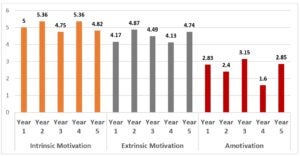
Figure 1. The relation between the academic year and subscales of AMS
IV. DISCUSSION
The findings of this study align with previous research, highlighting the importance of intrinsic motivation as a driver of academic success (Ryan & Deci, 2000). The higher intrinsic motivation among second-year medical students may be attributed to their positive experiences after successfully completing a challenging first year, and the same for the fourth-year medical students who had successfully completed a challenging clinical year 3. This transitional phase often acts as a motivational catalyst, increasing engagement and satisfaction in their studies (Nadel & Rosenberg, 2020).
Conversely, the lower motivation levels observed among third-year students may suggest a possible decline in intrinsic motivation due to the increasing pressures and clinical responsibilities accompanying their first year in clinical training at the hospital setting and clinical campus. This transitional period is often marked by numerous challenges, including stress from clinical evaluations and the need for adaptive learning strategies (Schunk et al., 2014). The study by Lyndon et al. (2023) found that academic motivation indeed fluctuates across different academic years, and several factors contribute to these changes. Changes in the curriculum structure from classroom-based learning to more clinical experiences can affect motivation levels, with some students finding clinical work more engaging and others struggling to adapt. The study emphasises the importance of understanding these fluctuations in academic motivation to develop targeted interventions and support systems for medical students.
A. Limitations
This study has a moderate response rate (47.5%), which may introduce response bias and potentially limit generalisability. The single institution may not represent diverse educational settings or geographical locations. The cross-sectional design prevents the examination of longitudinal changes in student motivation, and potential gender imbalances in the sample could limit generalisability across genders.
B. Implications
This study highlights the importance of medical educators recognising fluctuations in motivation across academic years. Medical schools should implement regular assessments of student motivation and well-being and develop targeted interventions to sustain students’ enthusiasm and engagement. For instance, mentorship programmes, peer support groups, and structured feedback sessions can provide tailored support to help students maintain their motivation throughout their academic journey.
These initiatives can help foster an environment conducive to maintaining high motivation levels.
C. Recommendations
Future research should aim to explore the qualitative aspects of motivation, diving deeper into individual experiences and the psychological factors influencing students’ intrinsic and extrinsic motivation. Additionally, comparing motivation levels with academic performance can provide useful insight into how motivation affects learning outcomes.
A more rigorous randomised approach with a larger sample size is advisable for future research endeavours. Additionally, exploring qualitative approaches to student-faculty interaction, student engagement, and student performance should be included in the investigation.
V. CONCLUSION
In conclusion, this preliminary study reveals that medical students display higher intrinsic than extrinsic motivation, particularly in their second year. Recognising these trends is essential for developing effective educational interventions to support student success throughout their medical education journey. Cultivating an environment that promotes and sustains motivation may lead to better academic performance and enhanced well-being among medical students.
Notes on Contributors
Dr Kye MMS is the corresponding author for this paper. She designed the study, analysed the data, and prepared the manuscript, working with the co-author.
Dr. Amit B. and Dr. Hnin PP contributed substantially to the design, editing, and preparation of the final manuscript.
Ethical Approval
The research study was approved by the Universiti Tunku Abdul Rahman Scientific and Ethical Review Committee on 4 November 2022 (Approval number: U/SERC/228/2022).
Data Availability
The data that support the findings of the study are openly available at https://doi.org/10.6084/m9.figshare.28544321.
Acknowledgment
We would like to acknowledge Newcastle University Medicine Malaysia for the support, and we also would like to acknowledge the students for their voluntary participation in this study.
Funding
There was no funding for this research study.
Declaration of Interest
The authors declare no conflicts of interest, including financial, consultant, institutional, or other relationships.
References
Nadel, B., & Rosenberg, A. (2020). The role of motivation in medical education. Medical Education Journal, 54(9), 883-890. https://doi.org/10.1111/medu.14205
Lyndon, M. P., Henning, M. A., Alyami, H., Krishna, S., Yu, T. C., & Hill, A. G. (2023). Changes in motivation and burnout in medical students over time: A longitudinal study. BMC Medical Education, 23(1), 1-9. https://doi.org/10.1186/s12909-023-04127-1
Ryan, R. M., & Deci, E. L. (2000). Self-determination theory and the facilitation of intrinsic motivation, social development, and well-being. American Psychologist, 55(1), 68-78. https://doi.org/10.1037/0003-066X.55.1.68
Schunk, D. H., Pintrich, P. R., & Meece, J. L. (2014). Motivation in education: Theory, research, and applications (4th ed.). Pearson. https://api.pageplace.de/preview/DT0400.9781292055251_A24621767/preview-9781292055251_A24621767.pdf
Vallerand, R. J., Pelletier, L. G., & Blais, M. R. (1992). The academic motivation scale: A measure of intrinsic, extrinsic, and amotivation in education. Educational and Psychological Measurement, 52(1), 1003-1017. https://doi.org/10.1177/0013164492052004014
*Dr Kye Mon Min Swe
Faculty of Medical Sciences, Newcastle University,
Newcastle upon Tyne, NE1 7RU, United Kingdom;
Newcastle University Medicine Malaysia (NUMed),
1, Jalan Sarjana 1, Kota Ilmu, Educity@Iskandar,
79200 Iskandar Puteri, Johor, Malaysia
601115133799
Email: kye-mon.min-swe@newcastle.edu.my
Announcements
- Best Reviewer Awards 2025
TAPS would like to express gratitude and thanks to an extraordinary group of reviewers who are awarded the Best Reviewer Awards for 2025.
Refer here for the list of recipients. - Most Accessed Article 2025
The Most Accessed Article of 2025 goes to Analyses of self-care agency and mindset: A pilot study on Malaysian undergraduate medical students.
Congratulations, Dr Reshma Mohamed Ansari and co-authors! - Best Article Award 2025
The Best Article Award of 2025 goes to From disparity to inclusivity: Narrative review of strategies in medical education to bridge gender inequality.
Congratulations, Dr Han Ting Jillian Yeo and co-authors! - Best Reviewer Awards 2024
TAPS would like to express gratitude and thanks to an extraordinary group of reviewers who are awarded the Best Reviewer Awards for 2024.
Refer here for the list of recipients. - Most Accessed Article 2024
The Most Accessed Article of 2024 goes to Persons with Disabilities (PWD) as patient educators: Effects on medical student attitudes.
Congratulations, Dr Vivien Lee and co-authors! - Best Article Award 2024
The Best Article Award of 2024 goes to Achieving Competency for Year 1 Doctors in Singapore: Comparing Night Float or Traditional Call.
Congratulations, Dr Tan Mae Yue and co-authors! - Best Reviewer Awards 2023
TAPS would like to express gratitude and thanks to an extraordinary group of reviewers who are awarded the Best Reviewer Awards for 2023.
Refer here for the list of recipients. - Most Accessed Article 2023
The Most Accessed Article of 2023 goes to Small, sustainable, steps to success as a scholar in Health Professions Education – Micro (macro and meta) matters.
Congratulations, A/Prof Goh Poh-Sun & Dr Elisabeth Schlegel! - Best Article Award 2023
The Best Article Award of 2023 goes to Increasing the value of Community-Based Education through Interprofessional Education.
Congratulations, Dr Tri Nur Kristina and co-authors! - Best Reviewer Awards 2022
TAPS would like to express gratitude and thanks to an extraordinary group of reviewers who are awarded the Best Reviewer Awards for 2022.
Refer here for the list of recipients. - Most Accessed Article 2022
The Most Accessed Article of 2022 goes to An urgent need to teach complexity science to health science students.
Congratulations, Dr Bhuvan KC and Dr Ravi Shankar. - Best Article Award 2022
The Best Article Award of 2022 goes to From clinician to educator: A scoping review of professional identity and the influence of impostor phenomenon.
Congratulations, Ms Freeman and co-authors.