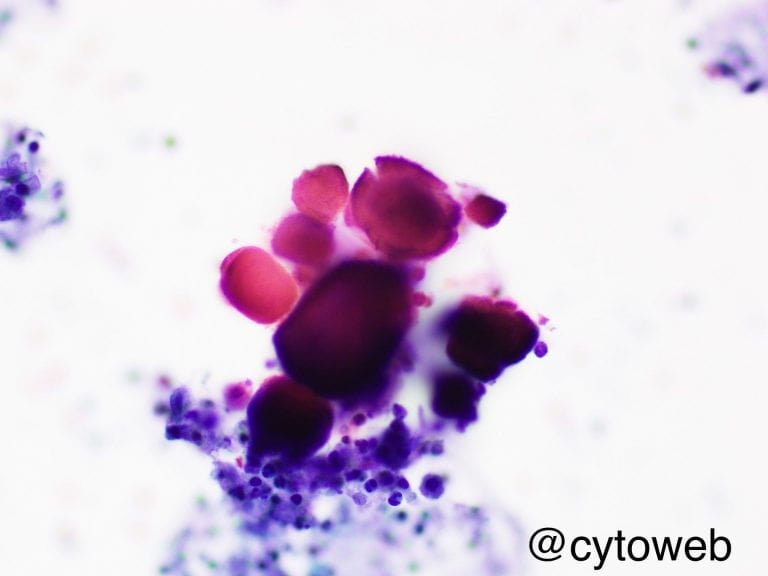
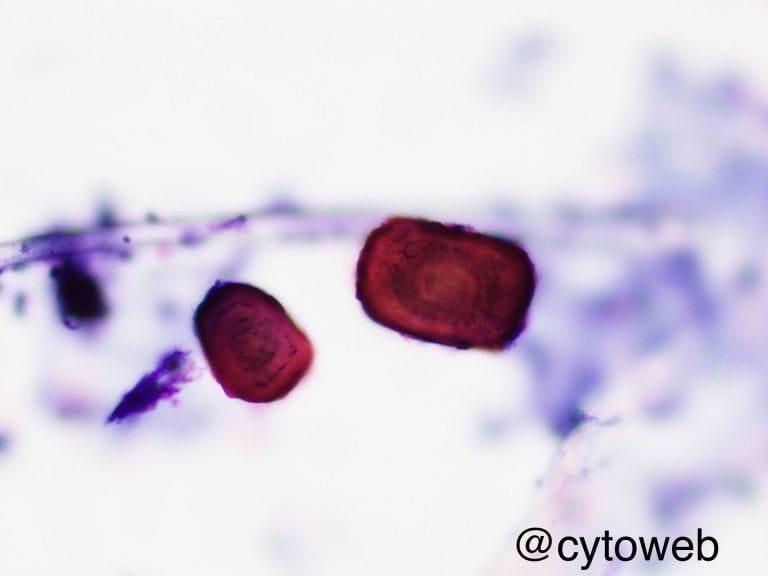
Corpora amylacea
The objects seen are non-calcified, round lamellated bodies which would be consistent with corpora amylacea. Cracking artifact may be seen. They are normally found in alveolar spaces.
What is the clinical significance of corpora amylacea?
Pulmonary corpora amylacea is an incidental finding seen in patients of increasing age and its clinical significance is unknown.
What is the theory on the pathogenesis?
In this particular study by Ohsutki et al., the core of pulmonary corpora amylacea was found to contain PAS-positive glycoproteins and the surfaces contain surfactant protein-A. The findings suggest formation of corpora amylacea likely begins as nidus-forming PAS-positive glycoproteins with concentric deposition of surfactant protein-A.
Ohtsuki, Y., Maeda, T., Soga, Y., Furuya, K., Okada, Y., Lee, G. H., & Furihata, M. (2010). Case report: Immunohistochemical characterization of pulmonary corpora amylacea in an autopsy case, with special reference to its pathogenesis.
Are these objects associated with degradation of epithelial cells?
These objects are unlikely to have been derived from degradation of epithelial cells, although they have been found to stain superficially for EMA and KL-6 antigens, which are fundamental components of the surface of airways.
Ohtsuki, Y., Maeda, T., Soga, Y., Furuya, K., Okada, Y., Lee, G. H., & Furihata, M. (2010). Case report: Immunohistochemical characterization of pulmonary corpora amylacea in an autopsy case, with special reference to its pathogenesis.
Are these different from those commonly found in the prostate?
A comparative immunohistochemical study showed different constituents between corpora amylacea of different sites, suggesting the pathogenesis is dependent on local and not systemic factors.
Röcken, C., Linke, R. P., & Saeger, W. (1996). Corpora amylacea in the lung, prostate and uterus: a comparative and immunohistochemical study. Pathology-Research and Practice, 192(10), 998-1006.