
The study aims to achieve the following:
- Estimate the prevalence of adolescents’ mental health problems to guide the planning of prevention and treatment services.
- Describe the development of adolescents’ across dimensions of continuity and coherence.
- Provide accurate information for policy makers to aid in decision-making.
- Increase awareness amongst the general population to combat stigmatisation.
- Build a study cohort in which future in-depth studies can be made possible (from 2020 onwards), in order to:
- i) Examine mental health development patterns over time through longitudinal studies and annual follow-ups of subsamples.
- ii) Investigate underlying mechanisms of certain disorders, such as the risk and protective factors in developing depressed mood and suicidal ideation;
hormonal changes related to the various disorders etc. - iii) Develop interventions, such as those aimed at building emotional resilience
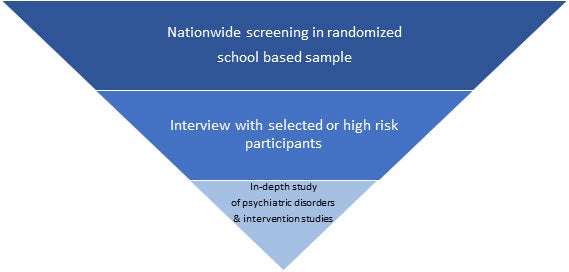
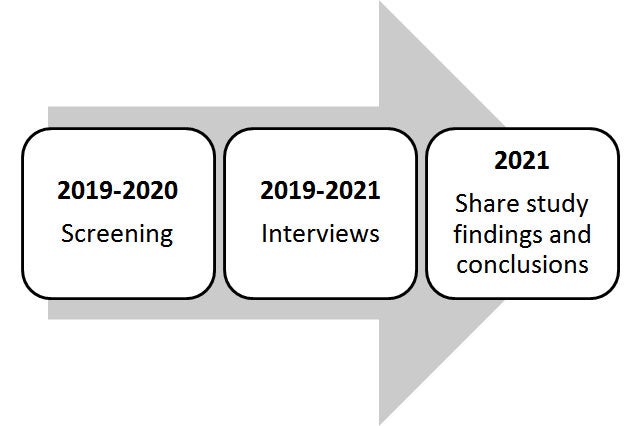
The study will comprise of 3 stages.
Stage 0: Approach
- Through MOE, 12,000 10- to 18-year old students will be randomly approached to participate in the study
Stage 1: Screening
- Participants, their parents, and teachers will complete multiple questionnaires relating to mental health and resilience respectively
Stage 2: Interview
- Selected participants will be contacted for a follow-up interview together with their parents
Why should I participate?
Your participation in the Singapore YEAR study will help to inform early intervention and preventive programmes. This will benefit future cohorts
of adolescents who might be at-risk of developing mental ill-health.
Participation in the screening conducted by the YEAR study team will also allow for identification of students who might be struggling with stress
or are at relatively high risk for developing mental health disorders by the pastoral team within the respective schools. In the event the screening
raises concerns about the child’s health, parents will be notified by phone or email and their child will be referred to the pastoral care team
within the school for further assessment.
What is resilience?
Resilience, also known as emotional resilience, is a dynamic process. It changes depending on the moment and situation. Resilience is defined by an
individual’s characteristics (character, beliefs and experiences) and the context. Moreover, it is the interaction between biology and environment that
builds a student’s ability to cope with adversity and to overcome threats to healthy development.
Resilience is a life skill that all teachers should focus on imparting throughout their students’ education. To place an emphasis on resilience in the
classroom is to realize that nurturing individuals who are able to respond to challenges and setbacks is an important educational outcome.
Additionally, resilient students are open to learning because they:
i) believe they can learn
ii) are receptive to assistance
iii) are comfortable with the rate at which they learn concepts
Resilient students see learning as a pursuit of knowledge and value motivation and effort as much as one’s breadth and depth of knowledge. When students
do not have these attitudes about learning, they should be encouraged to be confident and “keep trying” and be taught about resilience and perseverance.