
Keywords: Medical Education, Health Profession Education, Cardiovascular Teaching, Artificial Intelligence, Generative AI, SAMR Model
Introduction
The integration of Artificial Intelligence (AI) in education has grown rapidly in recent years; however, many implementations remain confined to superficial-level applications, such as content generation or the automation of routine tasks. To harness AI’s full transformative potential, educational institutions must advance beyond basic substitutional use towards higher-level tasks. This brief article presents our approach to integrating AI into learning interventions that support high-order cognitive processes rather than task automation.
The SAMR model for AI integration
The SAMR model1 (Substitution, Augmentation, Modification, Redefinition) is a technology integration model that is also applicable to AI-enabled tasks, which can guide AI deployment in Education. The diagram below illustrates how the technology integration evolves across levels.
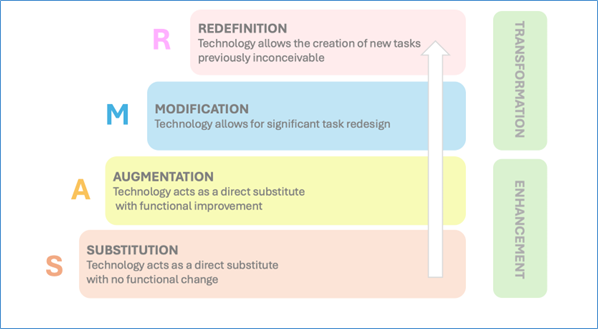
Figure 1. SAMR: A framework for technology integration
Evaluation of AI applications and studies on AI in education has shown that their use is largely confined to the enhancement stages2, focusing mainly on the substitution or augmentation of learning tasks. Emerging evidence suggests that it has not consistently improved learning but rather leads to cognitive decline3, likely due to weak or inappropriate pedagogical approaches. In particular, substitution and augmentation can be dangerous if learners have no foundational knowledge and skills.
Educators should aim for transformation-level interventions, those that ‘modify’ and ‘redefine’ learning to fully harness the potential of the technology. This case study illustrates how we designed and implemented an educational intervention that not only improved learning outcomes but also benefited the broader community.
Learning intervention: Incorporation of AI for better learning
At the NUS Yong Loo Lin School of Medicine, student queries related to first-year cardiovascular physiology component were traditionally addressed manually. Students entered their questions into a shared Excel sheet, and tutors responded to each query individually. This was a tedious and time-consuming process for educators, and many of the questions were repetitive. However, this model was highly appreciated by students and enabled educators to recognize misconceptions and learning gaps, hence it was maintained over the years.
With generative AI tools such as ChatGPT gaining popularity, the tutors considered the possibility of incorporating it into the process as a learning tool. One consideration was whether it could be used as a Substitution tool where the students seek responses to their questions. However, concerns regarding the reliability and accuracy of AI-generated content led tutors not to adopt this approach in its basic form.
Instead, tutors implemented a more effective Augmentation-level strategy. The students were asked to enter their questions into a generative AI platform, generate answers, and then enter both the question and the AI-generated answer into the shared document. The tutors then reviewed the question and answers, and confirmed if the responses were accurate, supplemented if necessary, or corrected if the answer was wrong. This significantly reduced the workload while maintaining academic quality. This hybrid model streamlined operations and improved the learning experience by combining AI assistance with expert oversight, representing a practical advancement in educational intervention in this context.
Building on this success, the intervention advanced to the Modification stage. A dedicated team developed a customized AI chatbot pre-trained using validated course materials, Q&A datasets, and previous tutor feedback. Named ‘NUS-Med GPT’, this platform enabled a shift in instructional design by integrating knowledge not only of physiology but also across other related disciplines such as anatomy and pathology. This approach allowed the chatbot to generate responses that were more contextualized to the curriculum and content. In addition, it has the ability to guide the student to the relevant learning resources, such as lecture recordings or notes, for further study. This platform is currently operational and being evaluated for its efficacy and accuracy to support continuous improvement. In the future, the model will be expanded to cover other body systems, enabling it to address questions from the entire curriculum in a more holistic manner.
Ultimately, our goal and ongoing work focus on advancing the project to the Redefinition stage. We envision AI evolving into an interactive learning assistant that not only answers questions but also poses personalized queries tailored to their individual learning needs. This serves as a preceptor to query and stimulate deeper thinking and learning. This dynamic feedback loop will enable real-time identification of knowledge gaps, guiding students through tailored learning pathways. This approach aims to deliver personalized and adaptive learning that targets each learner’s unique needs, enhancing precision and strengthening educational delivery from the educators’ perspective. At this level, AI promises a pedagogical transformation previously unattainable. We intend to gather objective evidence on the impact of this pedagogical intervention on learners and educators to support continuous improvement.
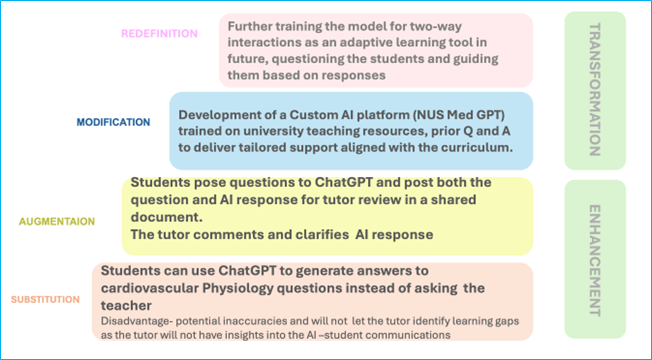
Figure 2. Summary of the AI-integrated learning intervention across the SAMR model
Conclusion
This learning intervention demonstrates how purposeful and staged integration of AI, guided by the SAMR model, can move educational practice beyond basic enhancement toward genuine transformation. By progressively refining AI’s role from augmentation to modification and ultimately redefinition, we illustrate its potential to strengthen learning. Harnessing the transformative role of AI tools will empower teachers and learners rather than fostering cognitive dependency or misinformation. There is ample scope for the continued development, implementation, and evaluation of such tools in medical education. This will ensure that AI serves as a strategic asset that advances both learner development and educational practice.
Notes on Contributors
Amanda Wong led implementation of the learning intervention, reviewed and approved the first version of the manuscript.
Wong Lik Wei contributed to the learning intervention, reviewed, edited, and approved the manuscript.
Moritz Messerschmidt led development of the technology tool, reviewed, edited, and approved the manuscript.
Nathasha Luke contributed to the learning intervention, drafted the initial manuscript, edited and approved the final version.
Ivan Low contributed to the learning intervention, reviewed, edited, and approved the manuscript.
Hoe Lee Hwee contributed to the learning intervention, reviewed, edited, and approved the manuscript.
Dinesh Kumar Srinivasan contributed to the learning intervention, reviewed, edited, and approved the manuscript.
Hooi Shing Chuan developed the conceptual framework for AI integration, reviewed, edited, and approved the manuscript.
Chen Zhi Xiong developed key concepts and the framework for the platform, reviewed, edited, and approved the manuscript.
Acknowledgement
We would like to thank the NUS Medicine Phase 1 teachers for partnering with us by reviewing and providing feedback to support the continuous quality improvement of the newly created NUS-MedGPT platform.
Funding
There is no funding for this article.
Declaration of Interest
We do not have any conflicts of interest, including financial, consultant, institutional, and other relationships that might lead to bias or a conflict of interest.
1 Ruben R. Puentedura, Building Transformation: An Introduction to the SAMR Model, 2009, http://www.hippasus.com/rrpweblog/archives/2014/08/22/BuildingTransformation_AnIntroductionToSAMR.pdf.
2 Morris Gordon et al., “A Scoping Review of Artificial Intelligence in Medical Education: BEME Guide No. 84,” Medical Teacher 46, no. 4 (February 29, 2024): 446–70, https://doi.org/10.1080/0142159x.2024.2314198.
3 Chunpeng Zhai, Santoso Wibowo, and Lily D. Li, “The Effects of Over-reliance on AI Dialogue Systems on Students’ Cognitive Abilities: A Systematic Review,” Smart Learning Environments 11, no. 1 (June 18, 2024), https://doi.org/10.1186/s40561-024-00316-7.
*Nathasha Luke
Department of Physiology,
Yong Loo Lin School of Medicine,
National University of Singapore,
Singapore
96204104
Email: nathasha@nus.edu.sg